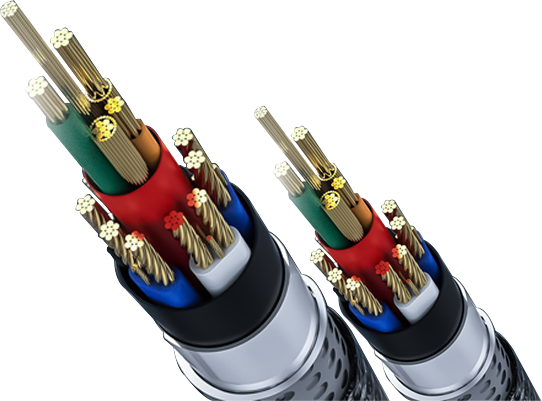
Outdoor environments place severe demands on cable performance. Ultraviolet radiation, temperature changes, moisture, and mechanical shock can all cause cable failure, affecting power transmission stability and even leading to safety accidents. Therefore, the performance of outdoor cables is crucial.
Cross-linked polyethylene (XLPE) and polyvinyl chloride (PVC) are the two most commonly used insulation materials for outdoor cables. XLPE is known for its high temperature resistance and durability, while PVC offers both cost advantages and good flame retardancy.
This article will combine the core requirements of outdoor environments and provide engineers, contractors, and other professionals with selection criteria through multi-dimensional performance comparisons, helping them match project needs.
What are XLPE Cables and PVC Cables?
Overview of XLPE Cables
XLPE, or cross-linked polyethylene, is an insulation material obtained by chemically or physically forming a three-dimensional network cross-linked structure of polyethylene molecules. This cross-linked structure breaks the linear molecular arrangement of ordinary polyethylene, fundamentally improving the material's various properties.
XLPE cables possess several key advantages: First, excellent heat resistance, maintaining stable performance at high temperatures and preventing insulation softening and failure; second, high mechanical strength, with strong tensile and impact resistance, capable of withstanding complex outdoor mechanical damage; and third, long service life, the stability of the cross-linked structure allowing for extended service in outdoor environments, reducing replacement frequency. These characteristics make them a crucial choice for harsh outdoor environments.
Overview of PVC Cables
PVC, or polyvinyl chloride, is a thermoplastic insulating material polymerized from vinyl chloride monomers. Its properties can be adjusted by adding plasticizers, stabilizers, and other additives to suit different application scenarios.
The key advantages of PVC cables are threefold: First, good flexibility, easy to bend and drag during installation, especially suitable for complex wiring scenarios; second, strong chemical stability, resisting the corrosion of many common chemicals; and finally, outstanding cost-effectiveness, with relatively simple raw materials and production processes, resulting in a significantly lower initial purchase cost compared to XLPE cables, making them highly attractive for projects with limited budgets.
Core Performance Indicators for Outdoor Cable Selection
The complexity of the outdoor environment necessitates a comprehensive consideration of multiple performance aspects when selecting cables. The following nine core indicators directly relate to the cable's applicability, safety, and economy, serving as crucial criteria for selection:
Temperature Resistance: Responds to extreme outdoor weather conditions (high and low temperatures) and heat generated during operation, preventing insulation aging or melting.
UV Resistance: Resists material degradation and cracking caused by prolonged sun exposure.
Moisture and Water Resistance: Prevents rainwater and moisture intrusion that could lead to insulation failure or conductive faults.
Mechanical Durability: Resists mechanical damage caused by construction impacts, soil compression, and wind swaying.
Fire Resistance: In fire-prone scenarios, slows the spread of flames and reduces the release of toxic fumes.
Electrical Performance: Ensures long-term stable insulation strength, meeting voltage level requirements for power transmission.
Detailed Comparison of Outdoor Performance of XLPE and PVC
Temperature Resistance: XLPE Offers Significant Advantages
XLPE cables possess excellent high-temperature resistance due to their cross-linked structure. They can operate continuously at 90°C and withstand short-circuit faults up to 250°C without severe failure. This makes them stable in outdoor environments with intense summer sun or under high loads.
PVC cables, limited by their thermoplastic properties, have weaker high-temperature resistance, with a maximum continuous operating temperature of only 70°C. Under high outdoor temperatures or heavy loads, the insulation layer is prone to softening, deformation, and even melting, significantly shortening their lifespan and increasing the risk of failure.
UV Resistance and Weather Resistance: XLPE is More Stable
XLPE material itself has good UV stability. Without the need for large amounts of UV stabilizers, it maintains structural stability under long-term outdoor sunlight exposure, resisting cracking, aging, and embrittlement, exhibiting excellent weather resistance.
PVC material is inherently more sensitive to UV radiation. Without a dedicated UV-stabilizing formula, surface cracking and insulation peeling may occur after 3-5 years of outdoor exposure. Even with the addition of stabilizers, its UV resistance only meets the needs of short- to medium-term outdoor use, and its long-term reliability is inferior to XLPE.
Moisture and Water Resistance: XLPE has superior resistance to water treeing
Outdoor moisture is a major cause of cable insulation failure, especially the phenomenon of "water treeing," which directly damages the insulation structure. XLPE material has extremely strong resistance to water treeing, effectively preventing moisture penetration and the formation of dendritic conductive channels. Even in humid environments or short-term immersion scenarios, it maintains stable insulation performance.
While PVC cables have some moisture resistance and can withstand ordinary moisture, their insulation layer is prone to swelling in long-term high-humidity or frequent water immersion environments, leading to a decrease in waterproof performance. Furthermore, their resistance to water treeing is far inferior to XLPE, posing a potential risk of failure with long-term use.
Mechanical Strength: XLPE is more resistant to abrasion and impact
XLPE's cross-linked structure gives it higher tensile strength and hardness, resulting in excellent mechanical durability. During outdoor construction, PVC is less prone to insulation damage from dragging, impacts, and other mechanical forces. In underground installations, it withstands soil compression and external loads, making it suitable for harsh outdoor environments.
PVC material is relatively soft, with weaker tensile strength and impact resistance. Improper handling during construction can easily scratch the insulation layer. In long-term outdoor use, it is also more susceptible to damage from wind and sand abrasion and impacts, offering relatively insufficient mechanical protection.
Fire Resistance: PVC's inherent flame retardancy is superior
Standard XLPE material has weak flame retardancy, easily producing molten drips during combustion, and its flame spreads rapidly. To meet fire safety requirements, specially modified low-smoke halogen-free (LSZH) XLPE material must be used, increasing costs accordingly.
PVC material itself has excellent flame retardancy, forming a carbonized layer during combustion that effectively blocks flame spread without requiring the addition of large amounts of flame retardants. Therefore, in outdoor scenarios with strict fire protection requirements (such as near flammable and explosive areas or densely populated areas), PVC cables have a natural advantage.
Electrical Performance: XLPE is better suited for high-requirement transmission
In terms of the core electrical performance indicator—dielectric strength—XLPE far surpasses PVC, capable of withstanding higher electric field strengths and exhibiting more stable insulation performance. Simultaneously, XLPE has a lower dielectric loss tangent, resulting in less loss during power transmission and higher energy efficiency.
PVC cables have relatively lower dielectric strength, and under long-term operation under high voltage or high load conditions, the insulation layer is prone to aging and failure, leading to lower electrical performance stability compared to XLPE. Therefore, in high-voltage outdoor power transmission and heavy-load power transmission scenarios, XLPE is a more reliable choice.
Optimal Application Scenarios for Both Cables
Advantageous Application Scenarios of XLPE Cables
When project requirements focus on long-term reliability, high temperature resistance, and high mechanical strength, XLPE cables are the optimal choice, specifically including:
Overhead Lines: For environments with long-term exposure to sunlight, rain, and large temperature fluctuations, XLPE's weather resistance and temperature resistance ensure stable operation.
Underground Power Distribution: For applications requiring resistance to soil compression and moisture intrusion, XLPE's mechanical strength and water tree resistance offer significant advantages.
Solar Photovoltaic Systems: Photovoltaic modules are often installed on rooftops or in outdoor locations, subjected to long-term exposure to sunlight and large load fluctuations. XLPE's high temperature resistance and electrical stability meet these requirements.
Industrial Outdoor Projects: For harsh conditions such as chemical industrial parks and metallurgical plants, where high temperatures and chemical corrosion exist, XLPE's comprehensive performance meets the requirements.
High Temperature or Strong Sunlight Areas: For areas with high summer temperatures in southern regions and high-altitude areas with strong ultraviolet radiation, XLPE can prevent rapid aging of the insulation layer.
Heavy-Load Power Transmission: For applications such as substation outgoing lines and large factory outdoor power transmission, XLPE's excellent electrical performance ensures efficient and stable transmission.
Advantageous Application Scenarios of PVC Cables
PVC cables are more advantageous when projects prioritize cost control or fire prevention, and the operating environment is relatively mild. Specifically, they are suitable for:
Indoor/outdoor transition areas: such as wiring on building exterior walls and wiring inside outdoor distribution boxes, where exposure time is short and the environment is relatively stable;
Low-voltage building wiring: such as outdoor low-voltage power distribution in residential areas and outdoor wiring in small shops, where voltage is low and load is stable;
Scenarios with strict fire prevention requirements: such as outdoor power distribution near forest areas and short-term outdoor wiring around densely populated areas, where the flame retardancy of PVC reduces the risk of fire;
Projects with tight budgets: such as temporary outdoor construction power supply and power layout for short-term rental sites, where the low cost of PVC helps control project investment.
Industry Standards to Consider
In addition to performance and application scenarios, cable selection must strictly comply with industry standards to ensure compliance and safety. The following are the core standards commonly used for two types of cables:
XLPE Cables: International standards include IEC 60502-1/2 (extruded insulated power cables with rated voltage of 1-30kV), BS 5467 (British Standard XLPE insulated cables), and NFC 32-321 (French Standard high-voltage XLPE cables); the US market commonly uses relevant ASTM standards. These standards strictly regulate the insulation thickness, temperature resistance, and mechanical properties of XLPE cables.
PVC Cables: International standards include IEC 60227 (PVC insulated cables with rated voltage of 450/750V and below) and IEC 60332 (Cable flammability testing standard); the British standard is BS 6004, and the US market commonly uses UL standards (such as UL 44). These standards primarily specify the flame retardant properties, flexibility, and electrical insulation properties of PVC cables.
Conclusion
The selection of outdoor cable insulation materials directly impacts the reliability, safety, and economy of power systems. XLPE and PVC are not inherently superior or inferior; the key lies in compatibility. XLPE, with its advantages of temperature resistance, aging resistance, and long lifespan, is suitable for harsh outdoor and high-voltage heavy-load scenarios. PVC, with its low cost and good flame retardancy, is suitable for low-voltage, mild environments and projects with limited budgets.
Selection requires a comprehensive consideration of four core factors: operating environment, voltage load, project budget, and local regulations. Blindly pursuing low prices or high performance can easily lead to cost risks or safety hazards.
It is recommended to consult professional cable suppliers before selection, providing project parameters such as environment, voltage, and lifespan, so that a professional team can customize a solution to ensure compliant and economical selection.

(1).jpg)