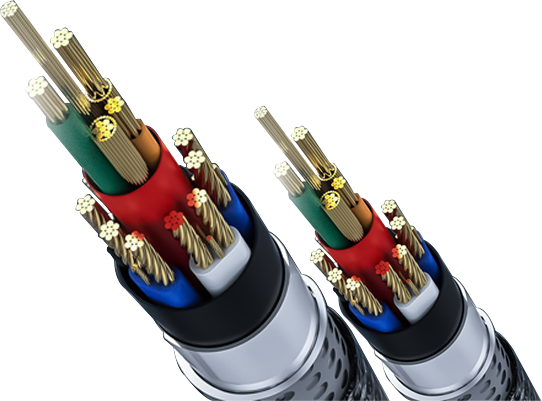
As a core component in power transmission and utility systems, GSW cables play an indispensable role with their unique performance. Widely used in overhead lines and grounding projects, this material is experiencing sustained demand growth alongside global infrastructure development. For professionals in power engineering and utility construction, a thorough understanding of
GSW cables' characteristics and value is fundamental to ensuring project quality and safety.
First, let's clarify a key concept: GSW is not the exclusive name for any complex cable, but rather the abbreviation for "Galvanized Steel Wire," which translates directly to "galvanized steel wire" in Chinese. Essentially, it is a functional material formed by galvanizing high-strength steel wire through a specific process. While often categorized as part of cable applications, its core value lies more in mechanical support and protective performance.
The critical role of GSW cables in power systems stems from the paramount demands for safety and stability in electricity transmission. Whether it's high-voltage overhead lines spanning mountains and rivers or grounding systems ensuring equipment safety, these applications require materials capable of withstanding extreme environmental conditions while maintaining structural integrity.
The Meaning of GSW in Cable Industry
In the cable industry, GSW (Galvanized Steel Wire) specifically denotes high-strength steel wire products with galvanization treatment. Its core definition consists of two key elements: 'high-strength steel wire substrate' and 'zinc coating protection.' Compared to ordinary steel wire, the galvanization process endows it with new performance advantages, enabling it to meet the stringent requirements of power engineering and other demanding applications.
Galvanizing is the core process for GSW cables to achieve protective performance, with hot-dip galvanizing being the most widely used method in the industry. The primary function of the zinc coating is corrosion protection.
The Structure of GSW Cable
While GSW cables may appear simple in structure, each component is meticulously engineered to fulfill specific performance requirements. The core structure consists of a base material, a galvanized layer, and optional auxiliary protective layers, with different combinations tailored for various application scenarios.
The conductor substrate, typically made of high-strength carbon structural steel, is the core component ensuring the mechanical properties of GSW cables.
The galvanized coating serves as the protective layer for GSW cables, with its thickness and uniformity being key quality indicators.
In terms of structure, GSW cable is divided into two types: single wire and stranded wire.
The core functions of GSW cable
The widespread application of GSW cables in power and utility sectors stems from their dual capabilities of mechanical support and functional protection, which can be summarized into five key features:
Mechanical strength is the most basic function of GSW cable.
The tension and load bearing are the core functions of GSW cable in overhead line.
Grounding / neutral connection is one of the important functions of GSW cable.
In applications involving guy wires and mooring lines, GSW cables demonstrate unique advantages.
In overhead cable system, GSW cable is also used as a cable.
Main Application Fields of GSW Cable
Overhead transmission and distribution lines
In the overhead transmission and distribution lines, GSW cable is the most widely used, mainly in the form of guy wire and tie wire.
Beyond their use as guy wires, GSW cables also serve to reinforce transmission tower structures. High-strength towers often incorporate GSW cables at critical load-bearing points to enhance structural integrity, thereby improving load-bearing capacity and extending service life. In ultra-high voltage transmission systems, where conductor tension is significantly higher, GSW cables must meet stringent requirements for strength and fatigue resistance. This necessitates the use of specialized GSW products featuring advanced stranded construction techniques.
Grounding and neutral connection system
Substations and power plants are the core hubs of the power system, and the reliability of their grounding systems is directly related to the safe operation of the grid. GSW cables, with their excellent conductivity and corrosion resistance, have become the core material for grounding networks in these facilities.
In industrial facilities, GSW cable grounding is equally critical. Equipment in sectors like chemical and metallurgical industries often faces risks of static charge buildup and electrical leakage. By connecting these devices to the grounding system via GSW cables, static electricity can be safely discharged, preventing accidents caused by static sparks. This setup also ensures operator safety in case of equipment leakage.
Communication and Public Utilities Engineering
In communication engineering, GSW cable is mainly used as a load-bearing cable.
In the field of public utilities, such as urban street lighting systems and traffic signal systems, GSW cables are commonly used to stabilize and ground utility poles.
Infrastructure and Construction Engineering
GSW cables demonstrate exceptional versatility in infrastructure applications. They are extensively used in highway and railway protective fencing and isolation nets, with their corrosion-resistant properties enabling effective adaptation to challenging environments along transportation routes while reducing maintenance costs. In bridge construction, GSW cables reinforce concrete structures to enhance load-bearing capacity and fatigue resistance.
In industrial anchoring applications, GSW cables are indispensable. For tasks like securing heavy machinery and supporting construction foundations, these cables provide high-strength anchoring solutions. With their exceptional mechanical properties, GSW cables deliver reliable support for equipment and structures, ensuring safety throughout construction and operation.
Advantages of GSW Cable
The GSW cable's ability to replace conventional steel wires and other materials across multiple industries stems from its exceptional performance, making it an engineering material with outstanding cost-effectiveness.
High strength is a defining feature of GSW cables. Standard GSW cables can withstand tensile forces exceeding 1200MPa, with high-strength variants reaching 1800MPa—far surpassing ordinary steel and meeting all high-strength load requirements.
The outstanding corrosion resistance is what sets GSW cables apart from ordinary steel wires. Depending on the environment, GSW cables typically last 20-50 years, far exceeding the 5-10 years of standard steel wires.
The primary benefit of extended service life is cost-effectiveness. While GSW cables are slightly more expensive to purchase initially than standard steel wires, their total lifecycle cost is significantly lower due to their long lifespan and minimal maintenance needs. For long-term infrastructure projects like power grids and communication systems, adopting GSW cables can substantially reduce future maintenance and replacement expenses, delivering substantial cost savings for enterprises.
Another standout feature of GSW cables is their exceptional adaptability. The zinc coating maintains stable performance across varying temperatures, while the base material's mechanical properties withstand significant thermal fluctuations. These characteristics make them ideal for engineering projects in diverse climates worldwide.
The minimal maintenance requirements are another key reason why GSW cables are highly favored by engineering teams. Unlike conventional steel wires that require regular anti-corrosion treatments like rust-proof coatings, GSW cables demand almost no maintenance under normal conditions. Only basic visual inspections after extreme weather events are needed, significantly reducing both operational workload and costs.
Comparison of GSW Cable and Other Similar Conductors
GSW and ACSR (Aluminum Conductor with Steel Core)
ACSR (Aluminum Conductor with Steel Core) is a widely used conductor material in power transmission systems, featuring a steel core encased in aluminum wire. It differs significantly from GSW cables in both application scenarios and performance characteristics. In terms of conductivity, the core strength of ACSR lies in its aluminum component, which exhibits excellent electrical conductivity, making it ideal for power transmission. Conversely, GSW cables have inferior conductivity and are primarily used for mechanical support rather than power transmission.
In terms of mechanical strength, each cable type has distinct advantages. The steel core of ACSR primarily provides structural support, though its overall strength is relatively low. In contrast, GSW cables utilize high-strength steel wire as their base material, offering significantly higher tensile strength and fatigue resistance compared to ACSR's steel core. As a result, ACSR is mainly used for overhead conductors to transmit electrical energy, while GSW cables are employed in scenarios requiring high-strength support, such as guy wires and grounding systems.
The key difference lies in their application scenarios: ACSR acts as a 'conductive conductor' to transmit electricity from the generation end to the consumption end, while GSW cable functions as a 'supporting conductor' to ensure the structural stability of transmission lines. Both components are indispensable and mutually reinforcing in power systems.
GSW and Stay Wire
Many people often confuse GSW cables with guy wires, but in reality, they are in a 'containment and containment' relationship. Guy wires are a practical application concept, referring to steel wire products used to secure structures like poles and towers. GSW cables, however, are a material concept. Due to their superior performance, they have become the preferred material for guy wires.
Terminology for guy wires varies across different markets. In North America, GSW cables used for power poles are commonly called "Stay Wire", while in Asia, terms like "GSW cable" or "galvanized steel guy wire" are more prevalent. It's important to note that not all guy wires are GSW cables. In low-strength scenarios, ordinary steel wires may be used, but in power and utility applications, GSW cables are the standard material for guy wires.
Common standards for GSW cables
Standards are the cornerstone of GSW cable quality assurance. Countries and regions have developed their own standards based on specific engineering requirements. Below are the most widely adopted standards globally:
ASTM standards are among the most widely adopted industrial standards globally. ASTM A475 specifically addresses high-strength galvanized steel wires, specifying mechanical properties including tensile strength, yield strength, and elongation. Meanwhile, ASTM A363 focuses on hot-dip galvanizing processes, detailing requirements for zinc coating thickness, adhesion, and appearance, which are essential for quality control in GSW cable galvanizing.
The IEC 60888 standard, developed by the International Electrotechnical Commission (IEC), is the dedicated specification for GSW cables in power systems. Tailored to the operational requirements of power grids, it establishes specific criteria for GSW cables' conductivity, fatigue resistance, and corrosion resistance. This standard serves as the primary reference for GSW cable procurement in global power engineering projects.
The UK BS 183 and India IS 2141 are the two most widely adopted standards in the region. BS 183 specifies detailed requirements for GSW cable twisting techniques and dimensional tolerances, making it widely used in European markets. IS 2141, tailored to India's climate and engineering needs, imposes stricter corrosion resistance standards on GSW cables, making it ideal for power engineering projects in South Asia.
Beyond international and regional standards, many major utility companies develop their own corporate specifications. These customized standards typically refine and enhance GSW cable performance metrics by integrating international benchmarks with their engineering expertise and specific requirements, ensuring optimal adaptability to particular application scenarios.
How to choose the right GSW cable
Selecting the appropriate GSW cable requires a comprehensive evaluation of engineering requirements, environmental conditions, and regulatory standards. The following are the key selection criteria:
Determining the required tensile strength is the first step in the selection process.
Environmental conditions are the core factors that determine the thickness of the GSW cable galvanized layer and the auxiliary protection measures.
The diameter and structure selection should be combined with the specific application scenarios.
Compliance with local utility standards is critical for ensuring project compliance. Power engineering standards vary across countries and regions: European projects must meet IEC 60888, U.S. projects follow ASTM standards, while domestic projects require compliance with national standards like GB/T 3428. During procurement, clearly specify that cables must meet local standards and require suppliers to provide corresponding test reports.
Common Questions and Answers about GSW Cable
Q: Is GSW cable a conductor?
Answer: GSW cable has some conductivity, but it is far lower than specialized conductive materials like copper and aluminum. Its primary function is mechanical support rather than electrical transmission. It only utilizes its conductivity to guide current in special scenarios such as grounding systems, and cannot be used as a power transmission conductor.
Q: Can GSW cables be used for grounding?
Answer: Yes, GSW cable is the ideal material for grounding systems. Its excellent corrosion resistance and moderate conductivity ensure long-term stable operation of grounding systems, while efficiently dissipating fault and lightning currents. It is widely used in grounding projects for substations, power plants, and industrial facilities.
Q: How long does a galvanized coating last?
Answer: The lifespan of the galvanized coating depends on environmental conditions and the zinc layer thickness. In dry environments, the coating on light-galvanized GSW cables can last over 20 years, while in coastal high-salt mist environments, the coating on heavy-galvanized GSW cables may last 15-20 years. Regular maintenance (e.g., removing surface contaminants) can further extend its service life.
Q: Can GSW cable replace copper grounding wires?
Answer: In most scenarios, copper grounding wires can serve as a viable alternative. While copper offers superior conductivity, its prohibitively high cost and inferior corrosion resistance compared to GSW cables make it less practical. For general power and industrial grounding applications, GSW cables provide adequate conductivity at a third to one-fifth the cost of copper wires, making them a more cost-effective choice. Copper wires are only required in specialized scenarios with exceptionally high conductivity demands, such as precision electronic equipment grounding.
Conclusion
As a core material in power and utility sectors, GSW cables are indispensable for overhead line support, grounding systems, and communication engineering due to their high strength, corrosion resistance, and long service life. They not only ensure the safe and stable operation of power systems but also play a vital role in infrastructure development, serving as a fundamental material for global energy transmission and utility advancement.
For engineering professionals, a thorough understanding of GSW cable performance, standards, and selection methods is essential for improving project quality and reducing costs. In future engineering practices, GSW cables should be scientifically selected based on specific requirements to fully leverage their performance advantages, ensuring the safe and stable operation of projects.