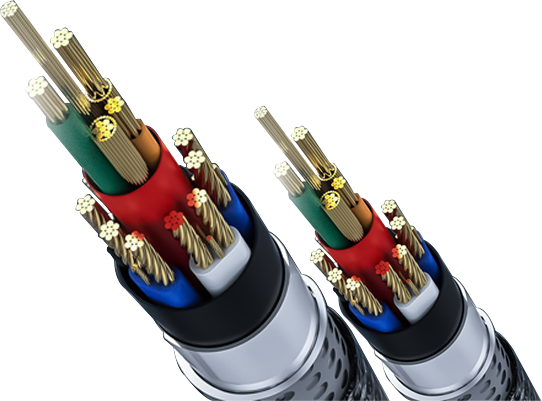
Introduction: New Cable Choice under Copper Price Fluctuation
As we approach 2030, copper prices have seen growing volatility driven by global resource distribution, supply-demand dynamics, and geopolitical factors, imposing significant cost pressures on cable manufacturers. Meanwhile, the widespread adoption of 5G networks, the explosive growth of new energy vehicles, and the rapid penetration of smart home technologies have fueled a continuous surge in cable market demand. Under the industry's imperative to "reduce costs and improve efficiency," copper-clad cables—leveraging their "copper-for-precision" advantage—have effectively balanced performance requirements with cost control. Their applications have expanded from initial low-voltage domains to diverse scenarios including data transmission and radio frequency communication.
Copper-clad Cable:Structure and Essence Analysis
Core Structure: Differences between Two Mainstream Types
The essence of copper-clad cables lies in their cladding structure. Based on core material variations, they are primarily categorized into two types: copper-clad aluminum (CCA) and
copper-clad steel (CCS), each with distinct performance and application characteristics.
Copper-clad aluminum cables feature a high-purity aluminum core encased in a pure copper sheath. The low density of aluminum significantly reduces cable weight, while the copper layer ensures excellent conductivity and corrosion resistance, making them ideal for cost-sensitive low-voltage applications. In contrast, copper-clad steel cables use high-strength steel as their core, with the copper layer primarily responsible for electrical conductivity and corrosion resistance. The addition of steel provides exceptional tensile strength and mechanical stability, making them particularly suitable for scenarios requiring external force resistance or long-distance installation.
In both CCA and CCS systems, the bonding of copper to core materials transcends simple physical adhesion. This metallurgical process creates a robust atomic-level bond between the copper layer and core material, preventing delamination during operation and ensuring stable current and signal transmission. Specifically, the metallurgical bonding forms a transitional layer at the interface between the two metals, preserving their individual performance advantages while achieving structural synergy.
Essential Difference: Core Difference with Pure Copper Cable
Many people often confuse copper-clad cables with pure copper cables, but in reality, they differ fundamentally in structure, performance, and cost. Pure copper cables use high-purity copper (typically T2 oxygen-free copper) for their conductors, offering high conductivity and excellent ductility. These cables are ideal for applications requiring exceptional transmission performance, though they are also more expensive.
Copper-clad cables feature a composite structure where their conductivity primarily depends on the surface copper layer. Due to the skin effect, current concentrates on the conductor's surface, meaning the copper layer's thickness meets most scenarios' requirements. Compared to pure copper cables, they offer lower costs (saving 30%-50% of copper material) and lighter weight (CCA weighs only about one-third of a standard pure copper cable). However, they lag slightly in conductivity and ductility, making them better suited for medium-to-low load transmission applications.
Manufacturing Process: The Key to Performance
The performance of copper-clad cables largely depends on the control of manufacturing processes. From raw materials to finished products, the production process mainly includes three core stages: cladding bonding, annealing, and drawing twisting. Each stage plays a decisive role in determining the final product quality.
Coating bonding is the most critical manufacturing process, with three primary methods currently used in the industry: continuous casting, hot rolling, and electroplating. Continuous casting involves directly pouring molten copper onto the core surface, ensuring a tight bond and high efficiency. Hot rolling combines copper strips with the core under high temperature and pressure, making it suitable for large-diameter cables. Electroplating utilizes electrolysis to deposit a copper layer on the core surface, offering high precision and uniform coverage, ideal for small-diameter or high-precision applications. The choice of coating method directly affects the bonding strength and thickness uniformity of the copper layer, ultimately determining the cable's conductivity and service life.
The annealing process is then performed to eliminate internal stresses generated during cable manufacturing through high-temperature treatment. This enhances the bonding stability between the copper layer and the core, while improving the cable's flexibility and ductility for easier bending and installation. The stranded conductor drawing process involves stretching individual conductors to specific diameters according to application requirements, then twisting them into multi-strand conductors to balance flexibility and conductivity. Stranded cables are better suited for frequent bending scenarios, whereas solid single-conductor cables offer superior transmission stability.
Notably, copper layer thickness is a critical factor affecting performance. A thicker copper layer provides conductivity closer to pure copper and enhanced corrosion resistance, though this comes at a higher cost. Conversely, an excessively thin layer may result in insufficient conductivity and increased wear during use, thereby reducing service life. Industry standards typically maintain copper layer thickness at 5%-15% of the core diameter, depending on application scenarios, to achieve optimal performance-to-cost balance.
Classification and Features: Selection for Different Scenarios
Copper clad aluminum (CCA): a representative of lightweight and economy
The key advantages of CCA cables lie in their lightweight and cost-effective design. With a resistivity typically ranging from 0.028 to 0.032Ω·mm²/m—slightly higher than pure copper (0.0172Ω·mm²/m)—they are perfectly suited for low-voltage, short-distance applications. In scenarios such as audio cables, network cables (e.g., Cat5e and Cat6), and low-voltage power lines, CCA delivers reliable performance at a fraction of the cost of pure copper, making it a cost-effective choice.
Furthermore, CCA's lightweight nature gives it a distinct edge in weight-sensitive applications like automotive wiring harnesses and solar photovoltaic DC cables. In the automotive industry, for instance, CCA cables effectively reduce vehicle weight, helping new energy vehicles achieve greater range. Additionally, aluminum's oxidation resistance, combined with the protective copper layer, ensures CCA's excellent corrosion resistance, making it ideal for use in humid or mildly corrosive environments.
Copper Clad Steel (CCS): The King of High Strength and RF Performance
Unlike CCA, CCS cables stand out with their high tensile strength and superior radio frequency (RF) performance. Steel's tensile strength is 3-4 times that of pure copper, enabling CCS cables to withstand heavy pulling forces and resist breakage—making them ideal for outdoor long-distance applications like coaxial cables and security surveillance systems. In security systems, CCS cables not only ensure stable video transmission but also endure physical impacts during installation and operation, significantly reducing maintenance costs.
In RF communication systems, CCS cables utilize copper layers to ensure low-loss signal transmission while their steel cores provide robust structural support, making them ideal for high-frequency applications like base station feeders and satellite receiving cables. However, due to steel's limited conductivity, CCS cables exhibit lower overall conductivity compared to CCA and pure copper, rendering them more suitable for signal transmission than high-power power delivery.
Braiding and Solid: A Choice of Flexibility
Beyond core material selection, the conductor's structural configuration significantly impacts copper-clad cable performance. Multi-strand stranded conductors, composed of multiple thin copper-clad wires, exhibit exceptional flexibility that allows easy bending and storage, making them ideal for applications requiring frequent movement or bending—such as headphone cables and internal device connections. In contrast, solid conductors, made from a single copper-clad wire, offer structural stability, more uniform conductivity, and reduced signal transmission loss, making them suitable for fixed installations like building wiring and outdoor cables.
Advantages and Limitations: Rational View of Value of Copper-Clad Cable
Core Advantages: Four Highlights Directly Hit the Pain Points of the Industry
The rapid adoption of copper-clad cables stems from their perfect alignment with the industry's demand for "cost reduction and efficiency enhancement," demonstrated through five key advantages. The most notable benefit is cost savings: As the core material is aluminum or steel, copper usage is significantly reduced, resulting in cable costs over 30% lower than pure copper cables. This cost advantage becomes particularly pronounced during periods of high copper prices.
The lightweight feature is equally noteworthy. CCA cables weigh only one-third as much as comparable pure copper cables, reducing both transportation and installation costs while easing the burden on weight-sensitive applications like new energy vehicles and drones. Their corrosion resistance stems from the surface copper layer, which forms a dense oxide film in air to prevent core corrosion and extend the cable's lifespan.
Furthermore, copper-clad cables offer flexible performance adaptability. By selecting different core materials (CCA or CCS), they can be configured to prioritize either conductivity or strength, meeting diverse application requirements ranging from low-voltage power supply to high-frequency signal transmission.
Limitations: Use with caution in these scenarios
Despite their significant advantages, copper-clad cables are not a universal solution, as their inherent limitations make them unsuitable for certain applications. The primary drawback lies in their conductivity, which is lower than that of pure copper. CCA (Copper Clad Aluminum) has a conductivity rate of approximately 60%-70% of pure copper, while CCS (Copper Clad Steel) is even lower. This results in higher voltage losses and increased heat generation during high-power, long-distance power transmission, making them unsuitable for high-voltage transmission lines or as primary power cables for large industrial equipment.
Secondly, copper-clad cables exhibit limited ductility and processability. This is particularly evident in CCS cables, where the high hardness of the steel core complicates terminal processing such as crimping and welding, often resulting in poor contact and necessitating specialized connectors. Furthermore, electrical codes in certain regions impose strict limitations on copper-clad cable usage. For example, critical applications like building fire protection wiring and emergency power systems typically require pure copper cables to ensure reliability under extreme conditions.
Application and Selection: A Complete Guide from Identification to Selection
Typical applications: These scenarios are best suited for copper-clad cables
With their distinctive performance characteristics, copper-clad cables have found extensive applications across multiple industries. In consumer electronics, CCA cables are commonly used for headphone cables, charger cables, and internal device connections, meeting conductivity requirements while reducing production costs. In data communication, CCA cables are widely adopted in Cat5e and Cat6 network cables to ensure stable Ethernet signal transmission. In coaxial cable applications, CCS cables are the preferred choice for television signals, broadband networks, and security surveillance systems due to their high strength and RF performance advantages.
The automotive industry is another key application area for copper-clad cables. Low-voltage wiring harnesses (e.g., lighting and infotainment systems) extensively use CCA cables to reduce vehicle weight. In smart home and security systems, sensors, alarm cables, and similar components often employ CCS or CCA cables to ensure stable signal transmission and ease of installation. However, it's important to note that in solar photovoltaic systems, copper-clad cables must comply with relevant standards and are typically limited to short-distance DC wiring.
Counterfeit Identification: Four Ways to Avoid Counterfeit Products
Some unscrupulous merchants in the market sell inferior products under the guise of "copper-clad cables," even passing off copper-plated cables as genuine copper-clad cables (the key difference lies in the thinner copper layer and less secure bonding). To identify authentic products, follow these four methods: First, visual inspection – high-quality copper-clad cables have a uniform, glossy copper layer without scratches or peeling, with a tightly bonded cross-section and no visible gaps. Second, weight comparison – CCA cables of the same specifications are significantly lighter than pure copper cables; if the weight approaches pure copper, it may be counterfeit. Third, conductivity test – measure resistance with a multimeter; the resistance value of copper-clad cables should fall between pure copper and the core material. If the resistance is excessively high, the copper layer is either too thin or the material is of inferior quality. Fourth, check compliance certificates – legitimate products should bear certifications from authoritative bodies like UL and IEC, along with clear specifications.
How to choose: Select according to your needs
When selecting copper-clad cables, the application scenario should guide the decision-making process, with the following factors to be considered: First, define the intended use. For low-voltage power supply or audio signal transmission, CCA (Copper Clad Aluminum) is the preferred choice. For high-frequency signals, outdoor installations, or security systems, CCS (Copper Clad Steel) is more suitable. Second, determine the specifications. Based on transmission power or signal frequency requirements, select appropriate gauge, copper layer thickness, and conductor structure (twisted or solid). A larger gauge and thicker copper layer enhance conductivity but increase costs.
Furthermore, product compliance is critical. As electrical standards vary across countries and regions (e.g., the UL standard in the U.S. and the CE standard in Europe), selecting products that meet target market requirements is essential to avoid compliance-related losses. Lastly, opt for products from reputable manufacturers, as these typically undergo rigorous quality inspections, deliver more stable performance, and offer comprehensive after-sales support.
Conclusion: Rational Choice, Maximizing the Value of Copper-Encapsulated Cable
Copper-clad cables are not mere substitutes for pure copper cables, but rather an optimized solution tailored for specific applications. Their core competitiveness lies in striking a balance between cost and performance. In today's market, where copper prices are volatile and demands are increasingly diverse, these cables offer industries more flexible options. Whether addressing the lightweight requirements of consumer electronics or the signal transmission needs in telecommunications, copper-clad cables can play a vital role by leveraging their unique advantages.
However, when selecting copper-clad cables, it is crucial to avoid the pitfalls of blindly pursuing low prices or replacing pure copper without proper consideration. Instead, decisions should be made rationally and scientifically by evaluating specific application scenarios, performance requirements, cost budgets, and compliance standards. Only through such a balanced approach can the full potential of copper-clad cables be realized—achieving both cost reduction and efficiency gains while ensuring the stability and reliability of cable systems. As manufacturing technologies continue to advance, the performance of copper-clad cables will further improve, and their applications will expand, injecting new momentum into the development of multiple industries.