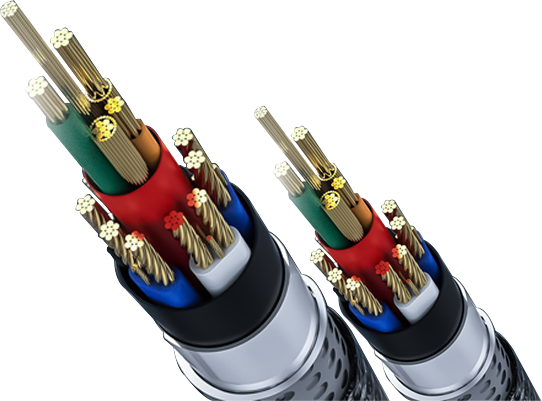
In the fields of power transmission and industrial control,
copper cables maintain a central position due to their superior electrical conductivity, excellent mechanical strength, and mature manufacturing processes. Conductor grade is the key factor in selecting copper cables, directly determining their performance, suitable applications, and service life. Among these, Category 2 and Category 5 copper conductors are the most commonly used types, suited for fixed installations and dynamic operation scenarios respectively. Procurement and engineering personnel often face selection dilemmas due to the differences between the two. This article begins by defining copper conductor grades, then analyzes the construction, characteristics, applications, and differences between these two cable types to provide professional guidance for selection.
What Are Copper Conductor Grades?.jpg)
To accurately distinguish between Category 2 and Category 5 copper cables, one must first understand the basis for classifying copper conductor grades. The globally recognized classification standard for copper conductors is IEC 60228 “Dimensions, properties and rated currents of conductors.” This standard categorizes copper conductors into multiple grades based on stranding structure, flexibility, and application scenarios. Grades 1 through 6 progressively exhibit increasing flexibility and gradually decreasing mechanical strength. Among these, Class 2 and Class 5 are the two most widely used grades in industrial and residential applications. A core criterion for their classification is the conductor's stranding method—specifically, the difference between stranded conductors and solid conductors.
A stranded conductor is formed by twisting multiple copper wires together according to specific rules. Compared to solid-core conductors, stranded conductors enhance cable flexibility and fracture resistance, preventing conductor breakage caused by bending during installation or use. Flexible conductors, however, build upon stranded conductors by increasing the number of copper strands and reducing the diameter of each strand. This further enhances flexibility, enabling the cable to withstand dynamic scenarios involving frequent bending and twisting. Conductor grade is critical to cable performance because it directly influences flexibility, mechanical stability, current-carrying capacity, installation difficulty, and durability. Different grades feature distinct stranding structures, leading to significant variations in cable adaptability across environments. Incorrect selection may cause premature aging, short circuits, or even safety incidents.
Category 2 Copper Cable
Category 2 copper cable is a limited-flexibility stranded conductor cable, serving as the mainstream choice for fixed installations in power transmission applications. Structurally, Category 2 copper conductors typically consist of several relatively thick copper wires twisted together at specific pitches. Individual wire diameters generally range from 0.5mm to 2.0mm. The twisted conductor structure is relatively compact, encased in an insulation layer (commonly PVC, cross-linked polyethylene, etc.) and a sheath layer. Some specialized applications may include an additional shielding layer for interference resistance. This design ensures both mechanical stability and sufficient flexibility to accommodate standard bending requirements during fixed installations.
Moderate flexibility is one of the most distinctive characteristics of Category 2 copper cables. Due to the relatively small number of twisted copper strands and the thicker individual wires, the conductor exhibits less bending resistance than solid-core conductors but remains significantly less flexible than highly flexible Category 5 cables. It is unsuitable for frequent bending or movement and is better suited for long-term use after a single fixed installation. The lower strand count not only simplifies the manufacturing process but also provides the conductor with high mechanical stability. Once fixed in place, the conductor resists deformation from minor external vibrations or tension, maintaining stable electrical conductivity over time. Simultaneously, this simplified construction offers cost advantages. Compared to Category 5 cables, Category 2 copper cables require less raw material and manufacturing labor, typically resulting in a 20%-40% lower price point. This makes them an ideal choice for budget-constrained scenarios.
Given these characteristics, Category 2 copper cable finds its primary application in fixed installations. In power distribution, it is widely used for building distribution circuits, outdoor overhead distribution cables, and interconnections between distribution panels, reliably transmitting medium-to-low voltage electricity. In industrial settings, it serves as the core conductive medium for switchgear, control cabinets, and fixed electrical circuits in machine tools—equipment that does not require frequent movement. For instance, in office building power distribution projects, Category 2 copper cables are selected for lines running from the main distribution panel to floor distribution panels, as well as for control circuits in fixed production lines within workshops. This choice ensures stable power supply while effectively controlling project costs.
Category 5 Copper Cable
Unlike Category 2 copper cables, Category 5 copper cables are high-flexibility stranded conductor cables designed primarily for dynamic applications involving frequent movement, bending, and twisting. Structurally, Category 5 copper conductors employ a “multi-strand fine copper wire stranding” design, with individual copper wires typically ranging from 0.1mm to 0.5mm in diameter and featuring a higher number of stranding layers. Some premium products employ a dual-layer stranding process: “bundle stranding + overall stranding.” This involves first twisting dozens of fine copper wires into smaller bundles, then twisting multiple bundles into the main conductor at a larger pitch. This intricate stranding structure allows the internal copper wires to freely shift positions, significantly enhancing the cable's flexibility.
Exceptional flexibility is the core competitive advantage of Category 5 copper cables. In scenarios involving frequent bending, twisting, or dragging, Category 5 copper cables maintain structural integrity without copper wire breakage from mechanical stress. For instance, in drag chain systems bending 10 times per minute, Category 5 cables can last tens of thousands of hours, whereas Category 2 cables may experience conductor failure within hours. This high flexibility makes it ideal for dynamic environments but also increases costs—fine copper wires demand higher manufacturing precision, more complex stranding processes, and 30%-50% higher raw material and labor costs compared to Category 2 cables, resulting in a relatively higher price.
Category 5 copper cables are primarily deployed in industrial automation and portable equipment requiring frequent movement. In robotics, the constant extension, retraction, and rotation of robotic arms demand cables with exceptional flexibility—a requirement precisely met by Category 5 copper cables. In machine tools, drag chain systems move cables alongside sliding components, making Category 5 copper cables the preferred choice due to their fatigue resistance. Additionally, portable power tools (e.g., handheld drills, cutters), mobile inspection equipment, and moving actuators in automated production lines all rely on Category 5 copper cables for stable power and signal transmission. Take automotive welding robots as an example: their robotic arms undergo thousands of bending cycles daily. Selecting Category 5 copper cables ensures continuous power supply during welding, preventing production line downtime caused by cable failures.
In-Depth Analysis of Core Differences Between Category 2 and Category 5 Copper Cables
Although both Category 2 and Category 5 copper cables feature stranded conductors, significant differences exist in key performance metrics. These distinctions directly define their applicable scenarios. In terms of flexibility, Category 2 copper cable offers moderate flexibility, suitable only for limited bending during fixed installations. It struggles to recover its original shape after bending. Conversely, Category 5 copper cable boasts exceptional flexibility, enabling repeated bending (over 100,000 cycles) with a smaller bending radius, making it adaptable to complex dynamic environments. In terms of strand count, Category 2 copper cables feature fewer strands (typically 7-19), with thicker individual wires. Category 5 cables, however, contain dozens or even hundreds of strands, each as fine as a hair, with a greater number of strand layers.
Regarding mechanical strength, Category 2 copper cables possess higher static mechanical strength due to their thicker wires and tighter stranding structure, enabling them to withstand greater tensile and compressive forces without damage after fixed installation. Category 5 copper cables, with their finer wires, exhibit relatively lower static mechanical strength but demonstrate significantly superior fatigue resistance compared to Category 2 cables when subjected to repeated bending, twisting, and other dynamic mechanical stresses. Minimum bend radius represents another key difference: Category 2 copper cables typically require a minimum bend radius of 6-8 times the cable diameter, while Category 5 cables can achieve a minimum bend radius as low as 3-5 times the diameter, making them more suitable for installation in confined spaces.
Regarding current-carrying capacity, under identical conductor cross-sectional areas, Category 2 copper cables slightly exceed Category 5 copper cables. This is because the finer copper strands in Category 5 cables create greater gaps, resulting in relatively poorer heat dissipation. Consequently, they are prone to overheating during high-current transmission, necessitating a reduced rated current. Cost-wise, Category 2 copper cable is significantly cheaper. For example, at a 16mm² cross-sectional area, the unit price of Category 2 cable is typically 30%-40% lower than Category 5 cable, a difference that becomes particularly noticeable during bulk purchases.
Differences also exist in suitable environments and installation complexity. Category 2 copper cable is ideal for stable, low-mobility fixed environments such as building power distribution and fixed equipment circuits. Installation is relatively straightforward, requiring only laying and securing along a fixed path. Category 5 copper cable is suited for dynamic, high-mobility environments like robotic systems and drag chain systems. Installation demands consideration of the cable's bending trajectory and range of motion, necessitating higher precision. Regarding durability, Category 2 copper cables exhibit exceptional longevity in static environments, with lifespans exceeding 20 years. However, they are prone to damage from copper wire breakage in dynamic conditions. Category 5 copper cables demonstrate superior durability in dynamic environments but have a lifespan comparable to Category 2 cables in static settings. Prolonged exposure to excessive tensile stress can also lead to copper wire breakage in Category 5 cables.
Comprehensive Review of Category 2 vs. Category 5 Copper Cable Advantages and Disadvantages
Every cable product has its application boundaries. A thorough understanding of the strengths and weaknesses of Category 2 and Category 5 copper cables helps us more accurately mitigate selection risks. The core advantages of Category 2 copper cable lie in its high cost-effectiveness and outstanding static performance: lower cost, effectively controlling project budgets; high static mechanical strength, resistant to external damage after fixed installation; simple installation requiring no complex routing design, reducing labor costs; and extended service life in static environments with low maintenance expenses. However, its drawbacks are equally pronounced: limited flexibility makes it unsuitable for frequently moved applications; forced use in dynamic environments risks copper wire breakage and insulation damage; and poor small-radius bending performance complicates routing in confined spaces.
The primary advantage of Category 5 copper cable lies in its exceptional flexibility and fatigue resistance: it withstands frequent bending, twisting, and movement, ensuring longevity in dynamic applications; its small minimum bend radius makes it suitable for tight-space routing; and it meets the high-precision motion requirements of industrial automation equipment, enhancing operational stability. However, its drawbacks primarily concern cost and static performance: high manufacturing costs result in expensive products, increasing project budgets for large-scale deployments; relatively low static mechanical strength may cause conductor damage under prolonged excessive tension; current-carrying capacity is slightly lower than Category 2 copper cables of the same cross-sectional area, requiring larger conductor cross-sections for high-current transmission scenarios and further increasing costs.
In practical applications, the advantages and disadvantages of both must be weighed based on specific scenarios. For instance, in fixed motor control circuits within workshops, Category 2 copper cables offer clear cost-effectiveness and meet static usage requirements. Conversely, in robotic arm control circuits, the high flexibility of Category 5 copper cables is indispensable. Despite higher costs, they remain a necessary choice to ensure proper equipment operation. Incorrectly using Category 2 copper cable in robotic applications may cause rapid cable failure, increasing equipment downtime and maintenance costs. Conversely, deploying Category 5 copper cable in fixed overhead distribution scenarios constitutes cost inefficiency, while its insufficient static mechanical strength may introduce safety hazards.
Industry Standards and Compliance
Adherence to industry standards is fundamental for ensuring safety, performance, and legal compliance during cable selection and deployment. Both Category 2 and Category 5 copper cables must strictly comply with IEC 60228 requirements in production and application. This standard specifies critical parameters for both conductor types, including copper wire diameter, stranding method, DC resistance, and tensile strength. For instance, it mandates that Class 2 conductors exhibit DC resistance not exceeding 0.017241 Ω·mm²/m at 20°C, while Class 5 conductors must maintain equivalent DC resistance to Class 2 to ensure comparable conductivity at identical cross-sectional areas.
The importance of compliance manifests in three aspects: First is safety. Standard-compliant cables meet safety requirements for insulation performance, heat resistance, and mechanical strength, effectively preventing accidents like short circuits and electrical leakage. Second is performance stability. The standard's strict specifications for conductor stranding structure and material purity ensure cables maintain stable electrical conductivity and mechanical properties during long-term use. Finally, legality: cable compliance is a mandatory inspection item during project acceptance in construction, industrial, and other sectors. Using non-compliant cables risks project rejection, necessitating rework and incurring penalties.
Incorrect conductor classification can have severe consequences. Using cables that do not meet Category 5 standards as Category 5 cables in dynamic applications like robotics can cause rapid aging and breakage, leading to equipment downtime or even safety incidents. Similarly, using Category 5 cables at the rated current of Category 2 cables may cause overheating due to overload, accelerating insulation degradation and shortening service life. Therefore, when selecting cables, choose products manufactured by reputable suppliers that comply with the IEC 60228 standard. Request manufacturers to provide product certification and test reports to ensure accurate cable classification.
Conclusion
During the actual selection process, it is recommended to conduct a comprehensive evaluation based on four dimensions: installation method (fixed or dynamic), operating environment (static or dynamic, spatial constraints), budgetary costs, and current-carrying requirements. This approach helps avoid selection errors caused by blindly pursuing low prices or overly emphasizing performance. Additionally, it is imperative to choose certified products compliant with the IEC 60228 standard to ensure cable safety and regulatory compliance. Looking ahead, as industrial automation continues to advance, demand for Category 5 copper cables will persistently grow. Meanwhile, Category 2 copper cables will maintain their core position in fixed power distribution applications. Understanding the fundamental differences between these two categories and precisely matching them to specific application requirements is key to maximizing the value of copper cables across diverse scenarios.