.jpg)
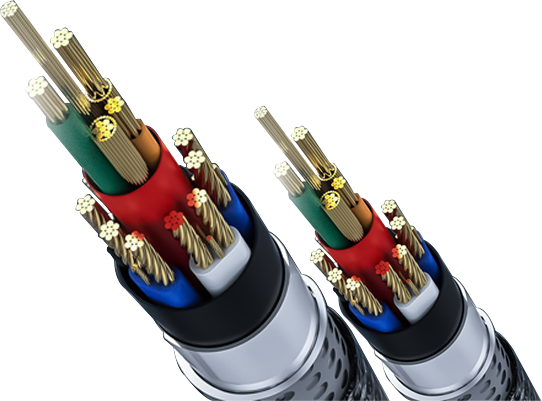
Armored cable is a specialized cable that adds an “armor layer” to conventional cable. This armor layer is typically made of metallic materials such as steel tape, steel wire, or aluminum tape, or special fiber materials. Its core function is to enhance the cable's mechanical protection capabilities. Structurally,
armored cable does not alter the cable's conductive core. Instead, it addresses the vulnerability of standard cables in harsh environments through an additional protective layer. Its electrical conductivity matches that of standard cables of the same specification, with the primary difference lying in its higher protection rating.
Core Application Scenarios and Dependent Industries for Armored Cables
The application of armored cables consistently revolves around the demand for “protection in complex environments.” Core application areas include:
Industrial Manufacturing (factory production lines, heavy equipment power supply)
Construction Engineering (temporary power supply for excavation pits, vertical wiring in high-rise buildings)
Municipal Engineering (street lighting, power supply for underground pipeline networks) , Energy & Mining (underground mine power supply, oilfield equipment cabling), Transportation (railway power lines, port machinery power supply), etc. These industries share the common requirement that cables must withstand mechanical impacts, compression, tension, or resist environmental corrosion—demands that standard cables struggle to meet for long-term stable operation.
Three Core Advantages of Armored Cables
The core competitiveness of armored cables lies in three dimensions: protection, safety, and durability. First, superior mechanical protection: the armor layer effectively withstands external impacts, compression, and tension, even resisting rodent bites, thereby reducing failure risks from physical damage. Second, enhanced safety performance: When insulation damage occurs, the metal armor layer provides auxiliary grounding, minimizing electric shock or fire hazards from leakage currents. Third, extended service life: The armor layer isolates external moisture and chemical corrosive agents, achieving a lifespan 2-3 times longer than standard cables in harsh outdoor or underground environments.
Core Differences Between Armored and Standard Cables
The core value of armored cables lies in their “irreplaceability in specific scenarios.” Standard cables provide only basic conductivity and insulation, suitable for simple indoor environments that are dry and free from mechanical damage risks. Armored cables, however, achieve dual functionality—“conductivity + protection”—through their armor layer, making them irreplaceable in three key scenarios: First, underground direct burial applications, where they withstand soil compression and construction machinery; second, outdoor exposed environments, where they endure weather erosion and UV aging; Third, in mobile or vibrating environments like heavy machinery and port cranes, where they withstand mechanical fatigue damage from frequent vibrations. Additionally, armored cables are mandatory in high-safety-requirement locations (e.g., chemical plants, underground mines), where standard cables are explicitly prohibited due to insufficient protection.
Primary Types of Armored Cables: Classification and Comparative Characteristics
Steel Wire Armored (SWA) Cable
Steel Wire Armored (SWA) cable is currently the most widely used armored cable type. Its armor layer consists of multiple strands of high-strength steel wire twisted together, offering outstanding tensile strength and impact resistance as core characteristics. Structurally, the SWA cable's steel wire armor layer is typically wrapped around the insulation layer, with an outer weather-resistant polyvinyl chloride (PVC) or cross-linked polyethylene (XLPE) sheath further enhancing protection.
Core applications for SWA cables focus on environments requiring resistance to significant tensile forces or impacts: such as vertical cabling in underground mines (resisting tension from its own weight), power supply for port cranes (withstanding frequent vibrations and mechanical shocks), and underground direct burial projects exceeding 1 meter depth (resisting soil pressure and construction damage). Its advantages include high mechanical strength, wear resistance, and a wide operating temperature range (-40°C to 70°C). Disadvantages include heavier weight requiring specialized machinery for installation, and the need for additional anti-corrosion treatment in highly corrosive environments (e.g., coastal areas with high salt fog).
Aluminium Wire Armoured (AWA) Cable
Aluminium Wire Armoured (AWA) cable uses aluminium wires for its armouring layer. Its core distinctions from SWA cable lie in lightweight construction and corrosion resistance. Aluminum wire has only one-third the density of steel, making AWA cables over 40% lighter than equivalent SWA cables. This significantly reduces installation difficulty and labor costs. Additionally, aluminum forms a dense oxide layer in air, offering superior resistance to salt spray and moisture corrosion compared to steel, making it more suitable for coastal applications.
While AWA cables excel in weight reduction and corrosion resistance, their mechanical strength (particularly tensile and impact resistance) is only 60%-70% that of SWA cables. Consequently, they are best suited for low-to-medium mechanical stress applications: such as vertical wiring in high-rise buildings (reducing wall load-bearing), outdoor lighting installations in coastal areas, and powering non-heavy equipment. Additionally, the aluminum wire armor layer offers superior conductivity compared to steel wire. In scenarios requiring auxiliary grounding, this can reduce the need for extra grounding conductors, thereby lowering wiring costs.
Other Special Armored Cables
Beyond mainstream SWA and AWA cables, various specialized armored cables have emerged to meet industry-specific demands. The most representative among these is fiber optic armored cable. This cable type uses optical fibers as its conductive (transmission) core, with armor layers made of steel tape or aramid fiber. Its primary function is to protect the optical fibers from mechanical damage and electromagnetic interference. Unlike metal conductor armored cables, fiber optic armored cables are primarily used in data transmission scenarios such as outdoor communication base station cabling, underground mining communication lines, and industrial control signal transmission. Their advantages include strong resistance to electromagnetic interference, high transmission rates, and armor layers that mitigate fiber breakage risks.
Additionally, specialized variants exist: steel tape armored cables (primarily for low-voltage distribution with excellent crush resistance but weaker tensile strength) and stainless steel armored cables (for highly corrosive environments like chemical plants and pharmaceutical facilities). Each type optimizes armor material and structure for specific environmental demands.
Structural Analysis of Armored Cables: Scientific Layered Protection Design
Four-Layer Core Structure of Armored Cables
The structure of armored cables follows a four-layer design logic: “core conductivity – insulation isolation – mechanical protection – environmental isolation.” Each layer has distinct functions and works synergistically:
First Layer: Inner Conductor, serving as the core for current or signal transmission, typically made of high-purity copper or aluminum. Copper conductors, valued for superior conductivity and ductility, are suitable for medium/high-voltage and high-precision signal transmission applications. Aluminum conductors, offering lower cost and lighter weight, are ideal for low-voltage, large-cross-section wiring scenarios such as municipal power distribution networks. Conductors are often multi-strand twisted to enhance flexibility and ease of installation.
Second Layer: Insulation layer, enveloping the conductor to prevent short circuits and leakage. Common insulation materials include cross-linked polyethylene (XLPE), polyvinyl chloride (PVC), and silicone rubber. XLPE offers superior insulation properties and high temperature resistance (with a long-term operating temperature up to 90°C), making it the preferred choice for medium- and high-voltage armored cables. PVC is cost-effective and easy to process, suitable for low-voltage applications. Silicone rubber is ideal for high-temperature environments (such as metallurgical workshops), withstanding temperatures up to 180°C.
Third Layer: Armor Layer The core protective structure of armored cables, with materials selected based on requirements—steel wire, aluminum wire, steel tape, etc. Armor installation methods include “stranded” (e.g., steel/aluminum wire) and “wrapped” (e.g., steel tape). Stranded structures offer superior tensile strength, while wrapped structures provide better crush resistance. Some high-end armored cables incorporate an inner buffer layer (e.g., polyester tape) within the armor to reduce abrasion on the insulation layer.
Fourth Layer: Outer Sheath, enveloping the armor layer. Its primary function is to isolate the cable from external environmental corrosion, such as moisture, chemical agents, and ultraviolet radiation. Common materials include PVC, polyethylene (PE), or low-smoke, zero-halogen (LSZH) compounds. LSZH jackets are suitable for high-rise buildings, subways, and other scenarios with stringent fire safety requirements, as they do not release toxic gases when burned.
Protection Principle of Armor Layer: Dual Assurance of Mechanical and Safety Protection
The armor layer provides protection in two core dimensions: First, mechanical damage protection: When cables endure external impacts or compression, the armor layer disperses stress, preventing direct damage to the insulation layer and conductors. For underground installations, it withstands accidental contact with construction machinery (e.g., excavators), reducing cable breakage risks. In outdoor environments, it blocks impacts from branches, gravel, and other objects. Second, enhanced safety protection: The metal armor layer functions as an auxiliary grounding conductor. When insulation failure causes leakage current, electricity can flow through the armor layer into the ground, triggering the operation of leakage protection devices and reducing electric shock incidents. Simultaneously, the armor layer limits flame spread, slowing cable combustion rates in fire scenarios.
Application Scenarios for Armored Cables: Comprehensive Coverage from Industrial to Civil Use
Industrial and Commercial Sectors: Core Application Domains
Industrial and commercial settings represent the primary application areas for armored cables, driven by demanding operational environments:
- In factory workshops, armored cables connect heavy machinery and production line equipment, withstanding operational vibrations and impacts from metal debris; In warehouses, they power shelf lighting and forklift charging systems, withstanding forklift and cargo impacts; At construction sites, temporary power lines must use armored cables to resist machinery and rain erosion; In large commercial complexes (e.g., shopping malls, office buildings), armored cables serve as primary power lines from underground distribution rooms to each floor, enhancing supply stability.
Outdoor commercial settings also highlight armored cables' advantages: Street lighting wiring uses armored cables to withstand wind, rain, UV exposure, and vehicle impacts; Power lines for outdoor advertising screens and landscape lighting systems utilize the armor layer for moisture and corrosion resistance, ensuring long-term stable operation.
Underground Installation: The Core Advantage Scenario for Armored Cables
Underground installation is the signature application scenario for armored cables, as soil environments demand extremely high levels of mechanical protection and corrosion resistance: In municipal grid upgrades, armored cables are extensively used for direct underground burial, replacing traditional trench installations to reduce construction costs and land use; In residential distribution projects, cables from substations to buildings employ direct-buried armored cables to avoid ground excavation disruptions to residents; Along railways and highways, armored cables are deployed underground for signal transmission and power supply lines, withstanding train vibrations and soil settlement impacts.
For underground installations, SWA or steel tape armored types are typically selected, paired with PE outer jackets to enhance soil corrosion resistance. When crossing heavy-load areas like roads or railways, double-layer armoring is employed to further elevate protection levels.
Civil Applications: Niche Yet Critical Use Cases
Compared to industrial and commercial settings, armored cables see relatively limited use in civil applications. However, they remain indispensable in specific scenarios: In villa or low-rise residential courtyard lighting and lawn irrigation system wiring, armored cables withstand accidental contact from gardening tools and rainwater erosion; In damp residential areas like basements and garages, armored cables enhance moisture resistance for power supply lines; in rural self-built homes requiring underground direct burial or outdoor wiring (e.g., for agricultural machinery power), armored cables offer greater reliability.
Safety regulations must be observed when using armored cables in residential settings: Only low-voltage specifications (e.g., 0.6/1kV) should be selected. During installation, ensure the armor layer is reliably grounded to prevent safety hazards caused by poor grounding.
Armored Cable Selection Guide:
Core Selection Factors:
Armored cable selection must be based on actual requirements, with four core factors considered:
First, cable specifications and cross-section: Determine the conductor cross-section based on load current magnitude. For example, a 10kW motor requires a copper-core armored cable with a cross-section of 4mm² or larger. Additionally, account for installation methods—when installing through conduits, increase the cross-section by one size (e.g., from 4mm² to 6mm²) to prevent inadequate heat dissipation.
Second, voltage and current ratings: Low-voltage applications (e.g., residential, small-scale industrial) require 0.6/1kV armored cables; Medium-voltage applications (e.g., municipal grids, large factories) require 6kV or 10kV ratings; High-voltage applications (e.g., substation feeders) necessitate specialized 35kV+ armored cables to ensure adequate insulation strength.
Third, environmental factors: - Outdoor environments: Prioritize PE outer sheath + SWA armor for enhanced UV resistance and impact protection. - Coastal high-salt-fog environments: Select AWA armor + corrosion-resistant outer sheath. - High-temperature environments: Opt for silicone rubber insulation + stainless steel armor. - Humid environments: Choose waterproof outer sheath + steel tape armor.
Fourth, mechanical stress requirements: - Vertical installations (e.g., high-rise buildings, underground mines): SWA armoring for enhanced tensile strength. - Horizontal installations subject to compression (e.g., factory floors): Steel tape armoring for improved crush resistance. - Mobile applications (e.g., cranes): Flexible armoring layers (e.g., fine steel wire braiding).
Installation Standards:
The installation quality of armored cables directly impacts their protective performance. Three core standards must be followed:
First, grounding standards: The metal armor layer must be reliably grounded with a grounding resistance below 4Ω. At terminal heads and intermediate joints, the armor layer must connect to grounding conductors via dedicated grounding terminals to prevent leakage risks from poor grounding.
Second, Laying Specifications: For direct burial, the cable burial depth must be no less than 0.7 meters. When crossing roads, protective conduits (e.g., steel pipes) must be used. For curved installations, the bending radius must be no less than 15 times the cable diameter (SWA cables) or 10 times (AWA cables) to prevent armor layer fractures. Avoid dragging cables during installation to prevent friction damage to the armor and insulation layers.
Third, joint treatment specifications: Terminations and intermediate joints must use specialized armored cable accessories to ensure waterproof sealing. The armor layer at joints must be securely connected to the accessory's armor clamping device to maintain continuous mechanical strength.
Additionally, installation must comply with regional standards, such as BS 7671 in the UK and GB 50217 “Design Standard for Power Engineering Cables” in China.
Conclusion:
Armored cables are specialized cables offering mechanical protection. Their core value lies in addressing the vulnerability of standard cables in complex environments like outdoor, underground, and industrial settings through their armor layer, achieving dual functionality of “electrical conductivity + protection.” By type, SWA cables suit industrial heavy-duty applications with high mechanical strength, while AWA cables cater to coastal and high-rise environments with lightweight corrosion resistance. Specialized armored cables address niche requirements. Structurally, their four-layer design synergizes conductivity, insulation, protection, and environmental isolation. Applications span multiple sectors, proving irreplaceable in underground and outdoor scenarios.