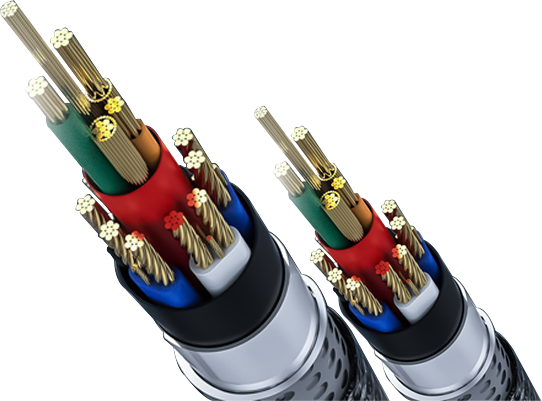
What is an AACSR cable?
AACSR cable, officially termed Aluminum Alloy Conductor Steel Reinforced (AACSR), is a composite conductor cable specifically engineered for high-voltage overhead transmission systems. Featuring an aluminum alloy conductor as the outer layer and a reinforced core of galvanized steel or aluminum-clad steel wires, it is manufactured through specialized twisting processes to deliver exceptional electrical conductivity and exceptional mechanical strength. As a core component of overhead transmission lines, AACSR cables are widely adopted in long-distance, high-voltage, and harsh-weather power transmission projects due to their triple advantages: superior conductivity, high mechanical strength, and strong weather resistance.
Unlike traditional ACSR (Aluminum Conductor with Steel Core), AACSR cables use aluminum alloy instead of pure aluminum for their conductive core. This design maintains comparable conductivity while significantly improving tensile strength, creep resistance, and corrosion resistance, effectively addressing the common issues of aging and cracking in traditional cables under long-span and highly corrosive conditions.
Keywords: AACSR cable, AACSR conductor, aluminum alloy core steel strand, overhead transmission cable
The structure of AACSR cable
conductor structure design
The AACSR cable features a composite structure with "conductive outer layer + reinforced inner layer". It comes in standard configurations of 7, 19,37, or 61 strands, with the exact number determined by transmission capacity and mechanical load requirements. The outer layer consists of concentrically stranded aluminum alloy wires, while the inner layer contains single or multiple reinforced cores. This symmetrical and compact design ensures uniform current distribution and balanced mechanical stress.
Functional division of components
•The aluminum alloy outer layer serves as the primary conductive medium, performing the core function of power transmission while exhibiting excellent corrosion resistance and fatigue resistance, enabling long-term outdoor exposure.
•Steel core (galvanized steel wire or aluminum-clad steel wire): Provides mechanical core support to enhance the cable's tensile strength, wind load resistance, and ice/snow load capacity, effectively controlling sag during long-span installation and preventing line deformation caused by self-weight or external forces.
What exactly is 'aluminum alloy' in AACSR?
Core Differences from Pure Aluminum
Traditional ACSR cables use pure aluminum (Al) as the conductive layer, whereas AACSR employs aluminum alloy materials (primarily Al-Mg-Si series). Compared to pure aluminum, aluminum alloys significantly enhance mechanical properties by adding alloying elements such as magnesium and silicon, while maintaining nearly unchanged conductivity. Pure aluminum has a tensile strength of approximately 120MPa, whereas aluminum alloys can exceed 200MPa, with creep resistance (the ability to resist deformation at high temperatures) improving by over 30%.
Core Advantages of Aluminum Alloy
•Enhanced tensile strength: meets the mechanical tension requirements for long-span installations, reduces tower spacing, and lowers project costs.
•Excellent creep resistance: Resistant to permanent deformation under high-temperature operation or long-term load, ensuring line stability.
•Enhanced corrosion resistance: Particularly resistant to harsh environments such as coastal salt spray and industrial acids/alkalis, thereby extending service life.
•Optimized processing performance: reduced breakage during twisting, enhancing production efficiency and product pass rate.
Key Characteristics of AACSR Cable
High mechanical strength: The synergistic effect between steel core and aluminum alloy enables tensile strength of 250-350MPa, capable of withstanding extreme loads such as strong winds, ice and snow, and earthquakes.
Excellent conductivity: The conductivity can reach 61% of pure aluminum, exceeding IACS standards, meeting the low-loss requirements for high-voltage power transmission.
Exceptional corrosion resistance: Featuring a dual-layer anti-corrosion design with an aluminum alloy exterior and a galvanized steel core, it is engineered for corrosive environments including coastal zones and industrial facilities.
Low sag characteristics: When installed over long spans (e.g., river or valley crossings), the sag is reduced by 15%-20% compared to traditional ACSR, lowering the required tower height.
Strong environmental adaptability: It can operate stably in the temperature range of-40℃ to +90℃, and adapt to different climatic conditions.
Comparison of AACSR, ACSR and AAAC
AACSR is made of aluminum alloy with a steel core, offering very high mechanical strength and excellent corrosion resistance. It is suitable for long-span transmission lines and harsh environments.
ACSR uses pure aluminum with a steel core, providing high strength and good conductivity. It is heavier and mainly used for general overhead transmission.
AAAC is made only of aluminum alloy, without a steel core. It has medium strength, excellent corrosion resistance, and the lightest weight, making it ideal for urban and coastal areas.
Primary Application Scenarios of AACSR Cables
•High/ultra-high voltage overhead transmission lines: Long-distance power transmission at 110kV and above, particularly suitable for major projects such as the West-East Power Transmission and inter-regional grid interconnection.
•Long-span crossing projects: scenarios involving large-span installations across rivers, lakes, valleys, etc., which reduce the number of poles and towers and lower construction difficulty.
•Transmission in harsh environments: coastal salt spray zones, industrial corrosion zones, high-altitude mountainous areas, and other regions with stringent weather resistance requirements.
•Special load zones: power lines in regions prone to extreme weather events (e.g., strong winds, heavy snowfall, or freezing disasters) that must withstand extreme mechanical loads.
•Industrial power supply network: power lines in heavy industrial areas such as steel, chemical, and metallurgy, which must withstand heavy loads and corrosion.
Core Technical Parameters of AACSR Cable
•Rated voltage: 110kV to 1000kV and above;
•Conductor cross-sectional area: 25mm²-1200mm²;
•Direct current resistance (20℃): 0.017-0.210Ω/km (varying with cross-sectional area);
•Tensile strength: 250-350 MPa;
•Maximum operating temperature: 90°C (short-term overload up to 105°C);
•Standard length: Typically 500-1000m per strand, with customization available per project requirements.
•Packaging method: Steel-wood coil wrapping, with each coil weighing 500-3000kg.
Manufacturing Process of AACSR Cable
Aluminum alloy wire drawing: The aluminum alloy ingot is drawn through a die into a single wire of specified diameter, with controlled conductivity and tensile strength.
Galvanized steel wire / aluminum cladding treatment: The steel core undergoes hot-dip galvanizing or aluminum cladding to enhance corrosion resistance.
The aluminum alloy wire is wound around the steel core with the concentric winding process, and the winding pitch and direction are controlled to ensure the stability of the structure.
Compaction and inspection: The stranded cable is compacted to reduce gaps, followed by testing of diameter, resistance, tensile strength, and other parameters.
Quality control: Key testing items include tensile test, DC resistance test, torsion test, and corrosion test, ensuring compliance with standard requirements.
Relevant Standards for AACSR Cables
The production and application of AACSR cables must comply with internationally recognized standards, with core standards including:
•ASTM B711/B711M (American Society for Testing and Materials standard);
•IEC 61089 (International Electrotechnical Commission standard);
•BS 215 (British Standard), DIN 48204 (German Standard).
In international engineering projects, product compliance is a core requirement for bidding. AACSR cables meeting these standards ensure project quality meets international standards and reduce technical risks.
Advantages of AACSR Cable in Power Transmission Engineering
Extended service life: Enhanced corrosion and fatigue resistance enables a lifespan of 30-40 years, significantly surpassing the 20-25 years of traditional ACSR.
Reduced maintenance costs: By minimizing repairs caused by corrosion, fractures, and similar issues, the average annual maintenance cost is reduced by 20%-30%.
Adapt to harsh environments: Perform reliably in complex settings like coastal areas and industrial zones, minimizing downtime caused by failures.
Improving engineering economy: when long-span erection is adopted, the number and height of tower can be reduced, and the cost of civil engineering and construction can be lowered.
Enhanced reliability: The balanced mechanical and electrical properties ensure stable power transmission even under extreme conditions.
How to choose the right AACSR cable?
Specify the voltage level: Select cables with corresponding insulation grades based on the rated voltage of the transmission project.
For long-span calculations (exceeding 500m), select models with high tensile strength and low sag.
Assess environmental conditions: for coastal and industrial zones, prioritize aluminum-clad steel core models with superior corrosion resistance.
Verify mechanical loads: Select products with matching tensile strength based on calculated wind loads, snow and ice loads, etc.
Comply with standard requirements: Select products compliant with IEC, ASTM and other applicable standards based on the project location.
Balance performance and budget: Optimize the cross-sectional area and structural design to control costs while meeting technical requirements.
CONCLUSION
As the core material in modern overhead transmission projects, AACSR cables achieve an optimal balance of conductivity, mechanical strength, and weather resistance through the scientific combination of aluminum alloy and steel core. They not only overcome the performance limitations of traditional cables in long-span and harsh environments but also reduce engineering costs and maintenance expenses, providing a reliable solution for high-voltage and long-distance power transmission.
For power engineers and project developers, choosing AACSR cables means selecting a transmission solution that ensures "high reliability, long lifespan, and strong adaptability." As the power industry transitions toward "efficiency, greenness, and intelligence," AACSR cables will play a more critical role in major projects such as cross-regional grid interconnection and renewable energy integration, becoming a key driver for the high-quality development of the power sector.