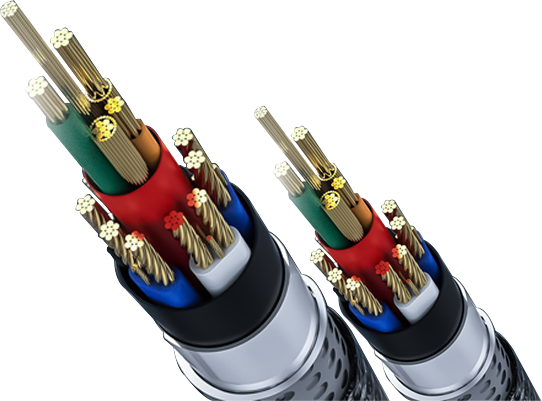
Copper cable Vs. Aluminum cable
Core Value and Comparative Significance of Conductor Materials
Conductors form the core of cable power transmission, with their material properties directly determining transmission efficiency, load capacity, and safety margins. Copper, with its superior conductivity and stable physical-chemical characteristics, remains the preferred choice for high-end cables. Aluminum, leveraging its cost and lightweight advantages, dominates large-scale power transmission. Together, they constitute the industry's mainstream conductor materials.
The core reasons for their dominance: abundant resource reserves enabling large-scale production, mature processing techniques compatible with diverse specifications, and physical-chemical properties aligned with core power transmission requirements.
Fundamental Understanding of Copper and Aluminum Cables
Copper Cables: The Standard for High-Performance Conductors
Copper cables utilize high-purity oxygen-free copper or low-oxygen copper as conductors. Their basic structure comprises a copper conductor, insulation layer, and protective layer (with optional shielding/armoring), delivering outstanding electrical conductivity and chemical stability.
Common types include YJV/YJV22 (mainstream for industrial and commercial buildings), BV/BVR (civil wiring), KVV (industrial control), and RVV (equipment connection), suitable for scenarios demanding high transmission stability and reliability.
Typical applications span critical domains such as indoor wiring in residential and commercial buildings, industrial automation control, precision instrument connections, power supply for data centers and medical equipment, and fire protection power supply in high-rise buildings.
Aluminum Cables: The Preferred Choice for Low-Cost, Large-Scale Transmission
Aluminum cables use aluminum or aluminum alloys as conductors, with structures similar to copper cables. The core difference lies in the physical and chemical properties of the conductor. They are commonly manufactured from high-purity aluminum rods, with some utilizing alloys like AA8030 to enhance mechanical strength and corrosion resistance.
Common types include AAAC (overhead transmission), ACSR (high-voltage overhead), NA2XY (building/industrial distribution), and YJLV/YJLV22 (industrial distribution). Aluminum alloy cables address the mechanical limitations of pure aluminum.
Core applications include large-scale power transmission scenarios such as high-voltage overhead transmission, urban distribution network overhead lines, large industrial plant power distribution, renewable energy power station collection lines, and cost-sensitive long-distance underground distribution networks.
Electrical Performance Comparison: Core Differences in Transmission Efficiency
Electrical performance is the core guarantee for cable transmission efficiency and stability. The difference between copper and aluminum stems from their conductivity properties (copper conductivity: 58.5 MS/m; aluminum: 37.7 MS/m).
In terms of conductivity, copper has 1.55 times the conductivity of aluminum. For the same cross-sectional length, copper offers lower resistance and reduced energy consumption, making it suitable for high-efficiency demand scenarios.
Regarding current-carrying capacity, copper conductors of the same cross-sectional area can handle 20%-30% more current than aluminum. Aluminum cables require a larger cross-sectional area (typically one size larger) to match the current-carrying capacity of copper cables, increasing installation space and costs.
Regarding voltage drop characteristics, aluminum conductors exhibit higher resistance, resulting in more pronounced voltage drop during long-distance transmission (approximately 1.5 times that of copper). Therefore, aluminum cables are suitable for short-distance distribution, while copper cables are preferred for long-distance precision power supply.
In energy efficiency, copper cables' lower resistance results in reduced I²R losses. Over long-term full-load operation, their annual energy consumption costs are 15%-25% lower than aluminum. In high-load, long-cycle scenarios, this efficiency advantage can offset the initial material cost difference.
Mechanical Properties Comparison: Key Factors Affecting Installation and Durability
Mechanical properties directly impact cable installation difficulty, adaptability to laying methods, and long-term durability. Differences between materials primarily manifest in tensile strength, flexibility, and weight.
Regarding tensile strength, copper (approximately 220 MPa) is 2.3 times stronger than aluminum (approximately 95 MPa). This means copper cables better withstand mechanical stresses like tension and dragging during installation, reducing the risk of conductor breakage or damage. Aluminum conductors, however, have lower tensile strength. Extra caution is required during overhead installation or long-distance dragging, often necessitating reinforcement with steel cores (e.g., ACSR aluminum conductors with steel strands) to enhance strength.
In terms of flexibility and bending radius, copper conductors significantly outperform aluminum. Copper cables typically have a minimum bending radius of 6-8 times their diameter, whereas aluminum cables require 8-12 times their diameter. This characteristic makes copper cables more suitable for installation in confined spaces or complex routes (e.g., building ceilings, internal equipment wiring), while aluminum cables are better suited for straight-path installations (e.g., overhead lines, long-distance direct burial underground).
The weight difference significantly impacts installation: Aluminum's density (2.7 g/cm³) is only 30% of copper's (8.9 g/cm³). Aluminum cables of the same cross-section and length weigh approximately one-third of copper cables. This makes aluminum cables easier to install and more cost-effective to transport for overhead installations, high-altitude work, or long-distance transportation, particularly suited for large-scale construction in major transmission projects.
Regarding mechanical stress endurance, copper cables can withstand frequent vibrations, bending, and other mechanical stresses over extended periods without conductor fatigue or fracture, making them suitable for scenarios involving frequent equipment movement (e.g., powering production line equipment). Aluminum conductors, however, are prone to plastic deformation or even fracture under prolonged mechanical stress and are better suited for fixed installations without frequent vibrations.
Thermal Performance and Heat Resistance: Ensuring Long-Term Stable Operation
Thermal performance directly determines a cable's maximum operating temperature, heat dissipation efficiency, and long-term reliability. The differences between copper and aluminum stem from their thermal conductivity and thermal expansion coefficients.
Regarding maximum operating temperatures, copper conductors can sustain long-term operation at 90°C (with cross-linked polyethylene insulation) and short-term overloads up to 130°C. Aluminum conductors also have a long-term operating limit of 90°C but exhibit slightly lower short-term overload capacity, typically not exceeding 120°C during overloads. In high-temperature environments (e.g., near industrial furnaces or outdoor exposure during summer), copper cables demonstrate superior thermal stability and are less prone to accelerated insulation aging.
Regarding thermal expansion behavior, aluminum's linear expansion coefficient (23.1×10⁻⁶/℃) exceeds that of copper (16.5×10⁻⁶/℃). This means aluminum conductors undergo greater dimensional changes in environments with significant temperature fluctuations. This leads to potential joint loosening in aluminum cables during prolonged thermal cycling, increasing contact resistance and posing overheating risks. Copper cables exhibit more stable thermal expansion/contraction, ensuring higher joint reliability.
Regarding heat dissipation efficiency, copper's thermal conductivity (401 W/(m·K)) is 1.7 times that of aluminum (237 W/(m·K)). Copper cables dissipate heat faster during full-load operation, effectively lowering conductor temperatures, delaying insulation aging, and extending cable service life. In densely installed scenarios (e.g., multiple cables laid parallel in trenches or cable trays), copper cables' thermal advantages become more pronounced, reducing current-carrying capacity reductions caused by poor heat dissipation.
Impact of Thermal Properties on Long-Term Reliability: Under prolonged high-temperature and high-load conditions, copper cable insulation ages 20%-30% slower than aluminum cable, resulting in a longer service life (average lifespan: 25-30 years for copper vs. 20-25 years for aluminum). This thermal stability advantage significantly enhances long-term reliability in high-load applications like renewable energy and industrial systems.
Corrosion Resistance and Environmental Adaptability: Adaptability Across Different Scenarios
Corrosion resistance directly determines a cable's service life in various environments. Differences stem from the varying chemical reactivity of copper and aluminum, as well as the adaptability of protective measures.
Regarding oxidation behavior, aluminum exhibits significantly higher chemical reactivity than copper. In air, it rapidly forms a dense aluminum oxide film (approximately 0.1μm thick). This film prevents further oxidation of the underlying aluminum, providing some corrosion resistance in dry conditions. However, in humid or acidic/alkaline environments, the aluminum oxide film is easily compromised, leading to continuous corrosion of the aluminum conductor. Copper oxidizes more slowly in air, forming a porous copper oxide layer that offers limited protection to the underlying copper. Nevertheless, copper exhibits superior resistance to acid and alkali corrosion, making it more stable in industrial corrosive environments.
Performance in Different Environments: In dry, clean indoor environments, both copper and aluminum cables operate stably. In humid environments (e.g., basements, coastal areas), aluminum cables are prone to corrosion and require additional protective measures. In coastal salt fog or industrial acid/alkali environments, copper cables demonstrate superior corrosion resistance, while aluminum cables require special anti-corrosion coatings (e.g., zinc coating) or corrosion-resistant aluminum alloy conductors; In direct soil burial scenarios, copper cables exhibit stronger resistance to soil corrosion, whereas aluminum cables necessitate anti-corrosion outer sheaths (e.g., PE sheath) and armor layers.
Common protective measures: For aluminum cable corrosion, the industry typically employs three protective methods: First, applying specialized anti-corrosion grease at joints to prevent oxidation. Second, using coatings like tin or zinc plating to enhance surface corrosion resistance. Third, selecting dedicated aluminum cable joints and terminals to ensure corrosion-resistant connections. Copper cable protection primarily focuses on preventing acid-alkali corrosion, typically achieved through corrosion-resistant outer jackets (e.g., XLPE, LSZH jackets). Joints may employ silver or tin plating to enhance contact stability.
Conclusion: Scientific Selection Balancing Performance and Cost
Copper and aluminum cables are not inherently superior or inferior but complementary choices suited to specific applications. Copper cables, with their superior electrical performance, stable mechanical properties, and high reliability, are ideal for critical scenarios demanding stringent safety and performance standards (e.g., building wiring, precision equipment power supply). Aluminum cables, leveraging their low cost and lightweight advantages, are well-suited for long-distance, large-scale, cost-sensitive transmission scenarios (e.g., overhead power lines, industrial distribution networks).
The core principle for selection is “application suitability + cost balance”: prioritize copper cables for critical applications and long-term projects to ensure safety and reliability; opt for aluminum cables in non-critical applications and short-term projects to control costs. Regardless of the cable type chosen, strict adherence to relevant standards and specifications is essential. Select products with authoritative certifications and ensure high-quality installation (particularly for aluminum cable jointing).