What is ADSS Cable?
A Comprehensive Guide to ADSS Optical Cables: A Practical Guide to All-Dielectric Self-Supporting Fiber Optic Cables
Introduction
With the rapid iteration of modern power and communication infrastructure, the demand for reliable overhead fiber optic solutions is increasing daily. Whether it's the precise dispatching of smart grids, broadband coverage in remote areas, or the construction of cross-regional communication backbone networks, a transmission medium that combines security, flexibility, and economy is needed. All-Dielectric Self-Supporting Fiber Optic Cables (ADSS) are a core solution born out of this need. With their unique structural design and superior performance, they have become the preferred choice for power companies and telecom operators—not only solving communication challenges in high-voltage environments but also redefining the deployment mode of overhead fiber optics.
What is an ADSS Optical Cable?
ADSS optical cable, or All-Dielectric Self-Supporting Fiber Optic Cable, is an overhead communication optical cable made entirely of dielectric materials without relying on a metal support structure. Its core definition includes two key characteristics: "All-dielectric" means the optical cable contains no metal components, fundamentally eliminating electromagnetic interference and the risk of electric shock; "Self-supporting" means the optical cable can be suspended between towers based on its own structural strength, without the need for an additional traction carrier. This design allows it to be directly installed on the towers of high-voltage transmission lines, making it an ideal choice for power communication and public network transmission.
ADSS Optical Cable Structure
Core Transmission Components
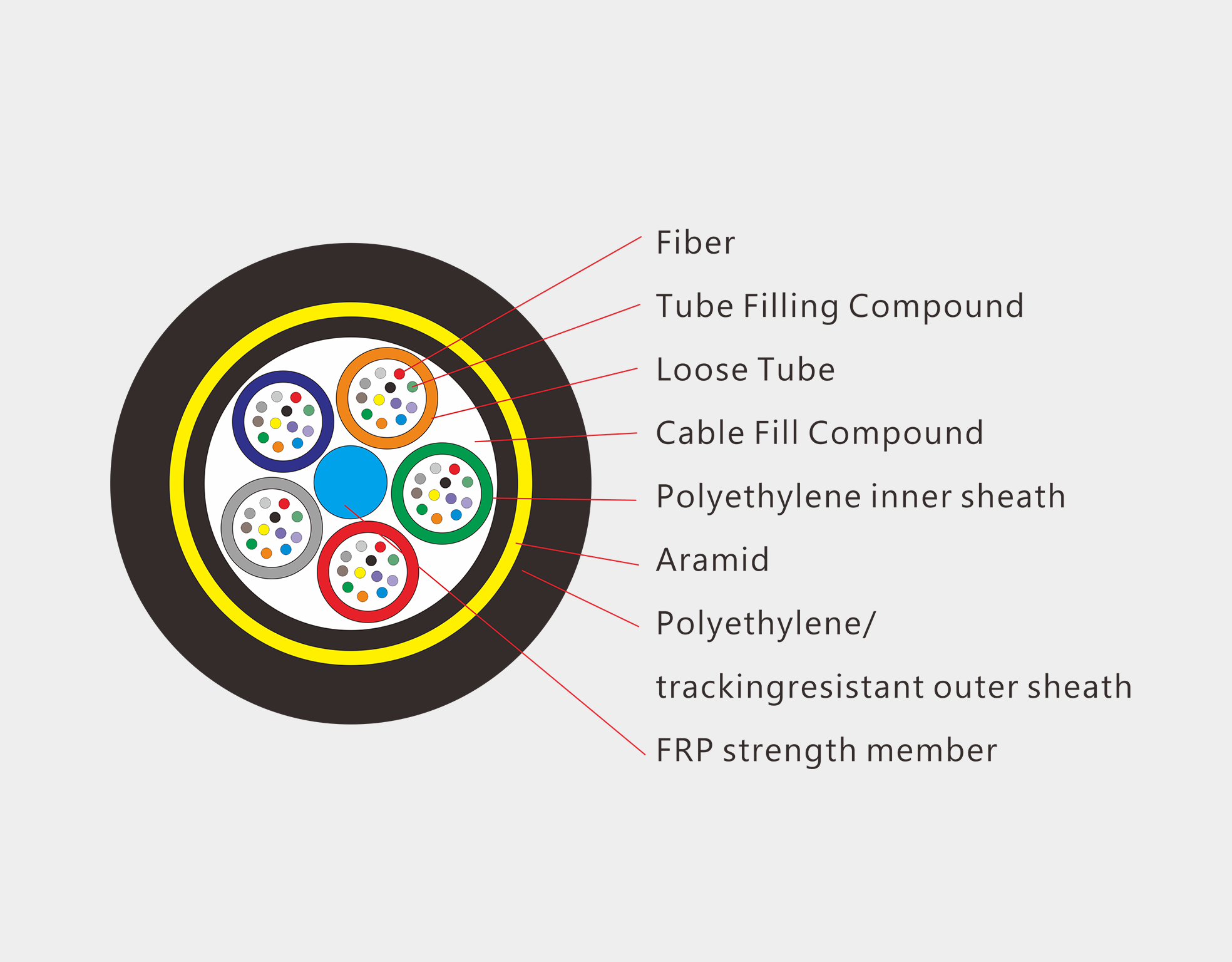
The core of the ADSS optical cable is optical fiber, primarily using G.652D or G.657A1 type single-mode fiber. The number of fiber cores typically ranges from 2 to 288, and can be flexibly configured according to transmission requirements. Fiber encapsulation methods include loose tube and central tube types: loose tube design uses buffer materials to isolate the fiber from external stress, while central tube design offers advantages such as compact structure and light weight. To cope with outdoor humid environments, the optical cable is filled with water-blocking gel, water-blocking yarn, or water-blocking tape, forming a triple moisture-proof protection system to ensure long-term stable operation of the optical fiber.
Strength-Bearing Components
The key to self-supporting capacity lies in the reinforcing core material—ADSS optical cables generally use aramid yarn (commonly known as Kevlar) as the core strength component. This material combines ultra-high tensile strength with lightweight characteristics, effectively withstanding tension during installation and wind and icing loads during operation. Some long-span models also incorporate glass fiber reinforced plastic (FRP) as an auxiliary reinforcement component to further enhance mechanical performance, enabling the optical cable to adapt to span requirements of 50 meters to over 1000 meters.
Outer Protective Sheath
The sheath, as the "protective outer garment" of the optical cable, directly affects its environmental adaptability. Common types include PE (polyethylene) sheaths and AT (anti-tracking) sheaths: PE sheaths are suitable for medium and low voltage environments below 110kV, possessing good weather resistance and corrosion resistance; AT sheaths are designed for high voltage lines of 110kV and above, using a special formula to suppress tracking effects, and can withstand continuous 6 hours without breakdown in a 3.5kV high voltage test, effectively resisting leakage current erosion under high voltage electric fields. Depending on the severity of the environment, single-sheath or double-sheath structures can also be selected. The double-sheath design provides additional mechanical protection and abrasion resistance.
Typical Cross-Section Design
The cross-section of ADSS optical cable presents a clear layered structure: a reinforcing core at the center, surrounded by a loose tube (or central tube) for the optical fiber, with water-blocking material filling the gaps, and the outermost layer wrapped with a sheath. This layered design achieves functional separation of "transmission-bearing-protection," ensuring both the transmission quality of the optical fiber and strengthening the overall structural strength. For different application scenarios, the cross-sectional structure will be optimized accordingly: long-span models will increase the amount of aramid yarn, while models for coastal areas will have a thicker sheath and optimized water-blocking design.
 The Working Principle of ADSS Optical Cable
The core working logic of ADSS optical cable is the dual synergy of "structural self-support + insulated transmission". In terms of mechanical support, the composite structure formed by the aramid reinforcing core and the sheath can evenly distribute its own weight and external load. Through reasonable tension design, the optical cable maintains stable sag between towers. Even in extreme weather such as strong winds and icing, it can absorb stress through the elastic deformation of the material, avoiding damage to the optical fiber. In terms of electrical safety, the all-dielectric structure gives the optical cable natural electrical insulation. It can operate normally by maintaining a safe distance from high-voltage conductors without the need for additional grounding devices, completely eliminating the safety hazards caused by high-voltage induced current.
Core Characteristics and Outstanding Advantages
The all-dielectric characteristics of ADSS optical cable give it extremely strong anti-electromagnetic interference capabilities. When operating near high-voltage transmission lines, it will not generate induced current due to electromagnetic induction, nor will it interfere with the power system. Its lightweight advantage (typically ≤220kg/km) significantly reduces construction difficulty, allowing for rapid deployment via drone towing and live-line work, eliminating the need for power outages. This makes it particularly suitable for upgrading and retrofitting older communication lines. In terms of environmental adaptability, the optical cable can withstand extreme temperature differences from -40℃ to 60℃, exhibiting excellent corrosion resistance and wind and sand resistance. It has proven its effectiveness in harsh environments such as the Xinjiang Gobi Desert and coastal salt spray. Furthermore, ADSS optical cables have extremely low maintenance costs and a service life exceeding 25 years, effectively reducing total lifecycle operating costs.
ADSS Optical Cable Specifications Classification
By Span Length
Based on the installation span, ADSS optical cables can be classified into three categories: short span (≤100 meters), medium span (100-300 meters), and long span (300-1000 meters+). Short-span models are suitable for densely packed pole and tower scenarios such as urban power distribution networks and industrial parks; medium-span models are widely used in county-level power transmission lines and rural broadband construction; long-span models are designed for large-span scenarios such as crossing rivers and valleys. Baoding Mobile used ADSS optical cables in post-disaster reconstruction to achieve river crossings of over 300 meters, significantly reducing pole erection costs.
Classified by Sheath Type
In addition to the basic PE and AT sheath classifications, ADSS optical cables can also be divided into single-sheath and double-sheath models. Single-sheath models are lower in cost and suitable for clean environments with minimal interference; double-sheath models, with their inner insulation and outer protection design, are suitable for scenarios with severe pollution and high wear risk, such as industrial areas and desert edges.
Classified by Application Environment
ADSS optical cables are further divided into distribution line-specific, transmission line-specific, and harsh environment-specific models for different scenarios. Distribution line type focuses on lightweight and flexible deployment, transmission line type strengthens anti-tracking and mechanical strength, and harsh environment type uses special sheath formula and structural design to cope with extreme conditions such as coastal salt spray, industrial pollution, and strong winds and sandstorms.
Comparison of ADSS optical cable with other optical fibers and cables
Comparison with OPGW optical cable
OPGW (Optical Fiber Composite Overhead Ground Wire) is a commonly used optical cable for high-voltage lines. Its core function is integrated "lightning protection + communication". It needs to be installed as a ground wire at the top of the tower and is suitable for newly built high-voltage lines. ADSS, on the other hand, focuses on communication functions and can be flexibly suspended at any position on the tower, making it more suitable for the renovation of old lines. In terms of cost, ADSS has lower installation costs and does not require power outages for construction. In terms of maintenance, OPGW fault repair requires power outages, which is more costly, while ADSS maintenance is more convenient, but the risk of tracking needs to be considered.
Comparison with OPPC Optical Cables
OPPC (Optical Fiber Composite Phase Cable) integrates fiber units within the phase cable, combining conductivity and communication functions, making it suitable for scenarios requiring simultaneous power and data transmission. ADSS, on the other hand, is completely non-conductive, with a simpler structure, greater installation flexibility, and unaffected by line faults. Their application scenarios are complementary: OPPC is suitable for new medium- and low-voltage distribution networks, while ADSS is more suitable for communication upgrades of various lines.
Comparison with Underground Fiber Optic Cables
Underground optical cables offer advantages such as strong concealment and good anti-interference capabilities, but their construction costs are extremely high, and repairs are difficult and time-consuming. ADSS optical cables have installation costs only 1/3 to 1/2 that of underground optical cables, shorten the construction period by more than 40%, and are easier to repair, making them particularly suitable for areas with complex terrain where underground pipelines are difficult to lay, such as mountainous areas and deserts.
Key Points for ADSS Optical Cable Installation
Main Installation Methods
The core installation method for ADSS optical cables is pole-mounted suspension, requiring specialized hardware including suspension clamps, vibration dampers, and tension clamps. Suspension clamps must be selected based on the cable diameter and tension to ensure secure fixation without damaging the sheath. Vibration dampers are used to suppress fatigue damage to the cable caused by light wind vibrations, and are indispensable, especially in long-span scenarios. During construction, technologies such as drone traction and tension-based cable laying can be used to improve installation efficiency and safety.
Key Precautions
Preparation before installation requires precise span calculations and sag tension design. A reasonable sag value must be determined based on the span length and meteorological conditions (wind speed, icing thickness) to avoid excessive tension leading to cable damage or insufficient tension causing wind-induced collisions. Simultaneously, the suspension position must be determined through electric field strength calculations to ensure a safe distance between the optical cable and high-voltage conductors, reducing the risk of electrotracking. In its ADSS optical cable deployment, the North China Oilfield achieved safe coexistence between the optical cable and high-voltage lines through precise electric field calculations and tension design.
Common Installation Mistakes
Common installation errors include improper sheath selection (e.g., using PE sheaths in high-voltage environments), improper tension control (too tight leads to excessive fiber strain, too loose causes wind deflection), and neglecting environmental factors (e.g., not using salt spray protection sheaths in coastal areas). These mistakes can shorten the lifespan of the optical cable or even cause direct failure. Therefore, it is essential to strictly adhere to standards such as IEC 60794-4-20 before installation to ensure construction quality.
Typical Application Scenarios of ADSS Optical Cables
In power systems, ADSS optical cables are widely used for communication on high-voltage/ultra-high-voltage/extra-high-voltage transmission lines, supporting smart grid dispatch automation, relay protection, equipment monitoring, and other services. The communication network built by the North China Oilfield using the ADSS+SDH system has increased the grid communication availability to 99.999%. In broadband construction, ADSS optical cables have become the preferred solution for rural broadband deployment, quickly achieving network coverage in remote areas by utilizing existing power poles. Furthermore, it is also used in communication systems for railways and highways, as well as in the expansion of telecommunications network backbones. ADSS optical cables have played a crucial role in scenarios such as photovoltaic energy storage clusters in Xinjiang and smart pastoral areas in northern Xinjiang.
Exclusive Advantages for Power Companies
For power utilities, the greatest value of ADSS optical cables lies in their ability to be installed without power outages, avoiding grid outage losses caused by communication construction. Their lightweight design has minimal impact on the load of existing towers, requiring no additional reinforcement and significantly reducing upgrade costs. In smart grid construction, the highly reliable communication links provided by ADSS optical cables can support new services such as unmanned substations and precise load control, becoming an important support for the digital transformation of the power grid.
Challenges and Limitations
The core challenge of ADSS optical cables is the risk of electrotracking under high-voltage environments. Improper sheath selection or inappropriate suspension positions can lead to sheath aging and damage over long-term operation. In addition, they have high requirements for installation quality; even slight deviations in sag and tension can affect their service life. Compared to OPGW optical cables, ADSS cables have weaker lightning protection capabilities, requiring additional lightning protection measures in high-lightning-prone areas. These limitations can be mitigated through rigorous selection and design, standardized construction procedures, and regular maintenance.
How to Choose the Right ADSS Optical Cable
Selection requires comprehensive consideration of four core factors: span length and mechanical load determine the specifications and structural design of the cable's reinforcing core; the voltage level of surrounding lines directly affects the sheath type (AT sheath is required for lines above 110kV); environmental conditions determine the number of sheath layers and protection level (double sheaths are preferred in coastal and polluted areas); the number of fiber cores needs to be determined based on the transmission volume, reserving sufficient expansion capacity. Simultaneously, it is necessary to ensure that the product complies with international standards such as IEC 60794-4-20, prioritizing products that have passed tracking resistance and high/low temperature tests.
Future Trends of ADSS Optical Cables
With the deepening development of smart grids, ADSS optical cables will further integrate with sensing technologies to achieve integrated communication and line monitoring (such as icing, temperature, and vibration monitoring). Fiber density will continue to increase, with high-density models exceeding 500 cores potentially emerging in the future to meet the demands of massive data transmission. Anti-tracking materials and sheath technology will be continuously upgraded to further enhance adaptability to high-voltage environments. In terms of market demand, grid upgrades and broadband in developing countries will be the main drivers of ADSS optical cable growth, extending application scenarios to more extreme environments (such as high altitudes and extremely cold regions).
Conclusion
With its unique all-dielectric, self-supporting design, ADSS optical cable solves communication challenges in high-voltage environments, becoming the preferred solution for the power and communications industries. Its lightweight, easy-to-install, and highly reliable characteristics make it irreplaceable in scenarios such as grid upgrades, broadband coverage, and cross-regional transmission. Whether it's the intelligent transformation of power companies or the network expansion of telecom operators, choosing the right ADSS optical cable can significantly reduce costs and improve efficiency. If you are facing communication link construction needs, it is recommended to contact a professional supplier for customized solution design, technical support, and accurate pricing, allowing ADSS optical cable to safeguard your infrastructure upgrades.
The Working Principle of ADSS Optical Cable
The core working logic of ADSS optical cable is the dual synergy of "structural self-support + insulated transmission". In terms of mechanical support, the composite structure formed by the aramid reinforcing core and the sheath can evenly distribute its own weight and external load. Through reasonable tension design, the optical cable maintains stable sag between towers. Even in extreme weather such as strong winds and icing, it can absorb stress through the elastic deformation of the material, avoiding damage to the optical fiber. In terms of electrical safety, the all-dielectric structure gives the optical cable natural electrical insulation. It can operate normally by maintaining a safe distance from high-voltage conductors without the need for additional grounding devices, completely eliminating the safety hazards caused by high-voltage induced current.
Core Characteristics and Outstanding Advantages
The all-dielectric characteristics of ADSS optical cable give it extremely strong anti-electromagnetic interference capabilities. When operating near high-voltage transmission lines, it will not generate induced current due to electromagnetic induction, nor will it interfere with the power system. Its lightweight advantage (typically ≤220kg/km) significantly reduces construction difficulty, allowing for rapid deployment via drone towing and live-line work, eliminating the need for power outages. This makes it particularly suitable for upgrading and retrofitting older communication lines. In terms of environmental adaptability, the optical cable can withstand extreme temperature differences from -40℃ to 60℃, exhibiting excellent corrosion resistance and wind and sand resistance. It has proven its effectiveness in harsh environments such as the Xinjiang Gobi Desert and coastal salt spray. Furthermore, ADSS optical cables have extremely low maintenance costs and a service life exceeding 25 years, effectively reducing total lifecycle operating costs.
ADSS Optical Cable Specifications Classification
By Span Length
Based on the installation span, ADSS optical cables can be classified into three categories: short span (≤100 meters), medium span (100-300 meters), and long span (300-1000 meters+). Short-span models are suitable for densely packed pole and tower scenarios such as urban power distribution networks and industrial parks; medium-span models are widely used in county-level power transmission lines and rural broadband construction; long-span models are designed for large-span scenarios such as crossing rivers and valleys. Baoding Mobile used ADSS optical cables in post-disaster reconstruction to achieve river crossings of over 300 meters, significantly reducing pole erection costs.
Classified by Sheath Type
In addition to the basic PE and AT sheath classifications, ADSS optical cables can also be divided into single-sheath and double-sheath models. Single-sheath models are lower in cost and suitable for clean environments with minimal interference; double-sheath models, with their inner insulation and outer protection design, are suitable for scenarios with severe pollution and high wear risk, such as industrial areas and desert edges.
Classified by Application Environment
ADSS optical cables are further divided into distribution line-specific, transmission line-specific, and harsh environment-specific models for different scenarios. Distribution line type focuses on lightweight and flexible deployment, transmission line type strengthens anti-tracking and mechanical strength, and harsh environment type uses special sheath formula and structural design to cope with extreme conditions such as coastal salt spray, industrial pollution, and strong winds and sandstorms.
Comparison of ADSS optical cable with other optical fibers and cables
Comparison with OPGW optical cable
OPGW (Optical Fiber Composite Overhead Ground Wire) is a commonly used optical cable for high-voltage lines. Its core function is integrated "lightning protection + communication". It needs to be installed as a ground wire at the top of the tower and is suitable for newly built high-voltage lines. ADSS, on the other hand, focuses on communication functions and can be flexibly suspended at any position on the tower, making it more suitable for the renovation of old lines. In terms of cost, ADSS has lower installation costs and does not require power outages for construction. In terms of maintenance, OPGW fault repair requires power outages, which is more costly, while ADSS maintenance is more convenient, but the risk of tracking needs to be considered.
Comparison with OPPC Optical Cables
OPPC (Optical Fiber Composite Phase Cable) integrates fiber units within the phase cable, combining conductivity and communication functions, making it suitable for scenarios requiring simultaneous power and data transmission. ADSS, on the other hand, is completely non-conductive, with a simpler structure, greater installation flexibility, and unaffected by line faults. Their application scenarios are complementary: OPPC is suitable for new medium- and low-voltage distribution networks, while ADSS is more suitable for communication upgrades of various lines.
Comparison with Underground Fiber Optic Cables
Underground optical cables offer advantages such as strong concealment and good anti-interference capabilities, but their construction costs are extremely high, and repairs are difficult and time-consuming. ADSS optical cables have installation costs only 1/3 to 1/2 that of underground optical cables, shorten the construction period by more than 40%, and are easier to repair, making them particularly suitable for areas with complex terrain where underground pipelines are difficult to lay, such as mountainous areas and deserts.
Key Points for ADSS Optical Cable Installation
Main Installation Methods
The core installation method for ADSS optical cables is pole-mounted suspension, requiring specialized hardware including suspension clamps, vibration dampers, and tension clamps. Suspension clamps must be selected based on the cable diameter and tension to ensure secure fixation without damaging the sheath. Vibration dampers are used to suppress fatigue damage to the cable caused by light wind vibrations, and are indispensable, especially in long-span scenarios. During construction, technologies such as drone traction and tension-based cable laying can be used to improve installation efficiency and safety.
Key Precautions
Preparation before installation requires precise span calculations and sag tension design. A reasonable sag value must be determined based on the span length and meteorological conditions (wind speed, icing thickness) to avoid excessive tension leading to cable damage or insufficient tension causing wind-induced collisions. Simultaneously, the suspension position must be determined through electric field strength calculations to ensure a safe distance between the optical cable and high-voltage conductors, reducing the risk of electrotracking. In its ADSS optical cable deployment, the North China Oilfield achieved safe coexistence between the optical cable and high-voltage lines through precise electric field calculations and tension design.
Common Installation Mistakes
Common installation errors include improper sheath selection (e.g., using PE sheaths in high-voltage environments), improper tension control (too tight leads to excessive fiber strain, too loose causes wind deflection), and neglecting environmental factors (e.g., not using salt spray protection sheaths in coastal areas). These mistakes can shorten the lifespan of the optical cable or even cause direct failure. Therefore, it is essential to strictly adhere to standards such as IEC 60794-4-20 before installation to ensure construction quality.
Typical Application Scenarios of ADSS Optical Cables
In power systems, ADSS optical cables are widely used for communication on high-voltage/ultra-high-voltage/extra-high-voltage transmission lines, supporting smart grid dispatch automation, relay protection, equipment monitoring, and other services. The communication network built by the North China Oilfield using the ADSS+SDH system has increased the grid communication availability to 99.999%. In broadband construction, ADSS optical cables have become the preferred solution for rural broadband deployment, quickly achieving network coverage in remote areas by utilizing existing power poles. Furthermore, it is also used in communication systems for railways and highways, as well as in the expansion of telecommunications network backbones. ADSS optical cables have played a crucial role in scenarios such as photovoltaic energy storage clusters in Xinjiang and smart pastoral areas in northern Xinjiang.
Exclusive Advantages for Power Companies
For power utilities, the greatest value of ADSS optical cables lies in their ability to be installed without power outages, avoiding grid outage losses caused by communication construction. Their lightweight design has minimal impact on the load of existing towers, requiring no additional reinforcement and significantly reducing upgrade costs. In smart grid construction, the highly reliable communication links provided by ADSS optical cables can support new services such as unmanned substations and precise load control, becoming an important support for the digital transformation of the power grid.
Challenges and Limitations
The core challenge of ADSS optical cables is the risk of electrotracking under high-voltage environments. Improper sheath selection or inappropriate suspension positions can lead to sheath aging and damage over long-term operation. In addition, they have high requirements for installation quality; even slight deviations in sag and tension can affect their service life. Compared to OPGW optical cables, ADSS cables have weaker lightning protection capabilities, requiring additional lightning protection measures in high-lightning-prone areas. These limitations can be mitigated through rigorous selection and design, standardized construction procedures, and regular maintenance.
How to Choose the Right ADSS Optical Cable
Selection requires comprehensive consideration of four core factors: span length and mechanical load determine the specifications and structural design of the cable's reinforcing core; the voltage level of surrounding lines directly affects the sheath type (AT sheath is required for lines above 110kV); environmental conditions determine the number of sheath layers and protection level (double sheaths are preferred in coastal and polluted areas); the number of fiber cores needs to be determined based on the transmission volume, reserving sufficient expansion capacity. Simultaneously, it is necessary to ensure that the product complies with international standards such as IEC 60794-4-20, prioritizing products that have passed tracking resistance and high/low temperature tests.
Future Trends of ADSS Optical Cables
With the deepening development of smart grids, ADSS optical cables will further integrate with sensing technologies to achieve integrated communication and line monitoring (such as icing, temperature, and vibration monitoring). Fiber density will continue to increase, with high-density models exceeding 500 cores potentially emerging in the future to meet the demands of massive data transmission. Anti-tracking materials and sheath technology will be continuously upgraded to further enhance adaptability to high-voltage environments. In terms of market demand, grid upgrades and broadband in developing countries will be the main drivers of ADSS optical cable growth, extending application scenarios to more extreme environments (such as high altitudes and extremely cold regions).
Conclusion
With its unique all-dielectric, self-supporting design, ADSS optical cable solves communication challenges in high-voltage environments, becoming the preferred solution for the power and communications industries. Its lightweight, easy-to-install, and highly reliable characteristics make it irreplaceable in scenarios such as grid upgrades, broadband coverage, and cross-regional transmission. Whether it's the intelligent transformation of power companies or the network expansion of telecom operators, choosing the right ADSS optical cable can significantly reduce costs and improve efficiency. If you are facing communication link construction needs, it is recommended to contact a professional supplier for customized solution design, technical support, and accurate pricing, allowing ADSS optical cable to safeguard your infrastructure upgrades.