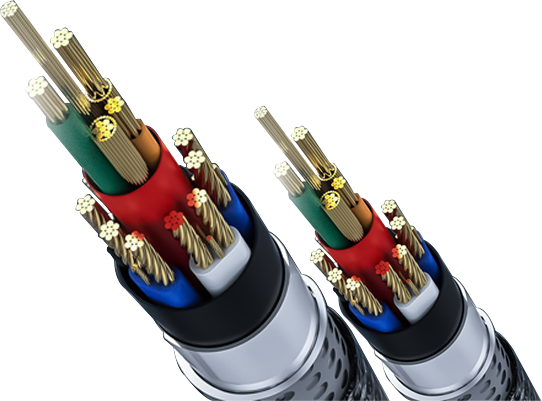
What's the purpose of a screen in MV cables?
Introduction: The Core Relationship Between Medium-Voltage Cables and Shielding Layers
Medium-voltage cables are a core component of power transmission networks. Widely used in distribution systems operating at voltage levels between 6 kV and 35 kV, they are responsible for power transmission between substations and end-users, within industrial complexes, and across urban and rural distribution grids. Whether in urban grid upgrades, industrial power supply, renewable energy grid integration, or rural electrification projects, the stable operation of medium-voltage cables directly determines the reliability and safety of the power system.
In the structural design of medium-voltage cables, the insulation system is the foundation for ensuring safe power transmission, while the shielding layer serves as the “guardian” of the insulation system—one of the core structural features that distinguishes medium-voltage cables from low-voltage cables. In medium-voltage applications, cable conductors carry high voltages and experience strong electric fields. Without effective shielding protection, issues such as electric field distortion, partial discharge, and insulation aging can easily arise, leading to faults like cable breakdown and short circuits. These not only cause power outages but may also result in severe consequences such as equipment damage and personal injury.
What Is a Medium-Voltage Cable Shielding Layer? Definition and Core Role
Many people tend to confuse the three concepts of shielding, insulation, and shielding protection. Although all three are components of the cable’s protective structure, their functional roles and mechanisms of action are fundamentally different. The core distinctions are as follows:
Insulation: Its core function is to isolate the conductor from the external environment, prevent current leakage, and withstand the rated voltage and overvoltages of medium-voltage systems. It serves as the “insulation barrier” for power transmission, with common materials such as XLPE, primarily addressing “leakage current” issues. For cables with PVC, EPR, or HEPR insulation in the 1.8/3 kV to 3.6/6 kV range, the shielding layer may be omitted in some cases; however, mainstream medium-voltage specifications must incorporate a shielding layer.
Shielding: Its core function is to control the distribution of electric fields within the cable, eliminating potential hazards such as electric field concentration and partial discharge, protecting the insulation layer from electric field damage, and providing a discharge path for fault currents. It primarily addresses issues of “electric field distortion” and “partial discharge.” Shielding is categorized into semiconductive shielding and metallic shielding, and it constitutes the core protective structure of medium-voltage cables. The semiconductive shield must be tightly bonded to the conductor and insulation through a triple-extrusion process to eliminate all gaps.
Shielding Protection: Broadly speaking, this encompasses the functions of the shield; narrowly defined, it specifically refers to the electromagnetic interference (EMI) protection provided by the metallic shield. This involves blocking the outward radiation of internal electric fields while preventing external electromagnetic signals from interfering with internal power transmission. It primarily addresses “electromagnetic interference” and serves as one of the additional functions of the metallic shield. The metal shielding layer can be constructed using copper tape, copper wire, or a combination of copper wire and copper tape; in some applications, aluminum foil composite shielding may also be used.
Simply put, the insulation layer is responsible for “isolating current,” the shielding layer is responsible for “controlling electric fields and protecting against faults,” and shielding protection serves as an “additional function” of the metal shielding layer. These three components work in concert to ensure the safe operation of medium-voltage cables.
Main Types and Structural Characteristics of Shielding Layers in Medium-Voltage Cables
Conductor Shield
The conductor shield is the first layer of shielding wrapped around the cable conductor. It is a semiconductive shield made of extruded semiconductive compounds. For some models, a semiconductive tape is applied over the top of the semiconductive compound. Through a triple-extrusion process, it is tightly bonded to the conductor and insulation layer to ensure no gaps remain. Its core material is carbon-filled polymer (with carbon black content controlled within an appropriate range), having a volume resistivity of 100–1000 Ω·m, and it maintains the same potential as the conductor.
The primary function of the conductor shielding layer is to “smooth the conductor surface and eliminate air gaps”: Cable conductors are typically multi-strand twisted structures with microscopic burrs and gaps on their surfaces. These burrs can cause electric field concentration, forming localized high-field regions; simultaneously, if air gaps exist between the conductor and the insulation layer, the lower dielectric constant of air compared to the insulation material can trigger partial discharge, damaging the insulation. The conductor shield fills in the burrs and gaps on the conductor’s surface, eliminates air gaps, and smooths the surface, ensuring uniform electric field distribution and providing a stable operating environment for the insulation. Typically, medium- and high-voltage cables rated at 6 kV and above must include a conductor shield, while low-voltage cables rated at 3 kV and below may omit it.
Insulation Shield
The insulating shield is the second shielding layer wrapped around the exterior of the XLPE insulation layer. It is also a semiconductive shielding layer, made of an extruded semiconductive cross-linked composite layer. For some models, a semiconductive tape may be used as an underlay. The minimum thickness is no less than 0.3 mm, the volume resistivity does not exceed 500 Ω·m, and it maintains equipotentiality with the grounding protection system. Depending on the manufacturing process, the insulation shielding layer can be classified as peelable or non-peelable. Peelable types are commonly used in medium-voltage cables rated at 35 kV and below; after peeling, no semiconductive particles remain, facilitating on-site installation.
The core function of the insulation shielding layer is to “ensure uniform electric field distribution”: Under high voltage, the electric field distribution within the insulation layer of medium-voltage cables is highly prone to distortion. If irregular areas exist on the surface of the insulation layer, they can create points of electric field concentration, leading to accelerated aging and breakdown of the insulation layer. The insulation shielding layer can form an “electric field loop” with the conductor shielding layer, confining the electric field between the conductor and the insulation shielding layer. This ensures uniform electric field distribution within the insulation layer, prevents electric field concentration, and protects the insulation layer from damage. Similar to the conductor shielding layer, medium-voltage cables rated at 6 kV and above must include an insulation shielding layer, while low-voltage cables may omit it. Additionally, the insulation shield can be wrapped around the exterior of the semiconductive water-blocking layer to provide longitudinal waterproofing.
Metal Shielding Layer
The metal shielding layer is the third shielding layer wrapped around the exterior of the insulating shielding layer and serves as the “core safety protection” of medium-voltage cables. It is primarily manufactured by winding or extruding copper tape, copper wire, or a combination of copper wire and copper tape; in some designs, aluminum foil composite shielding layers are also used. For example, some cables compliant with the IEC 60502-2 standard use 0.127 mm thick bare copper tape wound in a spiral pattern with an overlap rate of no less than 12.5% to ensure shield continuity. The cross-sectional area of the metal shield must be calculated based on the system’s short-circuit capacity and neutral grounding method; generally, for 10 kV systems, a minimum of 25 square millimeters is recommended.
The core function of the metal shielding layer is to “provide a grounding path and carry fault currents,” while also offering electromagnetic interference (EMI) protection: when faults such as insulation breakdown or leakage occur in the cable, the fault current can be rapidly discharged to ground through the metal shielding layer, preventing the fault from escalating and protecting equipment and personnel safety; simultaneously, the metal shielding layer blocks the outward radiation of internal electric fields, reducing electromagnetic interference (EMI) and preventing disruption to the normal operation of surrounding electrical equipment; Furthermore, the metal shield provides a certain degree of mechanical protection for the insulation, preventing it from being damaged by external forces. In high-voltage cables rated at 110 kV and above, the metal shield is often integrated with a metal sheath, combining waterproof sealing and mechanical protection functions.
The Core Functions of the Shielding Layer in Medium-Voltage Cables (Of Utmost Importance)
Electric Field Control: Preventing Electric Field Distortion and Ensuring Insulation Safety
Medium-voltage cables transmit high voltages (6 kV–35 kV), generating strong electric fields around the conductor. Without a shielding layer, severe electric field distortion occurs: irregularities on the conductor’s surface and in the insulation layer create localized high-field zones where the electric field strength far exceeds the insulation’s tolerance, easily leading to insulation aging and breakdown.
The shielding layer (conductor shield + insulation shield) employs “equipotential encapsulation” to confine the electric field between the conductor and the insulation shield, ensuring uniform distribution of the electric field within the insulation. This eliminates localized high-field concentration points, ensuring consistent electric field stress across all parts of the insulation and preventing damage caused by excessive localized electric fields. This is the core function of the shielding layer and the foundation for the stable, long-term operation of medium-voltage cables in high-voltage environments. For example, the dielectric strength of XLPE insulation can reach over 20 kV/mm under a uniform electric field, but it drops significantly under distorted electric field conditions, making breakdown highly likely.
Prevention of Partial Discharge: Delaying Insulation Aging and Extending Cable Lifespan
Partial discharge is one of the primary causes of insulation aging in medium-voltage cables: if air gaps or impurities exist between the conductor and the insulation layer, or within the insulation layer itself, the air within these gaps will be ionized under high voltage, resulting in partial discharge. Partial discharge continuously erodes the insulation layer, leading to defects such as electrical trees and water trees, gradually reducing insulation performance, and ultimately causing cable breakdown.
Shielding layers (especially conductor shielding) can effectively eliminate air gaps and impurities: The conductor shielding fills gaps on the conductor’s surface and adheres tightly to the insulation, eliminating air gaps between the conductor and insulation. Additionally, the uniform material of the semiconductive shielding prevents the retention of impurities, thereby reducing the occurrence of partial discharge at its source. Furthermore, the insulating shielding layer can further optimize the electric field distribution, reduce the probability of partial discharge, delay insulation aging, and extend the service life of the cable. Practice has proven that medium-voltage cables equipped with a complete shielding layer can have a service life of over 30 years, whereas cables without shielding or with poor shielding may have a service life of less than 10 years.
Reducing Electromagnetic Interference (EMI): Enhancing System Compatibility
When transmitting power, medium-voltage cables radiate electromagnetic signals outward, creating electromagnetic interference (EMI) that affects the normal operation of surrounding electrical equipment (such as control and communication devices). At the same time, surrounding electromagnetic signals may also interfere with power transmission within the cable, leading to voltage fluctuations and signal distortion.
A metal shielding layer serves as an “electromagnetic shield”: on one hand, it blocks the outward radiation of electromagnetic signals from inside the cable, reducing interference with surrounding equipment; on the other hand, it blocks external electromagnetic signals from entering the cable, preventing interference with power transmission and ensuring the stability of cable transmission. This function is particularly important in environments with dense electrical equipment, such as industrial plants and substations, as it effectively enhances the compatibility of the entire power system and prevents equipment failures caused by electromagnetic interference. For double-shielded cables, grounding one end of the inner shield (partial shield) and both ends of the outer shield (total shield) can further enhance interference resistance.
Common Materials for Shielding Layers in Medium-Voltage Cables
Semiconductive Compounds (Used for Conductor Shielding and Insulation Shielding)
Both conductor shielding and insulation shielding utilize semiconductive compounds, with the core material being carbon-filled polymers (carbon black + polyethylene/XLPE matrix). The carbon black content is controlled between 20% and 30% to ensure good semiconductive properties (volume resistivity of 10²–10⁴ Ω·m), while also ensuring good compatibility and adhesion with the insulation layer (XLPE) to prevent delamination or peeling.
High-quality semiconductive compounds must possess uniform composition and stable semiconductive properties, as well as excellent heat resistance and aging resistance, to withstand the long-term operating temperature of medium-voltage cables (90°C) and prevent a decline in semiconductive performance due to high temperatures. Additionally, the semiconductive compound must exhibit good processability to ensure tight bonding with the conductor and insulation layer through a triple-extrusion process, eliminating all air gaps.
Copper Materials (for Metal Shielding)
Copper is the primary material for metal shielding, primarily available in two forms: copper tape and copper wire. Each has its own advantages and is suited for different applications:
Copper Tape: Cold-rolled copper tape with a thickness of 0.1–0.3 mm is wrapped around the outer side of the insulation shielding layer using either a helical or overlapping wrapping method, with an overlap rate of no less than 15% (some standards require no less than 12.5%). It offers excellent shielding effectiveness, mechanical strength, and conductivity, making it suitable for conventional medium-voltage cable applications, such as indoor and tunnel installations. For example, some cables compliant with the IEC 60502-2 standard use 0.127 mm thick bare copper tape wound in a spiral pattern to ensure shielding continuity.
Copper wire: Tinned copper wire or bare copper wire with a diameter of 0.1–0.3 mm is wrapped around the outer side of the insulation shielding layer using a concentric stranding method. It is highly flexible and lightweight, making it suitable for applications involving bending and long-distance installation, such as direct burial underground and bridge installation. Copper wire shielding offers excellent electrical conductivity and rapid fault current dissipation, while also providing good tensile strength to prevent breakage during installation.
Conclusion: The Shielding Layer—The “Guardian” of Safe and Stable Medium-Voltage Cable Operation
As a core component of the medium-voltage cable insulation system, the shielding layer—comprising the conductor shield, insulation shield, and metal shield working in concert—performs critical functions such as electric field control, partial discharge suppression, fault current dissipation, and electromagnetic interference protection. It is the key guarantee for the safe, stable, and long-term operation of medium-voltage cables in high-voltage environments.
Unlike low-voltage cables, medium-voltage cables operate under high voltage, strong electric fields, and significant fault risks, making the shielding layer an indispensable core structure. It not only optimizes electric field distribution and prevents damage to the insulation layer but also provides a discharge path for fault currents, safeguarding equipment and personnel, reducing electromagnetic interference, and extending the cable’s service life. Whether during production, selection, installation, or operation and maintenance, the role of the shielding layer must be prioritized, and relevant standards must be strictly followed to avoid common pitfalls.