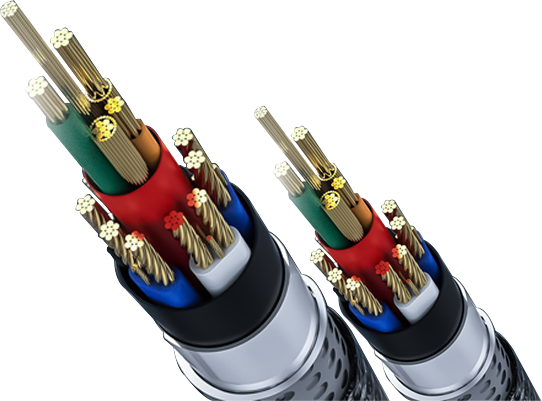
ACAR cables: The cornerstone of power transmission
Electricity serves as the lifeblood of modern society, with overhead conductors acting as the 'main artery' of power transmission, directly determining grid efficiency and stability. As electricity demand surges, traditional conductors can no longer meet the requirements for efficient and reliable power delivery. ACAR cables (aluminum alloy core aluminum stranded wire), with their balanced performance, have become the preferred solution for modern power grids.
The
ACAR cable, standing for Aluminum Conductor Alloy Reinforced, features a 'conductive outer layer + high-strength core' structure. Its outer layer uses high-purity electrical-grade aluminum stranded wire to ensure optimal conductivity, while the core is made of high-strength aluminum alloy AA-6201, replacing traditional steel cores to achieve a 'lightweight yet robust' design. This innovation distinguishes it from AC/DC (Aluminum Conductor/Steel Reinforced) and AAAC (All Aluminum Conductor) cables.
Explore ACAR Cable
Compared to ACSR, ACAR reduces weight by over 30% after removing the steel core, lowering transportation and installation costs while preventing electrochemical corrosion from aluminum-steel contact. With the same tensile strength, its conductivity improves by 15% and line losses are significantly reduced. Compared to AAAC, ACAR's aluminum alloy core enhances mechanical strength by 20%, making it better suited for long-span lines and addressing AAAC's weakness of "high conductivity but low load-bearing capacity".
ACAR's performance advantages stem from its precise material composition and structural design. The outer conductor employs EC-grade aluminum with conductivity approaching pure aluminum standards, while the central aluminum alloy core undergoes special heat treatment to achieve steel-like strength with reduced weight. Typical configurations include 30/7 (30 aluminum wires + 7 alloy cores) and 26/7, offering flexible options for transmission capacity.
The entire production process strictly adheres to rigorous standards including ASTM B524 (American Standard) and IEC 61089 (International Standard), with clear specifications covering everything from raw material purity to twisting techniques, ensuring consistent product performance across all batches. These standards serve as the 'passport' for ACAR cables to enter global markets and form the core guarantee of engineering reliability.
ACAR delivers dual breakthroughs in electrical and mechanical performance. Electrically, its high conductivity enables 10% higher power transmission than ACSR at the same cross-section, while the low thermal expansion coefficient reduces sag variation by 40% at high temperatures, effectively preventing short-circuit risks. Mechanically, the all-aluminum structure exhibits exceptional corrosion resistance, doubling the service life of ACSR in harsh environments like coastal areas and industrial zones.
The Structure and Material Secrets of ACAR Cables
The unique structure and carefully selected materials of ACAR cables are responsible for their excellent performance in power transmission.
Structurally, ACAR cables feature a unique stranded design. The conductors are primarily made of EC-grade aluminum, which boasts high purity and excellent conductivity. In manufacturing, advanced processing techniques transform aluminum into multi-strand wires that are twisted together to form the cable's outer conductive layer. This multi-strand design not only enhances flexibility for easier installation and laying, but also improves current-carrying capacity by promoting air circulation through the gaps between wires, effectively dissipating heat.
The reinforced core at the center of ACAR cables is made of aluminum alloy, which is the key feature distinguishing them from other cables. Unlike steel-cored aluminum stranded wire (ACSR), ACAR cables eliminate the steel core and use aluminum alloy as the reinforcement material. Aluminum alloy offers advantages such as low density, high strength, and corrosion resistance, enabling ACAR cables to maintain mechanical strength while being lighter and more corrosion-resistant. For example, the commonly used AA-6201 alloy, which undergoes special heat treatment, exhibits excellent strength and toughness. This ensures stable cable support and guarantees reliable performance in various complex environmental conditions.
In practical applications, ACAR cables feature various standard stranded configurations. For example, the 30/7 structure denotes a cable composed of 30 outer aluminum conductors and 7 inner aluminum alloy core wires, while the 26/7 configuration follows the same principle. These configurations are determined based on factors such as the cable's intended application, required electrical conductivity, and mechanical strength. Different stranded configurations exhibit distinct performance characteristics during operation, and engineers make precise selections according to specific project requirements.
The production of ACAR cables strictly adheres to relevant standards, with ASTM B524 and IEC 61089 being the primary benchmarks. ASTM B524, established by the American Society for Testing and Materials, provides detailed specifications for ACAR cables' materials, structural configurations, and performance testing methods. For instance, it specifies the composition and performance requirements for aluminum conductors and aluminum alloy reinforcement cores. The standard also regulates parameters such as the number of stranded layers, wire count per layer, and twisting patterns. IEC 61089, issued by the International Electrotechnical Commission, is globally recognized and adopted. This international standard defines unified specifications for ACAR cables, ensuring compliance with fundamental quality and performance requirements across different regions. These standards act as rigorous quality gauges, monitoring every stage from raw material procurement to production processing and final product inspection. This comprehensive oversight guarantees stable quality and reliability of ACAR cables, giving users peace of mind during use.
Performance secrets: Electrical and mechanical characteristics
ACAR cables deliver outstanding electrical and mechanical performance, making them the ideal choice for power transmission applications.
In terms of electrical performance, ACAR cables feature high current-carrying capacity. Their outer layer is made of high-conductivity electrical-grade aluminum, which effectively conducts current and reduces resistance losses, thereby enhancing the cable's current-carrying capacity. This means that under the same conditions, ACAR cables can transmit more electrical energy to meet the growing power demand. For instance, in large industrial areas with high power requirements, ACAR cables can reliably provide sufficient power to various large-scale equipment in factories, ensuring smooth production operations.
Meanwhile, ACAR cables demonstrate exceptional low sag and thermal expansion characteristics. With a minimal thermal expansion coefficient across various environmental temperatures, these cables maintain consistent length stability during temperature fluctuations, effectively minimizing sag variations. Even during extreme seasonal temperature swings between scorching summers and freezing winters, ACAR cables sustain stable suspension heights. This design prevents sag-induced line failures, ensuring secure and reliable power transmission throughout the year.
In terms of mechanical properties, ACAR cables demonstrate exceptional corrosion resistance. Their aluminum alloy core and outer aluminum layer provide robust protection against corrosion, enabling long-term stable operation in harsh environments. Whether in humid coastal areas or regions with severe chemical pollution, these cables effectively resist moisture, salt, and various chemical substances in the air. This corrosion resistance reduces maintenance and replacement costs while extending the service life of the cables.
Furthermore, ACAR cables boast lightweight and high-strength design advantages. The reduced weight facilitates easier transportation and installation, lowering construction difficulty and costs. Their exceptional strength ensures structural integrity under various external forces such as wind and snow loads, effectively preventing fractures and other failures.
ACAR is a 'jack-of-all-trades' — its conductivity rivals AAAC, strength far exceeds AAAC, and weight matches both, only slightly inferior to ACSR in extreme strength while avoiding ACSR's corrosion flaw.
The multiple applications of ACAR cables
With its balanced performance, ACAR demonstrates precise and extensive applications: Firstly, in urban-rural power transmission and distribution trunk lines, its lightweight design reduces tower load-bearing capacity, cutting engineering costs. Secondly, for long-span specialized lines such as river crossings and mountainous transmission routes, it meets high-tensile requirements. Thirdly, during grid upgrades, it directly replaces aging conductors, increasing transmission capacity by over 20% without requiring tower modifications.
In coastal areas, ACAR's salt spray corrosion resistance extends its maintenance cycle from 5 years to 15 years compared to ACSR. In industrial parks, its chemical corrosion resistance reduces line failures. These advantages make ACAR a' low TCO (Total Cost of Ownership)' option.
ACAR cables demonstrate exceptional performance in specialized environments. For long-span river crossing projects, these cables must possess sufficient strength to traverse wide waterways while resisting erosion and moisture. Their high-strength aluminum alloy core and corrosion-resistant aluminum sheath make them ideal for such applications. These cables can securely suspend between towers on both riverbanks, safely transmitting electricity to the opposite shore and ensuring power interconnection across the water. In coastal areas where air contains high concentrations of salt, ACAR cables' superior corrosion resistance enables long-term stable operation in harsh conditions. This reduces maintenance and replacement costs caused by corrosion, ensuring stable power supply in coastal regions. For instance, ACAR cables have significantly improved power transmission reliability in transmission lines between power plants and urban areas in coastal cities, guaranteeing the normal operation of urban infrastructure.
ACAR's core strengths can be summarized in four key aspects: First, it delivers energy efficiency leadership, saving over 100,000 kWh annually per 100 km with minimal line losses. Second, it features maintenance-free operation, with its all-aluminum structure eliminating corrosion risks and reducing lifecycle costs by 50%. Third, its lightweight design boosts installation efficiency by 30%. Fourth, it is environmentally friendly, achieving a 95% aluminum recycling rate and meeting the' dual carbon' goals.
The significant advantages of ACAR cables
In practical applications, ACAR demonstrates clear advantages: When projects require a balanced combination of strength, conductivity, and lightweight, ACAR is the preferred choice. For ultra-high voltage and extreme-span scenarios, ACSR can be paired with ACAR. For short-distance power distribution and cost-sensitive projects, AAAC offers better cost-effectiveness. This complementary nature makes ACAR a versatile tool for grid engineers.
ACAR cables demonstrate exceptional current-carrying capacity and efficient power transmission capabilities. By utilizing high-conductivity electrical-grade aluminum as the outer conductor, they effectively reduce resistance and minimize energy loss during transmission. This means that under identical transmission conditions, ACAR cables can deliver more electrical energy, significantly improving power transmission efficiency. For instance, in long-distance power lines, the low-resistance characteristic of ACAR cables substantially reduces power loss along the transmission lines, saving substantial energy for power systems. Additionally, the low thermal expansion coefficient of ACAR cables ensures stable performance across varying temperature environments, reducing line failures caused by temperature fluctuations and further enhancing the reliability of power transmission.
ACAR cables demonstrate exceptional corrosion resistance. During power transmission, cables are constantly exposed to various environmental conditions that may cause corrosion. The aluminum alloy core and outer layer of ACAR cables exhibit superior corrosion resistance, effectively resisting moisture, salt, chemicals, and corrosive soil elements. In coastal areas where high salt concentrations in the air significantly accelerate cable corrosion, ACAR cables maintain stable performance for decades through their outstanding corrosion resistance. This not only reduces maintenance and replacement costs but also enhances the operational stability of power systems.
ACAR cables are distinguished by their extended lifespan and low maintenance costs. Featuring optimized structural design and superior material properties, these cables maintain stable performance in harsh environments with exceptional durability. This not only reduces power outages caused by cable aging or damage, enhancing grid reliability, but also significantly lowers maintenance expenses for power systems. Unlike conventional cables, ACAR cables require minimal upkeep and replacement cycles, thereby conserving substantial human, material, and financial resources.
From an eco-friendly perspective, ACAR cables demonstrate exceptional performance. Featuring a fully aluminum construction—a recyclable metal—these cables can be recycled and repurposed after their service life, significantly reducing environmental impact. Unlike cables containing non-recyclable materials, ACAR cables better align with modern society's environmental standards, making them a sustainable and eco-conscious choice for power transmission.
Comprehensive Comparison of ACAR with Other Conductors
ACAR's quality control spans the entire production process. In addition to complying with standards like ASTM B524 and IEC 61089, its core testing focuses on three key aspects: conductivity testing (verified through DC resistance method), tensile testing (ensuring compliance with tensile strength requirements), and corrosion testing (simulating harsh environments to verify durability). The product specifications range from 16mm² to 1000mm², compatible with voltage levels from 10kV to 500kV.
Conclusion: ACAR cable is one of the optimal solutions for modern power grids
In summary, ACAR cables are not a 'champion' in single performance, but a 'king' in comprehensive value. With core advantages of 'strong conductivity, light weight, corrosion resistance, and long life', they precisely meet the upgrading needs of modern power grids.
For detailed technical specifications, engineering cases, or precise quotations for ACAR cables, please contact us. Our professional team will provide customized solutions to maximize the value of this "power grid powerhouse".