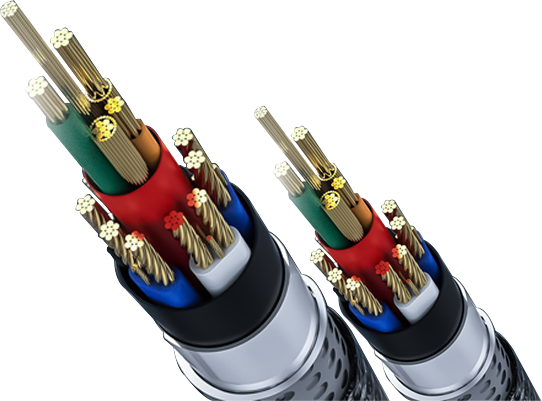
Types of Underground Cables
Introduction: Core Value and Application Significance of Underground Cable Systems
Overview of Underground Cable Systems
Underground cable systems involve laying cables underground (direct burial, cable trenches, etc.) to transmit electrical power/signals. These power facilities cover the entire “transmission-distribution-consumption” chain and can accommodate various voltage level requirements. Driven by urbanization, renewable energy expansion, and grid upgrades, their application scale continues to grow, establishing them as a core component of modern power systems.
Core Advantages of Underground Cables Over Overhead Lines
Underground cables are progressively replacing overhead lines due to their core advantages:
Aesthetic and Space-Saving: Eliminates the need for utility poles, preserves landscapes, and suits urban cores, scenic areas, and similar settings;
Safety and reliability: Resistant to harsh weather and external interference, with low power failure rates and over 30% improved reliability;
Environmental adaptability: Stable operation in extreme conditions like high temperatures, humidity, and corrosion, suitable for industrial parks and coastal areas;
Low maintenance costs: Minimal routine inspections required, with a service life 10-15 years longer than overhead lines, resulting in lower long-term operational expenses;
Minimal Electromagnetic Interference: Effectively shields electromagnetic fields, reducing radiation impact on surrounding equipment and human health.
Importance of Selecting Appropriate Underground Cables
Cable selection directly impacts power system safety, stability, and economic efficiency. Improper selection may lead to insulation breakdown, mechanical damage, shortened lifespan, and supply failures. Moreover, maintenance becomes difficult and rectification costs rise significantly after underground cable installation. Therefore, accurately selecting cable types suited to specific scenarios is crucial for ensuring compliant and safe project operation.
What Are Underground Cables? Definition, Structure, and Core Requirements
Definition and Core Applications of Underground Cables
Underground cables are specifically designed for subterranean installation in areas such as soil or cable trenches, transmitting electrical power/signals. Core applications include urban distribution networks, residential/commercial power supply, industrial power distribution, renewable energy transmission, and long-distance transmission. Their structural design emphasizes moisture resistance, corrosion resistance, and mechanical damage protection to withstand complex underground environments.
Basic Structural Components of Underground Cables
Underground cables consist of five core layers from inner to outer (additional layers may be included as needed):
Conductor: The core transmission unit, primarily made of copper or aluminum, requiring excellent conductivity, mechanical properties, and corrosion resistance;
Insulation Layer: An electrical isolation barrier preventing leakage and short circuits, commonly using materials like PVC or XLPE to suit different voltage scenarios;
Inner Liner: Located between the insulation and armor layers, protecting the insulation while providing moisture resistance and cushioning;
Armor Layer: Enhances mechanical strength to resist external damage, categorized as steel tape (STA) or steel wire (SWA) armor;
Outer Sheath: Outermost protective layer providing corrosion resistance, waterproofing, and aging resistance, typically made of PVC, PE, LSZH, etc.
Core Performance Requirements for Underground Cable Installation
The complex underground environment demands the following core cable properties:
Moisture and Water Resistance: Prevents moisture ingress causing insulation aging and breakdown;
Mechanical Strength: Withstands soil pressure, external impacts, and rodent/insect damage;
Thermal Stability: Suited for poor heat dissipation underground, utilizing high-temperature-resistant insulation materials;
Corrosion resistance: Withstands soil, salt spray, and other corrosive agents;
Aging resistance: Adapt to temperature and humidity fluctuations to extend service life.
Classification Methods and Core Types of Underground Cables
Classification by Voltage Level
Voltage level serves as the primary basis for classifying underground cables, directly determining insulation thickness, structural design, and application scenarios. Based on rated voltage, they fall into four categories:
Low-voltage underground cables (≤1kV):
Features thinner insulation layers and relatively simple structures. Primarily employs PVC or XLPE insulation, with some incorporating steel tape armor. Copper conductors are predominant, while aluminum conductors are used in cost-sensitive scenarios. Mainly deployed for power distribution in residential communities, commercial buildings, small industrial parks, and low-voltage collection lines in renewable energy projects.
Medium-voltage underground cables (1kV-35kV):
Features thicker insulation layers, predominantly using XLPE or EPR insulation materials. Requires additional layers including an inner lining, shielding layer, and armor layer, resulting in a more complex structure. Suitable for urban distribution grids, main power supply lines in industrial parks, and transmission for medium-scale renewable energy power stations. This voltage level represents the most widely applied category for underground cables.
Classification by Application Scenario
Classified into five major categories based on application scenarios, precisely matching diverse power requirements:
Residential Distribution: Low-voltage (0.6/1kV) PVC/XLPE insulation, moisture-proof and safe, suitable for residential area power supply
Industrial & Commercial Grid: Low-medium voltage XLPE insulation + armored, corrosion-resistant and damage-tolerant, suitable for factories/commercial complexes
Power Transmission: Medium/high-voltage XLPE insulation + high-strength armoring, low-loss, suitable for grid trunk lines
Underground Service Entries: Low-voltage flexible cables, moisture-proof and wear-resistant, suitable for building service entries
Renewable Energy Systems: XLPE/LSZH insulation, weather-resistant and high/low-temperature tolerant, suitable for PV/wind power
Analysis of Primary Underground Cable Types and Characteristics
Underground cables are primarily categorized into four types based on structure, insulation material, and installation method: PVC-insulated, XLPE-insulated, armored, and direct-buried. Each offers distinct advantages suited for different scenarios.
PVC-Insulated Underground Cables
The mainstream low-voltage type, utilizing PVC as insulation material. Features a simple structure, low cost, and acid/alkali resistance, suitable for residential communities and small-scale industrial low-voltage distribution. Temperature resistance: 60-70°C. Not suitable for high-temperature or highly corrosive environments.
XLPE-Insulated Power Cables
The preferred choice for mid-to-high-end applications. XLPE insulation offers temperature resistance of 90-125°C, low loss, aging resistance, and a lifespan of 25-30 years. Suitable for low, medium, and high-voltage applications and complex underground environments. Higher cost than PVC.
Armored Underground Cable
Features steel tape (STA) or steel wire (SWA) armor for high mechanical strength and superior protection; STA suits low-to-medium voltage direct burial, while SWA suits medium-to-high voltage and high-stress environments
Direct-Buried Underground Cable
Specifically designed for direct burial, featuring low installation costs, moisture resistance, corrosion resistance, and mechanical damage resistance. Suitable for urban distribution networks and long-distance residential area installations. Not recommended for highly corrosive or frequently excavated areas.
Conductor Materials for Underground Cables: Copper vs. Aluminum Comparison
Copper Conductors
Advantages: Superior conductivity, low losses, high mechanical strength, corrosion resistance, stable joints. Disadvantages: High cost, heavy weight. Suitable for: Medium-high voltage, high-load, safety-critical applications.
Aluminum Conductors
Advantages: Low cost, lightweight, easy installation; Disadvantages: High losses, prone to oxidation, low mechanical strength (requires joint protection); Suitable for: Low-voltage, long-distance, cost-sensitive scenarios.
Core Selection Factors
Selection requires balancing: cost budget, conductivity requirements, installation difficulty, and operational stability. Match copper/aluminum conductors based on specific needs.
Common Insulation Materials for Underground Cables and Their Properties
Insulation materials serve as the “safety barrier” for underground cables, directly determining their safety rating, temperature resistance, weather resistance, and service life. Common insulation materials include PVC, XLPE, EPR/EPDM rubber, and LSZH (Low Smoke Zero Halogen), each suited for different application requirements.
PVC (Polyvinyl Chloride)
The mainstream insulation material for low-voltage underground cables, offering low cost and easy processing. It has a long-term operating temperature of 60-70°C and resists acid and alkali corrosion, making it suitable for low-voltage, indoor/outdoor underground applications (e.g., residential distribution). Its drawbacks include releasing toxic gases (hydrogen chloride) when burned, poor heat resistance, and brittleness at low temperatures, rendering it unsuitable for high-temperature, highly corrosive, or environmentally sensitive environments.
XLPE (Cross-linked Polyethylene)
The preferred insulation material for mid-to-high-end underground cables. Its cross-linking process creates a three-dimensional network structure, enabling a long-term operating temperature of 90-125°C. It offers excellent heat resistance, aging resistance, and insulation properties, with low electrical energy loss and a long service life (25-30 years). Suitable for low, medium, high, and extra-high voltage underground cables, as well as complex environments like direct burial, high temperatures, and humidity. Disadvantages include a 30%-50% higher cost than PVC and more complex processing requirements.
EPR/EPDM Rubber
Specialized insulating materials primarily composed of Ethylene Propylene Rubber (EPR) and Ethylene Propylene Diene Monomer (EPDM) rubber. They offer outstanding flexibility, resistance to high and low temperatures (-40°C to 120°C), ozone resistance, and corrosion resistance. Suitable for underground cables in harsh environments (e.g., coastal areas, mines, chemical industrial parks), flexible underground cables (e.g., mobile equipment power supply). Disadvantages include higher cost and processing difficulty.
LSZH (Low Smoke Zero Halogen)
Environmentally safe insulation material made from low smoke zero halogen polyolefin. Produces low smoke density and releases no toxic halogenated gases during combustion, with a toxicity index ≤5. Complies with RoHS environmental standards. Offers excellent weather resistance and corrosion resistance, suitable for densely populated, enclosed, or environmentally sensitive underground settings (e.g., subways, tunnels, hospitals, high-end campuses). Drawbacks include a cost 50% higher than PVC and slightly reduced low-temperature flexibility.
Conclusion: Summary of Underground Cable Types and Selection Recommendations
As the core transmission medium in modern power systems, underground cables offer diverse types and broad applicability. They can be categorized by voltage level into low, medium, high, and extra-high voltage cables; by application into residential distribution, commercial/industrial grids, and renewable energy systems; and by structure into PVC-insulated, XLPE-insulated, armored, and direct-buried types. Their core advantages lie in aesthetics, safety, reliability, and strong environmental adaptability, effectively meeting the demands of urbanization and new energy industry development.