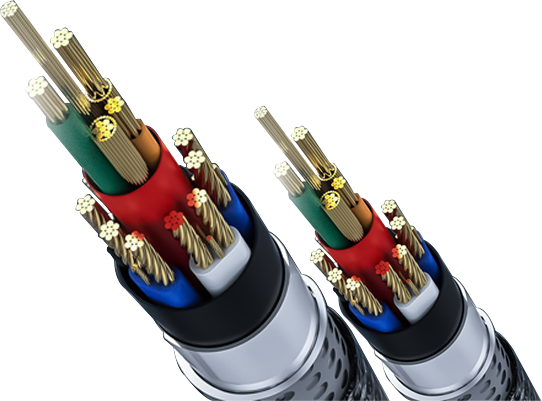
Insulating materials are the "safety barrier" of cables, directly determining their service life, safety performance, and suitability for different applications. They not only isolate current to prevent short circuits but also resist environmental corrosion.
Many buyers only focus on parameters such as conductors and voltage when selecting cables, neglecting the suitability of the insulating material, which can easily lead to
problems such as rapid aging and safety hazards, ultimately increasing overall costs.
PE, PVC, and XLPE are the three most widely used insulating materials. This article breaks down their core differences, performance, and suitable applications to help buyers and engineers make accurate selections and avoid pitfalls.
Overview of Three Common Cable Insulating Materials
PVC (Polyvinyl Chloride): The "cost-effective choice" for low-voltage applications
PVC is a thermoplastic material polymerized from vinyl chloride monomers. It features low cost, easy processing, and good flame retardancy, making it currently the most widely used low-voltage cable insulation material globally.
It is suitable for a wide range of applications, especially low-voltage applications in indoor and fixed installations. Typical applications include: residential and commercial building wiring (such as BV wire), industrial control cables, flexible cables, and low-voltage power cables.
PE (Polyethylene): The "preferred material" for low-loss applications
PE is a thermoplastic material polymerized from ethylene monomers. It has a stable molecular structure and features excellent insulation performance, low dielectric loss, and chemical corrosion resistance. Based on density, there are two common types: LDPE (low-density polyethylene) and HDPE (high-density polyethylene). LDPE has better flexibility, while HDPE has higher mechanical strength.
PE material focuses on "low loss and anti-interference," and is primarily used in applications requiring high signal transmission quality, such as communication cables, coaxial cables, radio frequency cables, as well as low-loss power cables and outdoor waterproof cables.
XLPE (Cross-linked Polyethylene): The "core choice" for medium and high-voltage applications
XLPE is a thermosetting material modified from polyethylene through cross-linking technology – using chemical or physical methods to change the polyethylene molecules from a linear structure to a three-dimensional network structure, completely changing its thermoplastic properties and significantly improving its temperature resistance, voltage resistance, and aging resistance. Unlike PVC and PE (thermoplastic materials), XLPE (thermosetting material) does not melt or flow at high temperatures and maintains stable performance under high pressure and high temperature environments. Therefore, it has become the preferred insulation material for medium and high-voltage power cables.
Analysis of Core Performance Differences
The core performance differences of the three materials determine their suitability and lifespan: In terms of electrical insulation, PVC is moderate, PE is excellent (low loss), and XLPE is superior (high-voltage stability, strong resistance to electrical treeing); in terms of operating temperature, PVC is 70℃ (flame-retardant type 90℃), PE is -60℃~80℃ (softens easily at high temperatures), and XLPE is 90℃ (250℃ during short circuit, best thermal stability).
Mechanical strength: PVC is moderate, PE (HDPE has high strength, LDPE is average), and XLPE is the best; chemical resistance and moisture resistance: PE and XLPE are excellent (XLPE has stronger water resistance), PVC is average; flexibility and installation: PVC is the best, PE is relatively hard, and XLPE is balanced; lifespan: PVC 5-10 years, PE 10-15 years, XLPE 15-20 years or more, with increasing aging resistance.
Electrical Performance Comparison: Adapting to Different Voltage and Transmission Needs
PVC Cables: Suitable for low voltage, meeting basic needs
PVC has moderate insulation resistance and relatively high dielectric loss, and cannot withstand the long-term effects of high-voltage electric fields. Therefore, it is only suitable for low-voltage (≤1kV) scenarios. Its electrical performance can meet the basic power supply needs of civil and general industrial applications, offering outstanding cost-effectiveness, but it is not suitable for high-voltage, low-loss transmission scenarios.
PE Cables: Low-loss advantage, suitable for signal/high-frequency transmission
PE has extremely high insulation resistance and extremely low dielectric loss, and strong anti-interference ability, making it the best among the three materials in terms of electrical transmission performance. It is especially suitable for high-frequency signal transmission and low-loss power transmission scenarios, such as communication cables and radio frequency cables, effectively reducing signal attenuation and power loss, but its resistance to electrical treeing under high voltage is weaker than XLPE.
XLPE Cables: High-Voltage Stability, Core Material for Medium and High-Voltage Applications
After cross-linking modification, XLPE's electrical performance is significantly improved. It maintains stable insulation performance in high-voltage environments and has extremely strong resistance to electrical treeing (the phenomenon of insulation layer aging and cracking under high voltage), effectively avoiding the risk of high-voltage breakdown. Therefore, XLPE is the core insulation material for medium and high-voltage (10kV and above) power cables, suitable for high-voltage power distribution and long-distance power transmission scenarios.
Thermal Performance and Temperature Rating: Determining Cable Current Carrying Capacity and Environmental Adaptability
Operating temperature is a core indicator of insulation materials, directly determining the cable's current carrying capacity (the maximum current it can carry) and its adaptability to high-temperature environments:
• PVC: Conventional operating temperature is 70℃, and can reach 90℃ after flame-retardant modification. It is prone to softening and aging at high temperatures, and has a relatively small current carrying capacity, making it unsuitable for high-temperature environments.
• PE: The maximum long-term operating temperature is 80℃. It has good low-temperature resistance (can operate normally at -60℃), but has poor thermal stability at high temperatures, is prone to softening and deformation, and has limited current carrying capacity.
• XLPE: The long-term operating temperature is 90℃, and it can withstand short-term high temperatures of 250℃ during short circuits. It has extremely strong thermal stability, does not melt or flow at high temperatures, and has the largest current carrying capacity among the three materials, making it suitable for high-temperature and high-voltage scenarios.
Simply put, the higher the operating temperature, the greater the cable's current carrying capacity, and the better it is adapted to high-temperature environments (such as industrial plants and outdoor exposure scenarios). This is the core reason why XLPE is widely used in industrial settings.
Mechanical and Installation Characteristics: Affecting Construction Difficulty and Scenario Adaptability
Flexibility and Bending Performance
PVC has the best flexibility, is easy to bend and pull, and is suitable for indoor wiring, narrow space installation, flexible cables, and other scenarios, with the lowest construction difficulty; PE material is harder, with poor flexibility and a larger bending radius, making it unsuitable for complex bending scenarios; XLPE balances flexibility and mechanical strength, has good bending performance, and can meet the installation requirements of most fixed installation scenarios.
Abrasion and Impact Resistance
XLPE has optimal mechanical strength, with strong tensile strength, impact resistance, and abrasion resistance, making it suitable for buried, outdoor, and industrial plant environments prone to external damage; HDPE has good abrasion resistance, while LDPE is relatively average; PVC has moderate mechanical strength and average abrasion resistance, making it more suitable for indoor, dry environments without external impact.
Environmental and Chemical Resistance: Determining Cable Lifespan
The environmental adaptability of the three materials differs significantly, directly affecting the lifespan of cables in different scenarios:
• Moisture/Water Resistance: PE and XLPE have excellent moisture and water resistance, suitable for buried, coastal, and humid environments; PVC has average moisture resistance and is prone to aging in long-term humid environments.
• Chemical Corrosion Resistance: PE and XLPE have strong resistance to acids, alkalis, oils, and chemical reagents, suitable for chemical workshops and coastal high-salt spray environments; PVC has resistance to general chemical corrosion but poor oil resistance.
• UV Aging Resistance: PE and XLPE require the addition of UV stabilizers for outdoor exposure, otherwise they are prone to aging and cracking; PVC has average UV resistance and is prone to aging and becoming brittle with long-term outdoor exposure.
Fire Performance and Safety: Adapting to Different Safety Requirements
The fire performance of cables directly relates to the safety of personnel and equipment, and the fire characteristics of the three materials differ significantly:
• PVC: It is self-extinguishing (it extinguishes itself after being removed from the fire source) and has good flame retardancy, but it releases toxic and corrosive gases such as hydrogen chloride when burning, and produces dense smoke, making it unsuitable for crowded and enclosed spaces (such as subways, hospitals, and data centers).
• PE/XLPE: Their inherent flame retardancy is generally average, but after modification with flame retardants, they can meet flame-retardant, low-smoke, and halogen-free standards; they produce less smoke when burning and do not release toxic gases, offering better environmental safety than PVC, making them suitable for crowded environments with high environmental requirements.
Currently, scenarios such as subways, hospitals, and data centers often require the use of low-smoke, halogen-free, flame-retardant PE or XLPE cables to ensure personnel safety in case of fire.
Typical Application Scenarios: Precisely Matching Needs and Avoiding Pitfalls
PVC Cables: Low-voltage, Indoor, Cost-effective Scenarios
Core applications: Indoor wiring for residential/commercial buildings (BV/BVR cables), low-voltage control cables, indoor flexible cables, ordinary low-voltage power cables; suitable for cost-sensitive scenarios without high temperatures, chemical corrosion, or requiring indoor dry environments.
PE Cables: Low-loss, Signal Transmission, Waterproof Scenarios
Core applications: Communication cables, coaxial cables, radio frequency cables, low-loss power cables, outdoor waterproof cables, buried communication cables; suitable for scenarios requiring high signal transmission quality, waterproofing, moisture resistance, and low loss.
XLPE Cables: Medium-to-High Voltage, Industrial, Long-term Stable Scenarios
Core applications: Medium-to-high voltage power cables (10kV and above), industrial plant power cables, buried high-voltage transmission cables, high-temperature environment cables, substation cables; suitable for high-voltage power distribution, long-distance power transmission, industrial high-temperature/complex environments, and scenarios requiring long service life.
Conclusion: Material Selection First, Suitability is Key
There is no absolute "superiority or inferiority" among the three cable materials: PE, PVC, and XLPE; only "suitability." PVC excels in cost-effectiveness, suitable for low-voltage indoor scenarios; PE excels in low loss, suitable for signal transmission and waterproof scenarios; XLPE excels in high-voltage stability and long lifespan, suitable for medium-to-high voltage and complex industrial scenarios.
PE, PVC, and XLPE have no absolute advantages or disadvantages; the key is suitability: PVC is cost-effective, suitable for low-voltage indoor use; PE has low loss, suitable for signal transmission and waterproof scenarios; XLPE is stable at high voltage and has a long lifespan, suitable for medium-to-high voltage and industrial scenarios. Don't just look at the price when choosing materials; consider voltage, environment, safety requirements, and long-term costs. Suitability is key to ensuring stable operation and reducing costs.