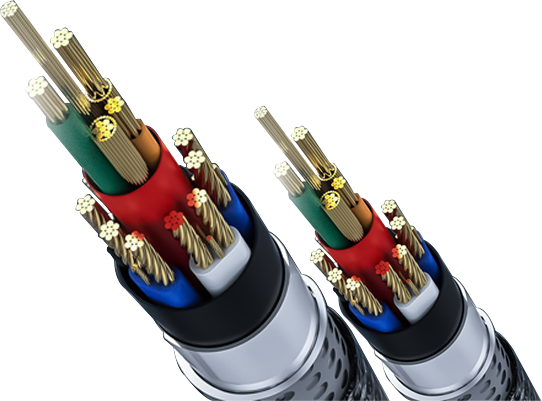
Overhead cable is a power transmission and distribution cable supported by power poles, towers and other supporting structures above the ground. It is the core component of the power system, undertaking the key task of transmitting electric energy from power stations to end users, and constitutes the "artery" of the cross-regional power network.
Basic Structure Overview.jpg)
The core structure of
overhead cables focuses on conduction and protection, mainly consisting of a conductor made of aluminum, aluminum alloy, or ACSR to ensure low resistance and high mechanical strength, and an insulation layer (for insulated types) typically using XLPE or HDPE to prevent leakage and short circuits. Some designs also include a neutral wire for load balancing and grounding protection.Installation height must comply with safety standards: distribution poles are generally 10–15 m high with conductors at least
6 m above ground, while high-voltage transmission poles reach 30–50 m to maintain safe clearances. Overhead systems adapt well to plains, hills, and mountainous terrain, operating reliably within –40°C to 60°C, though protection is required against extreme weather such as heavy rain, typhoons, and ice loading.
Main types of overhead cables
Bare overhead conductor
Wires without insulation, using air as the insulating medium, are widely used in medium and high-voltage transmission lines. There are three core types:
•AAC (all-aluminum conductor): Composed of pure aluminum stranded wires, it offers excellent conductivity, lightweight, and low cost. Suitable for distribution lines below 110kV, but its mechanical strength is relatively weak, making it unsuitable for large-span installations.
•AAAC (All-Aluminum Conductors): A high-strength aluminum alloy material that combines electrical conductivity with mechanical durability, offering excellent corrosion resistance. Weighing only one-third as much as copper conductors, it is ideal for medium-to-high voltage applications and large-span scenarios.
•ACSR (Aluminum Conductor with Steel Core): This type of cable features a galvanized steel core encased in aluminum strands, combining the structural strength of steel with the conductivity of aluminum. As the most widely used configuration, it is ideal for high-voltage and ultra-high-voltage transmission lines as well as complex terrain applications.
The advantages of this type of conductor include low cost, excellent heat dissipation, and high transmission capacity; its limitations are weaker safety performance, susceptibility to external influences such as trees and birds, and the requirement to maintain sufficient safety distance.
Insulated overhead cable
Cables with an insulation layer covering the conductor eliminate safety hazards associated with bare conductors, primarily including:
•ABC (Aerial Busbar Cable): Three-phase conductors and neutral wire are bundled together, with an external insulation layer. Its compact design and easy installation make it ideal for urban and rural power distribution, reducing pole tower space requirements and lowering failure rates.
•Encapsulated conductor: A conductor coated with semiconductive or insulating material, positioned between bare conductors and fully insulated cables. It combines thermal management with safety, making it ideal for high-safety distribution systems.
Compared with bare conductors, insulated conductors can be installed in densely populated areas and near buildings without requiring excessive safety distances; bare conductors are more suitable for remote areas with sparse populations, where transmission efficiency and cost control are prioritized.
Low, medium, and high voltage overhead cables
Classified by voltage level, each has its own application scenarios:
•Low-voltage (≤1kV) systems: Designed for residential communities and industrial distribution networks, these systems feature short transmission distances and limited capacity, with ABC cables being the most common type.
•Medium-voltage (10-35kV) systems: Serving urban distribution networks and county-level power transmission, they form the backbone connecting substations to end-users.
•High-voltage (≥110kV) systems encompass ultra-high voltage (220-500kV) and extra-high voltage (±800kV and above), designed for large-scale inter-regional power transmission projects such as the West-East and North-South Power Transmission Initiatives.
The Structure and Material of Overhead Cable
Conductor material
The primary materials are aluminum and copper, with aluminum and aluminum alloys accounting for over 90% of applications. Copper has higher conductivity than aluminum and requires a smaller cross-sectional area for the same capacity, but its density is 2.7 times that of aluminum, making it heavier and costing 3-4 times more than aluminum, which makes large-scale application prohibitively expensive. Aluminum forms a dense oxide film in air, offering superior corrosion resistance compared to copper. Additionally, aluminum boasts high cost-effectiveness, lightweight properties, and abundant resource reserves, making it the preferred material for overhead cables.
Insulating material (for insulating type)
Must meet requirements for weather resistance, temperature resistance, and insulation performance. Common types:
•XLPE (Cross-Linked Polyethylene): The most widely used material, featuring high-temperature resistance (up to 90°C for extended periods), excellent aging resistance, superior insulation, and high strength, making it ideal for medium and high-voltage cables.
•HDPE (High-Density Polyethylene): With excellent weather resistance and UV resistance, it is more cost-effective than XLPE and is ideal for low-voltage insulated cables.
•PVC (polyvinyl chloride): offers excellent insulation and low cost, but has poor high-temperature resistance (≤70°C) and emits toxic fumes when burned. It is only suitable for low-voltage applications in low-temperature environments.
All insulation materials must demonstrate exceptional weather resistance and UV protection to withstand outdoor elements like heavy rain and ozone, preventing aging and cracking.
Supporting component
Key components for stable operation:
•Steel core: Used in conductors like ACSR, providing mechanical strength, bearing weight and load, and preventing tensile deformation.
•Tension cables: independent load-bearing components, typically made of steel strands or high-strength aluminum alloy wires, which secure insulated cables and reduce conductor stress.
•Metal fittings and accessories: including insulators, wire clamps, and connectors. Insulators isolate conductors and prevent tower leakage, wire clamps secure cables, and connectors ensure electrical conductivity and mechanical integrity at connection points.
Application scenarios of overhead cable
Power transmission line
In core application scenarios, high-voltage and extra-high-voltage overhead cables undertake the critical task of inter-regional power transmission. For instance, China's West-East Power Transmission Project utilizes ±800kV ultra-high-voltage cables to deliver wind and hydropower from the northwest and southwest regions to eastern load centers, with transmission distances exceeding thousands of kilometers and a capacity surpassing 10 million kilowatts.
Distribution network
Medium and low voltage cables are widely used in urban and rural distribution networks. In cities, insulated types are predominantly employed to balance safety and aesthetic considerations, while rural areas primarily utilize bare conductors due to their cost-effectiveness, ease of maintenance, and suitability for decentralized power demands.
Rural electrification project
For remote rural and mountainous areas, overhead cable is the preferred electrification solution due to their complex terrain and dispersed population. Underground cable construction is prohibitively expensive, whereas overhead cables can be rapidly deployed using simple poles, offering extensive coverage and quick results.
Temporary power supply and construction site
This solution is the preferred choice for temporary power supply in construction sites, large-scale events, and emergency rescue operations. Featuring easy installation and disassembly, it enables rapid network deployment. The components are fully recyclable after project completion, ensuring strong cost-effectiveness.
Advantages of overhead cable
Lower installation costs
This method eliminates complex procedures like excavation, pipeline laying, and backfilling, requiring only pole construction and cable installation. Its cost advantage is particularly evident in scenarios with complex terrain and long distances.
Easier maintenance
Exposed to the field of view, potential hazards such as cable damage and insulator aging can be quickly identified through visual inspection or drone patrols. Maintenance can be performed without damaging ground facilities, as it can be completed at high altitudes, offering high efficiency and low cost.
Faster fault detection and repair
The fault point is visually identifiable and can typically be repaired within hours; however, underground cables require specialized equipment for localization, with the repair process extending over several days and affecting a wider area.
long distance transmission adaptation
With excellent heat dissipation performance, UHV cables can enhance transmission capacity by increasing conductor cross-sections or using split conductors. Their transmission distance has now exceeded 3,000 kilometers, making them the optimal solution for long-distance power transmission.
Flexible network scaling
It can be rapidly scaled up by adding circuits, replacing conductors, or upgrading insulators, requiring no extensive modifications to existing infrastructure and demonstrating strong adaptability.
Disadvantages and Limitations of Overhead Cable
Highly influenced by weather conditions
Exposure to outdoor environments is vulnerable to heavy rainstorms, typhoons, snow and ice, and lightning strikes, which may cause insulator flashovers, cable ruptures, tower collapses, short circuits, and other faults.
The visual impact is significant.
The tower and cable occupy the air space, which affects the urban landscape and the view of the natural scenic spot. The use of tower and cable is restricted in the core area of the city and the scenic spot, and the underground cable is adopted instead.
External damage risks are higher
Power supply failure is caused by factors such as tree contact, bird nest, vehicle hitting the pole tower and human damage.
Channel resources are required
The construction of the corridor should be reserved, and no building or tall tree should be planted in the corridor.
Comparison of overhead cable and underground cable
In terms of installation cost, overhead cables offer clear economic advantages, requiring no excavation or duct installation and costing only about one-third to one-fifth of underground cable systems. Underground cables involve complex civil works, resulting in significantly higher initial investment.
From a maintenance perspective, overhead cables allow direct visual fault identification, enabling fast and simple repairs. Underground cables, however, require specialized fault-locating equipment, making maintenance more complex, time-consuming, and costly.
Fault location efficiency also differs substantially: overhead cable faults can be identified quickly through visual inspection, while underground cable faults often require multiple testing procedures, extending repair time.
Regarding service life, both systems provide long-term reliability. Overhead cables typically operate for 25–30 years, while underground cables can reach 30–40 years, though with higher long-term maintenance costs.
In application, overhead cables are ideal for long-distance transmission, rural electrification, and distribution networks, whereas underground cables are preferred in urban centers, scenic areas, and special industrial zones due to their minimal visual impact.
Standards and specifications
Production, installation and use must comply with strict standards:
•IEC standards (International Electrotechnical Commission): IEC 61089 (insulated overhead cables) and IEC 60207 (bare overhead conductors), serving as globally recognized core standards.
•ASTM standards (American Society for Testing and Materials): ASTM B230 (aluminum conductors) and ASTM D2655 (XLPE insulation materials), the dominant standards in North America.
•BS standards (British Standards): BS 215 (bare overhead conductor) and BS 6724 (insulated overhead cable), applicable to European and Commonwealth countries.
Compliance is paramount in international engineering projects. Adherence to target country standards helps avoid trade barriers and ensures project acceptance and system compatibility.
Conclusion
Overhead cables play a vital role in long-distance transmission, urban–rural distribution, and rural electrification due to their low cost, simple installation, efficient maintenance, and strong adaptability. Available in multiple types—from bare conductors to insulated cables, and from low voltage to extra-high voltage (EHV)—they meet diverse application requirements while complying with international and national safety standards.
When selecting overhead cables, key factors such as voltage rating, environmental conditions, and mechanical strength should be carefully evaluated. Working with experienced manufacturers and engineering partners ensures proper selection, installation, and maintenance, safeguarding the long-term reliability of power systems.