Custom Cables | Custom Cable Manufacturer
The Existence Significance of Customization of Cable
Power cables are not universal components for all scenarios, as their operational performance is closely tied to specific environments and working conditions. Standard cables are designed based on common requirements for conventional applications, with parameters set according to universal principles. However, in actual engineering practice, many projects face working environments that exceed these assumptions—such as high-temperature, high-humidity, and high-salt-fog conditions on offshore platforms, frequent bending of robotic equipment, and strong electromagnetic interference in industrial workshops. When the electrical performance, mechanical strength, or environmental adaptability of standard cables fails to meet practical demands, custom cables emerge. Their core value lies in resolving the mismatch between standard designs and real-world applications, ensuring safe and stable operation through targeted optimization rather than being mere "non-standard products."
Definition of Custom Cable
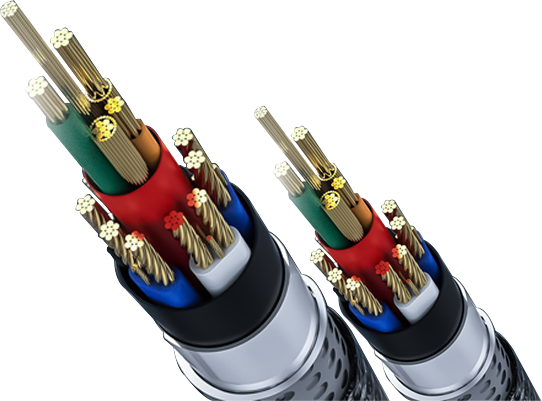
Customized cables are power cables engineered specifically for particular projects, tailored to their electrical parameters, mechanical requirements, and environmental conditions rather than following standard product catalog specifications. This customization isn't a complete redesign from scratch, but rather focuses on "parameter-oriented optimization" —allowing adjustments to individual critical parameters (e.g., heat resistance ratings) or integrated optimization of multiple metrics like conductivity, flexibility, and corrosion resistance. Unlike standard cables that rely on "stock selection" models, customized cables adopt an "engineering-driven design" approach. Starting from actual needs, they achieve precise performance-application matching through technical calculations and structural optimization, enabling both localized improvements to standard cables and bespoke solutions for unique scenarios.
Drive customized electrical parameters
Rated voltage
The customized design of rated voltage depends on insulation thickness, dielectric strength, and safety margins. Voltage requirements vary significantly across different scenarios: low-voltage equipment typically uses cables rated at 450/750V or below, while high-voltage power transmission and distribution cables may exceed 110kV. Insulation thickness must be precisely calculated to prevent electrical breakdown at rated voltage while controlling volume and cost. AC and DC systems have distinct insulation design requirements: DC systems require corona-resistant and anti-aging modified XLPE materials due to uniform electric fields that accumulate space charges; AC systems prioritize optimizing dielectric loss characteristics to reduce energy loss and enhance electrical aging resistance.
Current-carrying capacity
Current-carrying capacity is the core metric for cable current transmission. Custom designs must select conductor cross-sections based on load current and permissible temperature rise. While larger cross-sections enhance current-carrying capacity, they increase volume, weight, and cost, requiring a balance between performance and economy. Installation conditions significantly impact current-carrying capacity: air-laid conductors with excellent heat dissipation offer higher capacity, whereas pipe-laid or buried conductors face thermal limitations and require increased cross-sections for compensation. Additionally, variables like installation density and ambient temperature must be considered during customization to prevent insulation aging or safety hazards caused by high temperatures.
Conductor Material and Structure
The selection of conductor materials directly impacts electrical conductivity efficiency and service life. Common types include copper, aluminum, and copper-clad aluminum: Copper conductors with high conductivity and strong oxidation resistance are suitable for precision equipment and critical power transmission lines; Aluminum conductors, characterized by low cost and lightweight properties, are widely used in high-voltage long-distance power distribution; Copper-clad aluminum combines copper's conductivity with aluminum's lightweight advantages, making it ideal for weight-sensitive applications like aerospace and portable devices. Conductor structures can be categorized into solid, stranded, and flexible types: Solid conductors with high mechanical strength and low cost are suitable for fixed installations; Stranded conductors offer excellent flexibility, facilitating internal equipment and pipeline wiring; Flexible conductors, composed of multi-strand ultra-fine copper wires, can withstand frequent bending and are compatible with robotic systems and automated production lines. Depending on mechanical strength requirements, options include hard-drawn conductors (high strength, low flexibility) or annealed conductors (good flexibility, slightly lower strength).
Mechanical and structural customization
Flexibility and Bending Radius
Flexibility and bending radius significantly impact installation adaptability and service life. Customized designs optimize performance by adjusting conductor strand count and pitch. Higher strand count (more strands, finer wires) enhances cable flexibility, allowing smaller bending radii. For fixed-cable installations, lower flexibility requirements permit bending radii of 10-15 times the cable diameter. Continuous-cable applications involving frequent equipment bending may reduce radii to 5-8 times the diameter, with specialized designs reaching up to 3 times the diameter. Pitch design must balance flexibility and manufacturing costs: smaller pitches improve flexibility but increase processing difficulty and costs.
Tensile Strength and Mechanical Load
In scenarios requiring enhanced tensile strength for overhead lines, towed cables, and mine hoisting equipment, customized designs often incorporate reinforcement components such as galvanized steel strands, aramid yarns, or load-bearing suspension lines. Steel strands are suitable for heavy-load applications, while aramid yarns—lightweight and aging-resistant—are ideal for weight-sensitive environments. Additionally, wear-resistant and tear-resistant sheathing materials like polyurethane (PU) or chloroprene rubber should be selected to improve damage resistance during stretching and friction processes.
Cable Diameter and Weight Limitation
In space-constrained environments (e.g., device interiors or narrow pipelines), cable diameter and weight must be optimized. Designers should balance insulation thickness, shielding structure, and overall dimensions: using high dielectric strength materials to reduce insulation thickness while employing thin-walled shielding structures to maintain effectiveness and minimize diameter. For weight-sensitive applications like aerospace and portable devices, lightweight conductors such as aluminum or copper-clad aluminum, along with thin-walled sheaths, can be selected to reduce weight without compromising performance.
Environmental and installation conditions compatibility
Temperature range
Temperature is the key factor affecting cable lifespan. Material selection should be tailored to operating conditions: For low-temperature environments (-40°C and below), use cold-resistant rubber or fluoropolymer to prevent PVC from cracking; for high-temperature environments (e.g., boiler areas and metallurgical workshops), opt for XLPE or silicone rubber to avoid insulation softening and aging. In temperature cycling scenarios, account for material thermal expansion and contraction, optimize conductor-insulation bonding methods, and minimize structural damage.
Chemical, UV and Moisture Resistance
Industrial settings like workshops and mines require oil-resistant, acid-and alkali-resistant nitrile rubber or fluororubber sheaths. Outdoor cables must incorporate UV stabilizers to prevent cracking from sun exposure. In humid environments such as underground or marine areas, waterproof designs like longitudinal water-blocking tapes and radial water-resistant sheaths are essential. Indoor cables prioritize moisture and dust protection, while outdoor cables must meet multiple requirements including UV resistance and weather resistance.
Fire resistance requirement
High-density or enclosed spaces require stringent fire resistance performance. Custom options include flame-retardant cables (to suppress flame propagation) or fire-resistant cables (to maintain electrical conductivity during fires). Public buildings such as hospitals, shopping malls, and subways must adopt low-smoke halogen-free (LSZH) materials to prevent the generation of toxic smoke and corrosive gases during fires.
Shielding and Electromagnetic Compatibility
Electromagnetic interference (EMI) can degrade signal transmission quality, making shielding design a critical component in customized cable systems. Shielding serves to isolate external interference and prevent the cable's own electromagnetic field from affecting surrounding equipment. Common shielding methods include foil shielding (aluminum foil material, suitable for low-to-medium frequency interference and cost-effective), braided shielding (copper wire braiding with high mechanical strength, ideal for high-frequency interference), and foil + braided composite shielding (combining the advantages of both). Proper grounding design is essential, as it directs the interference currents captured by the shielding layer into the ground to avoid coupling effects that compromise transmission quality.
Standard Compliance and Non-Standard Design
Custom cables are not 'non-compliant products' and can be designed in full compliance with international or regional standards such as IEC, UL, and IEEE. The key to customization lies in 'parameter optimization within the standard framework,' such as selecting conductor cross-sectional areas according to IEC 60228 while adjusting insulation and shielding structures. For special scenarios (e.g., cutting-edge technology projects or equipment under extreme conditions) where existing standards fail to meet requirements, non-standard designs may be implemented after thorough technical justification. However, these must undergo rigorous performance testing and safety evaluations to ensure the solution is scientifically sound and reliable.
Typical application scenarios
Customized cables are primarily deployed in high-performance applications: Industrial automation and robotics systems require cables that withstand repeated bending and electromagnetic interference to ensure uninterrupted equipment operation; renewable energy infrastructure (e.g., solar DC cables and wind turbine loop cables) demands designs resistant to extreme temperatures, UV radiation, and aging to function effectively in outdoor environments; mining operations, offshore platforms, and marine environments necessitate cables with wear-resistant, corrosion-resistant, waterproof, and flame-retardant properties to endure harsh conditions; while specialized infrastructure and pilot projects (including high-voltage DC power transmission/distribution and new energy vehicle charging stations) require customized cables to facilitate the implementation of innovative technologies.
Engineering design process
Custom cable design follows a systematic workflow: "requirement definition → electrical calculation → material selection → structural design → prototype manufacturing → verification testing → iterative optimization." The process begins with defining critical parameters including voltage, current, temperature, installation method, and service life. Next, engineers calculate key metrics such as conductor cross-sectional area and insulation thickness. Subsequently, materials for conductors, insulation, sheathing, and shielding are selected to finalize the overall structure. After prototype manufacturing, comprehensive tests covering electrical performance, mechanical properties, and environmental adaptability are conducted. Finally, parameters are adjusted based on test results to ensure the product meets actual operational requirements.
Conclusion
Custom cables are engineering solutions tailored to specific constraints. Their core value lies in resolving the compatibility gap between standard cables and practical applications through parameter optimization and structural design, thereby enhancing safety, reliability, and service life in specialized scenarios. Engineers who understand their technical logic can avoid blindly opting for expensive custom products or failures caused by inadequate standard cable adaptation. With advancements in industrial automation and renewable energy sectors, cable performance requirements will become increasingly diverse. Custom cables will play a pivotal role in more specialized applications, emerging as an indispensable component in engineering design.