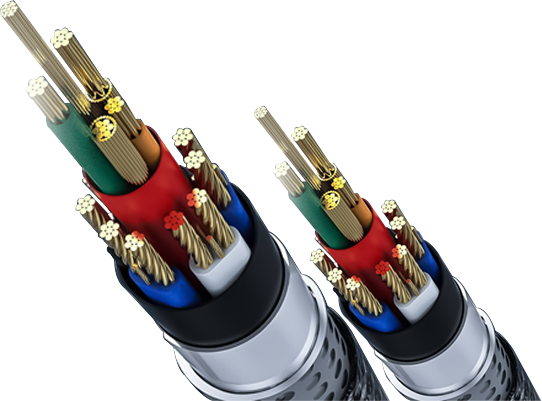
What is Stainless Steel Wire Armored Cable ?

Oct 23, 2026
Many EPC and distribution engineers know that single-core AC power cables need non-magnetic armor to avoid eddy current heating. The YJV72 and YJLV72 series are widely specified for this kind of application. Most buyers, however, only think of these models as aluminium wire armor (AWA) cables. What is less often mentioned is that the same YJV72 / YJLV72 range can also be supplied with austenitic stainless steel wire armor (SSWA). This option keeps the non-magnetic electrical performance, while adding much better corrosion resistance for difficult coastal, mining and acidic soil projects.
To understand how this works, it helps to start with the basic model code. Under GB/T 12706 and IEC 60502, YJV72 and YJLV72 refer to XLPE-insulated, PVC-sheathed cables with non-magnetic metallic wire armor.
  • YJ: XLPE cross-linked polyethylene insulation
  • V: PVC inner sheath
  • 7: Non-magnetic metallic wire armor
  • 2: PVC outer sheath
  • YJV72: Copper conductor version
  • YJLV72: Aluminium conductor version
The key point here is that the “7” does not automatically mean aluminium wire. It simply means non-magnetic metallic wire armor. That category can include both AWA aluminium wire and SSWA austenitic stainless steel wire, depending on the project specification.
It is also important to be careful about the type of stainless steel used. Only austenitic grades such as 304 or 316 stainless steel are non-magnetic and suitable for single-core AC circuits. Martensitic stainless steel is magnetic and should not be used. If a magnetic stainless steel is selected, it can create eddy current losses, temperature rise and long-term insulation degradation. That is one of the most frequently overlooked specification traps for YJV72 / YJLV72 cables.
The electrical principle behind non-magnetic armor is straightforward. When alternating current flows through a single-core cable, it produces a surrounding magnetic field. If the armor is magnetic, that field can induce circulating currents in the armor itself. These eddy currents generate heat, reduce effective ampacity and accelerate insulation ageing over time. Non-magnetic armor, whether aluminium or austenitic stainless steel, does not concentrate magnetic flux in the same way, so eddy current effects remain very low.
Where SSWA differs from AWA is mainly in mechanical strength and corrosion behaviour. Aluminium wire armor is usually a good choice for moderately corrosive coastal areas and standard single-core AC feeders. But in locations with continuous salt spray, tidal moisture, acidic red soil or mining-related corrosion, aluminium can deteriorate more quickly, especially if the outer sheath is damaged during installation or operation.
Stainless steel wire armor, by contrast, provides higher resistance to chloride attack and acidic environments. It also offers higher tensile strength, which can be useful where cables are pulled over long distances, installed in vertical shafts or routed through steep terrain.
Model Armour Type Magnetic Tensile Strength Corrosion Resistance Typical Site
YJV72 / YJLV72 AWA Aluminium wire No Medium Moderate; better for mild to moderate chloride exposure General coastal distribution, standard single-core feeders
YJV72 / YJLV72 SSWA Stainless steel wire (304/316) No High High; better for salt spray, acid soil and mining environments Ports, docks, mines, vertical shafts, heavy corrosion zones
YJV22 / YJLV22 STA Steel tape Yes Low Low Multi-core cables only
YJV32 / YJLV32 SWA Galvanized steel wire Yes High Low Multi-core cables only

Practical selection guide

For most ordinary projects, AWA aluminium wire armor is the sensible choice. It meets the non-magnetic requirement for single-core AC circuits and is more cost-effective than stainless steel.
SSWA stainless steel wire armor becomes a better option when the environmental conditions are more severe. If the site has heavy salt exposure, acidic soil, mining pollution or a combination of high mechanical tension and corrosion, SSWA can offer greater durability.
However, SSWA is not automatically the better choice for every project. It is more expensive and heavier than AWA. For that reason, it should be treated as a targeted upgrade rather than a universal replacement. In extremely corrosive applications, it is also worth considering an HDPE outer sheath instead of PVC for additional protection.

Common misconceptions

One common misunderstanding is that YJV72 and YJLV72 can only be supplied with aluminium wire armor. In fact, the armor material can be changed as long as it remains non-magnetic.
Another mistake is assuming that all stainless steel is suitable for single-core AC use. Only grades such as 304 and 316 are appropriate.
A third misconception is that SSWA should always replace AWA. In practice, the choice depends on site conditions, mechanical requirements, corrosion risk and project budget.
When installing SSWA YJV72 / YJLV72, the same basic rules generally apply to AWA versions. The armor should be earthed at both ends, installation bending radii should be respected, and ampacity derating should be considered for high ambient temperatures.

Applications

SSWA-armored YJV72 and YJLV72 cables are typically used where standard AWA cables may not provide enough mechanical strength or corrosion resistance.
One of the most common applications is port and dock power supply, where salt spray and moisture are continuous. These cables are also used in coastal industrial zones, power plants and heavy industrial plants where single-core AC feeders are run through corrosive or high-humidity areas.
Mining and acidic soil sites are another important area. In parts of Africa and Latin America with acidic red soil or mining-related pollution, aluminium armor can degrade relatively quickly. SSWA cables are more resistant to these conditions and are often specified for critical buried feeders.
Vertically installed cables are another typical use case. SSWA’s higher tensile strength makes it suitable for deep cable shafts, hydropower station installations and steep mountain distribution lines, where cable pulling forces are higher.
In the EPC tender environment, SSWA YJV72 / YJLV72 cables are often selected as a premium technical option for substation outgoing circuits, municipal distribution networks and industrial plant power supply in harsh environments.

Conclusion

YJV72 and YJLV72 cables provide a flexible solution for single-core AC circuits that require non-magnetic wire armor. AWA aluminium wire armor is the standard choice for most moderately corrosive applications, while SSWA 304/316 stainless steel wire armor is available as a higher-performance option.
The main advantage of SSWA is that it preserves the non-magnetic behaviour needed for single-core AC operation, while offering better corrosion resistance and higher mechanical strength than AWA. This makes it particularly useful for ports, coastal areas, mining sites, acidic soil environments and vertical shaft installations.
At the same time, SSWA is not always the default answer. It is more expensive and heavier than AWA, so it should be selected based on actual site conditions rather than general preference. The final choice should take into account corrosion risk, mechanical load, installation method, temperature conditions and project budget.
By choosing the right armor material, engineers can reduce the risk of eddy current heating, corrosion failure and unexpected early damage. That is why the armor selection step is more than a minor detail in cable specification — it is one of the factors that directly affects long-term system reliability.
 
Email
CopyRight © 1989 Chunbin Cable Co., Ltd.
Technical support :Coverweb
Fill in you have to consult
We will contact you as soon as we receive the inquiry and ensure the security of your information.
Name*
Email*
Phone
Country
Message*