What Is Curing in Solar Cables?
In inquiries, technical documentation, and communications with manufacturers regarding photovoltaic cables, the term “curing” frequently appears and is often translated as “solidification” or “cross-linking.” Many international procurement professionals are puzzled: Why do photovoltaic cables need to be cured? What exactly does curing change in the cable? Curing is the most critical process step in photovoltaic cable manufacturing and directly determines whether the cable can withstand the harsh outdoor environment of a photovoltaic system. Centered on the theme “What Is Curing in Solar Cables,” this article systematically explains the meaning of curing in solar cables, its process methods, impact on performance, standard requirements, and quality assessment methods, helping solar procurement and international trade professionals understand this core process.
What Is Curing: Curing and Crosslinking in Solar Cables
“Curing” literally translates to “solidification” or “vulcanization.” In solar cable manufacturing, it refers to the process of using physical or chemical means to transform insulation and jacket materials from a thermoplastic state to a thermosetting state—a process commonly known in engineering as crosslinking. Crosslinking involves establishing three-dimensional network-like chemical bonds between polymer molecular chains, transforming the original linear molecular structure—which could soften and flow with temperature—into a network structure that does not melt or deform when heated.
The insulation and jackets of photovoltaic cables typically use crosslinked polyolefin materials, such as crosslinked polyethylene, crosslinked polyolefin elastomers, and crosslinked HEPR. During extrusion, these materials are still in a thermoplastic state; however, after the curing process, their molecular structure undergoes irreversible changes, giving the material an entirely new performance grade. Therefore, curing is not merely a surface treatment or drying process, but a critical process that alters the material’s molecular structure—and it is the fundamental reason why photovoltaic cables differ from ordinary PVC cables.
Why Do PV Cables Require Curing?
PV cables are installed in outdoor environments such as rooftops, ground-mounted power plants, and agri-solar projects, where operating conditions are far more demanding than those of indoor wiring. This necessitates that their insulation and sheaths undergo cross-linking and curing to meet operational requirements.
- Continuous operation at high temperatures: The temperature of the backsheet of photovoltaic modules often exceeds 70 degrees Celsius, and the temperature of the cable conductors is even higher. Ordinary thermoplastic materials soften and deform at such temperatures, whereas cross-linked materials can operate stably over the long term at higher temperatures; high-quality photovoltaic cables can withstand continuous operating temperatures of up to 120 degrees Celsius or even 125 degrees Celsius.
- Intense UV Exposure: Photovoltaic cables are exposed to sunlight year-round. UV radiation accelerates the aging and cracking of ordinary plastics, whereas cross-linked polyolefin materials, combined with UV-resistant formulations, can be used outdoors for over 25 years without significant degradation.
- Humid and Water-Submerged Environments: Roof water accumulation, rain exposure, and underground installation all require cables to have good water resistance. Cross-linked materials have a denser molecular structure, lower water absorption, and more stable insulation performance.
- Mechanical Stress and Installation Bending: During the installation of photovoltaic systems, cables are frequently bent and dragged. Cross-linked materials offer higher mechanical strength and better resistance to bending, making them less prone to cracking.
- Flame Retardancy and Safety Requirements: Photovoltaic power plants have strict requirements for flame retardancy. Cross-linked polyolefin materials, when combined with low-smoke, halogen-free formulations, produce minimal smoke and corrosive gases during combustion, meeting the safety standards of modern photovoltaic power plants.
Simply put, without the curing process, PV cables cannot operate reliably over the long term in outdoor environments with high temperatures and intense UV radiation, nor can they meet the 25-year design life requirement of PV systems.
Common Curing Methods for PV Cables
Electron Beam Irradiation Cross-linking
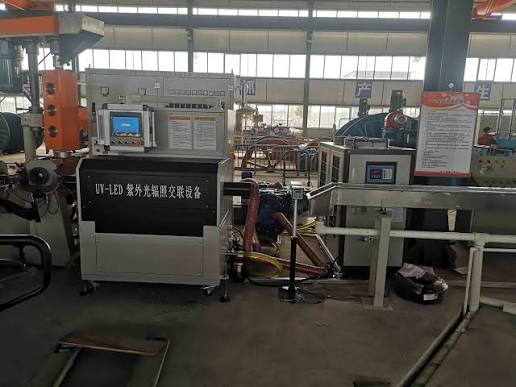
Electron beam irradiation cross-linking is currently the most prevalent curing method for PV cables. After the cable is extruded, a high-energy electron beam generated by an electron accelerator is used to irradiate the insulation and sheath materials. The high-energy electrons break the carbon-hydrogen bonds in the polymer molecular chains, generating free radicals. Cross-links then reform between adjacent molecular chains, thereby establishing a three-dimensional network structure. Irradiation cross-linking is a purely physical process that does not require the addition of chemical cross-linking agents. The process is clean, highly controllable, and ensures good batch consistency, making it the process commonly adopted for high-end photovoltaic cables today.
Silane Chemical Cross-linking
Silane cross-linking is a chemical cross-linking method. Silane coupling agents are added to the material formulation, and after extrusion, hydrolytic condensation reactions are promoted by steam or a warm water environment to induce cross-linking of the molecular chains. This process requires relatively low capital investment in equipment; however, the cross-linking process necessitates precise control of temperature and humidity, resulting in a longer production cycle. It is also used in photovoltaic cables.
Peroxide Chemical Cross-linking
Peroxide cross-linking involves decomposing the peroxides in the formulation under high-temperature, high-pressure conditions to generate free radicals, which initiate molecular chain cross-linking. This method is commonly used for XLPE insulation in medium- and high-voltage power cables but is relatively less common in the low-voltage, thin-wall insulation of photovoltaic cables.
Specific Effects of Curing on Photovoltaic Cable Performance
After cross-linking and curing, the performance of photovoltaic cables improves significantly compared to that of thermoplastic materials, primarily in the following aspects:
- Significantly improved temperature resistance: The continuous operating temperature of cross-linked materials can reach 120 degrees Celsius or even 125 degrees Celsius. The permissible short-term temperature during a short circuit is higher, and the cable will not melt or deform at high temperatures.
- Enhanced weather resistance and UV resistance: The cross-linked structure, combined with a UV-resistant formulation, allows the cable to be used long-term in outdoor environments with intense sunlight, meeting the 25-year service life requirement for photovoltaic systems.
- Improved mechanical properties: The material’s strength, tear resistance, and flexural durability have been enhanced, making it less prone to damage during installation and construction.
- Enhanced chemical stability: Resistance to acids, alkalis, ozone, and salt spray has been strengthened, making it suitable for corrosive environments such as coastal areas and industrial zones.
- Stable electrical performance: The insulation resistance of the cross-linked material remains stable, and its insulation performance degrades slowly during long-term operation, ensuring system safety.
It is important to emphasize that the cross-linking effect depends on whether the degree of cross-linking is sufficient. Insufficient cross-linking results in only limited improvements in material performance; only when the degree of cross-linking meets the required standards can the material truly exhibit thermosetting characteristics. Therefore, reputable manufacturers conduct tests—such as thermal elongation tests—on cross-linked materials to confirm that the degree of cross-linking complies with standard requirements.
The Relationship Between Curing and Photovoltaic Cable Standards
The cross-linking and curing effectiveness of photovoltaic cables is ultimately governed and verified by standards. Currently, the most widely adopted standard for PV cables in the international market is EN 50618, corresponding to the H1Z2Z2-K type; many PV projects worldwide use this standard as the basis for acceptance.
The EN 50618 standard sets clear requirements for cable insulation and sheath materials, mandating the use of cross-linked materials, and specifies performance criteria such as continuous operating temperature, UV resistance, ozone resistance, acid and alkali resistance, and flame retardancy.
In addition, IEC 62930 is another important international standard for photovoltaic cables, with technical requirements that are essentially consistent with those of EN 50618.
How to Determine Whether a Photovoltaic Cable Has Undergone Cross-linking Curing
For procurement personnel, determining whether a photovoltaic cable has truly undergone cross-linking curing—either on-site or during the sample review phase—can be approached from the following aspects.
- Check certification markings: Qualified photovoltaic cables should bear EN 50618 or IEC 62930 certification markings, as well as third-party certificates from organizations such as TÜV; this is the most authoritative basis for judgment.
- Check the printed information: The text printed on the cable jacket typically includes the model number H1Z2Z2-K, applicable standards, certification numbers, and manufacturer information. Clear and complete markings indicate that the product is traceable.
- Request test reports: Ask the supplier to provide thermal elongation test reports and cross-linking degree test data, as these serve as direct evidence to verify the effectiveness of the cross-linking process.
- Heat observation method: Heat a small section of the sheath material. Thermoplastic materials will soften, deform, or even melt, whereas cross-linked thermosetting materials will not melt when heated but will gradually discolor and age. This method can be used for preliminary assessment.
- Verify Material Names: Confirm that the product documentation specifies the use of cross-linked polyolefins, cross-linked polyethylene, or cross-linked HEPR, rather than standard PVC or standard PE.
Common Misconceptions Regarding the Curing of Photovoltaic Cables
- Using standard PVC cables as photovoltaic cables: PVC cables are not cross-linked, so their temperature resistance, UV resistance, and service life cannot meet the requirements of outdoor photovoltaic applications. Over time, they will crack and deteriorate, posing safety hazards.
- Assuming all PV cables are radiation-crosslinked: Some low-cost products may use chemical crosslinking or formulations that are not fully crosslinked, resulting in performance gaps compared to properly radiation-crosslinked products; verification through certifications and test reports is essential.
- Neglecting cross-linking degree testing: Relying solely on appearance and printed markings without requesting test data—such as thermal elongation—makes it impossible to confirm whether the cross-linking effect meets standards.
- Confusing temperature resistance ratings: Different PV cables have varying continuous operating temperature ratings. When selecting a cable, choose the appropriate rating based on the project’s actual ambient temperature; do not assume performance is consistent simply because the model numbers are the same.
- Neglecting low-smoke, halogen-free requirements: Modern PV projects generally require low-smoke, halogen-free, and flame-retardant materials; when purchasing, confirm that the materials meet the corresponding flame-retardant and halogen-free requirements.
Frequently Asked Questions
First, are “curing” and “drying” the same thing? No. “Drying” refers to the removal of moisture through heating and is an auxiliary process; “curing” refers to cross-linking and solidification, which alters the molecular structure of the material and is the core process that determines the cable’s performance rating.
Second, must PV cables be cross-linked? Yes. According to the EN 50618 and IEC 62930 standards, the insulation and sheath of PV cables must be made of cross-linked materials to meet the requirements for high-temperature resistance, UV resistance, and a 25-year service life.
Third, which is better: radiation cross-linking or chemical cross-linking? The irradiation cross-linking process is clean, precisely controlled, and highly consistent, making it the mainstream process for high-end photovoltaic cables today; chemical cross-linking requires a lower initial investment in equipment but demands higher control precision. The specific choice should be determined based on product certification and test data.
Fourth, how can one verify that a cable’s cross-linking degree meets requirements? The most reliable method is to review third-party certification certificates, thermal elongation test results, and cross-linking degree test reports; the cable is considered compliant if the test data meets the standard requirements.
Summary
Curing, or cross-linking, is the core process in photovoltaic cable manufacturing that transforms insulation and sheath materials from thermoplastic to thermosetting. Through electron beam irradiation or chemical cross-linking, the material’s molecular chains form a three-dimensional network structure, thereby achieving excellent properties such as high-temperature resistance, UV resistance, weather resistance, mechanical stress resistance, and flame retardancy. This is the foundation that enables photovoltaic cables to meet the 25-year service life requirement in harsh outdoor environments.