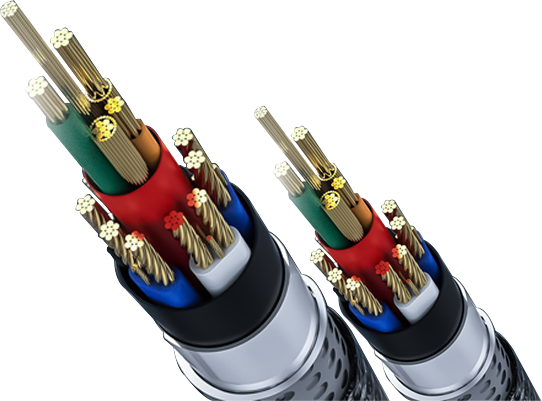
In modern electrical environments such as industrial automated workshops, data center server rooms, and new energy vehicle charging stations, the signal transmission stability of wires and cables directly determines the operating efficiency and safety of equipment. Electromagnetic interference (EMI) and radio frequency interference (RFI) act like invisible "signal killers." The former is caused by electromagnetic fields generated during equipment operation, while the latter comes from high-frequency signals such as radio waves. Both can lead to data transmission errors, equipment malfunctions, and even component burnout. Cable shielding technology, as a core means of resisting these interferences, not only ensures pure signal transmission but also enhances the mechanical strength of cables and improves their adaptability to extreme environments, playing an irreplaceable role in key areas such as industrial control, communication systems, and power distribution.
.jpg) The Core Role of Cable Shielding: More Than Just Interference Resistance
The Core Role of Cable Shielding: More Than Just Interference Resistance
A high-quality
cable shielding layer is not a single-function "protective film" but a "safety barrier" integrating multiple protections. Its core role can be summarized in five aspects:
Reducing Electrical Noise: Through the reflection and absorption of electromagnetic fields by the metal shielding layer, more than 80% of external interference energy can be filtered. The remaining energy is conducted to the ground through the grounding system, preventing interference signals from penetrating the conductor core. A steel company's ironmaking workshop previously experienced frequent disconnections between its PLC and remote I/O due to high-frequency interference. After replacing the cables with shielded ones, signal stability improved by 90%.
Preventing Signal Distortion: In long-distance transmission scenarios, unshielded cables can experience signal attenuation of 20%-30%, while shielding effectively reduces signal loss, ensuring the transmission accuracy of high-frequency signals or precision data. For example, after using high-coverage shielded cables in the lithography machines of semiconductor cleanrooms, wafer positioning accuracy was controlled within ±0.1μm.
Enhancing Mechanical Performance: The metallic shielding layer improves the cable's tensile and abrasion resistance, extending its service life in dynamic scenarios such as dragging and bending. After adopting shielded cables, a car manufacturing company resolved the issue of broken cores in its robot arm cables, reducing production line downtime by 40%.
Optimizing Grounding: The shielding layer, acting as a dedicated grounding path, eliminates "floating ground interference," forming a stable signal loop, especially in multi-device interconnected systems, preventing ground loop interference.
Enhanced Environmental Adaptability: In harsh environments such as high temperature, humidity, and corrosion, the shielding layer combined with a special sheath can form double protection. A chemical plant saw its cable lifespan extended threefold after adopting corrosion-resistant shielded cables.
When facing scenarios such as long-distance data transmission (over 100 meters), areas with dense high-voltage equipment (e.g., substations), and high-frequency precision instruments (e.g., medical imaging equipment), cable shielding changes from an "optional configuration" to a "mandatory requirement."
Comprehensive Analysis of Mainstream Cable Shielding Types
Different shielding structures have significantly different core materials and protective characteristics, and are suitable for different scenarios. The following are the six most widely used shielding types in the industrial field:
Foil Shielding (Aluminum/PET Composite Tape)
Structural Characteristics: Composed of aluminum foil and polyester (PET) film, it achieves 100% coverage of the conductor through spiral winding or longitudinal wrapping processes. The PET layer enhances the tear resistance of the aluminum foil, preventing damage during installation.
Core Advantages: Shielding effectiveness against high-frequency electric fields above 1MHz can reach 80dB, far exceeding other basic shielding types; weight is only 1/3 of traditional metal shielding, reducing cost by approximately 20%, making it particularly suitable for small-diameter cables or scenarios with limited wiring space.
Typical Applications: Local area network (LAN), Ethernet and other data cables; oscilloscope and other instrument cables; and audio and video transmission lines. In high-frequency interference environments such as semiconductor cleanrooms, foil-shielded cables are crucial for ensuring the operation of precision equipment.
Braided Shielding (Copper or Tinned Copper)
Structural Characteristics: Copper or tinned copper wire is interwoven into a mesh shielding layer, with a braiding density typically between 70% and 95%. Tin plating enhances corrosion resistance.
Core Advantages: Attenuation of low-frequency magnetic fields (50-200Hz) can reach 60dB; excellent mechanical strength, able to withstand frequent bending and dragging without damage; tinned copper material also enhances oxidation resistance, extending outdoor service life.
Typical Applications: Dynamic scenarios such as industrial control cables, coaxial cables, and robot motion cables. After adopting tin-plated copper braided shielded cables, the packet loss rate in PLC-robot communication at a car manufacturing plant's welding workshop decreased from 15% to 0.5%.
Spiral Shielding (Wound Metal Wire)
Structural Characteristics: Single or multiple metal wires are spirally wound around the conductor. The winding pitch can be adjusted according to flexibility requirements; a smaller pitch results in better shielding.
Core Advantages: Flexibility far exceeds braided shielding, capable of withstanding over a million bending cycles; terminal handling is simple and convenient. Although the shielding effectiveness is moderate (approximately 40-50dB), it is sufficient for typical dynamic scenarios.
Typical Applications: Medical equipment cables (such as surgical robots), wiring for moving instruments in automated production lines, and crane control system cables. After adopting spiral shielded cables, a crane equipment factory increased its replacement cycle to more than double.
Foil + Braided Composite Shielding
Structural Characteristics: The inner layer is an aluminum/PET composite foil providing full coverage, while the outer layer is a copper braided mesh for enhanced protection, forming a dual structure of "high-frequency protection + mechanical reinforcement."
Core Advantages: Combining the 100% coverage of foil shielding with the mechanical strength of braided shielding, it can achieve electromagnetic protection across the entire frequency band from 10kHz to 1GHz, with a shielding effectiveness of up to 90dB, making it the optimal solution for complex interference environments.
Typical Applications: Precision instruments (such as mass spectrometers), industrial automation control systems, radio station audio transmission lines, and high-speed data cables for 5G base stations. After adopting this type of cable on an electronics factory's SMT production line, signal stability improved by 120%.
Metal Armored Shielding (Steel Wire/Aluminum Armor)
Structural Characteristics: A layer of steel wire armor (SWA) or aluminum armor (STA) is wrapped around the cable sheath. Some products use a longitudinal steel tape wrapping process to enhance sealing.
Core Advantages: The core function is mechanical protection, resisting crushing, digging damage, and rodent infestation during underground installation, while also providing a certain degree of low-frequency shielding. It can withstand temperatures from -40℃ to 120℃, adapting to extreme outdoor environments.
Typical Applications: Power distribution cables, mining cables, outdoor street lighting wiring, and underground utility tunnel communication cables. After substations adopted armored shielded cables, the signal transmission error rate decreased from 10% to 0.1%.
How to Accurately Select Shielding Type? Six Core Dimensions + Comparison Table
Incorrect selection of shielding type may lead to two consequences: over-protection resulting in wasted costs (e.g., armored cables for ordinary offices increase costs by more than 50%), or insufficient protection causing equipment failure. A comprehensive evaluation from the following six dimensions is necessary:
Interference Intensity: For high-frequency, strong interference (e.g., radar stations), choose foil + braided composite shielding; for low-frequency interference (e.g., motor workshops), choose braided shielding; for no significant interference, choose basic foil shielding.
Signal Frequency: For high-frequency signals above 1MHz, foil shielding is preferred; for low-frequency signals (50-200Hz), braided shielding is recommended; for signals across the entire frequency band, composite shielding is mandatory.
Flexibility Requirements: For fixed installations, armored or braided shielding is recommended; for frequent bending (e.g., robotic arms), spiral shielding is recommended; for extremely cold environments, flexible shielding with a PUR sheath is recommended.
Installation Environment: For underground installations, armored shielding is recommended; for cleanrooms, foil shielding is recommended; for high-temperature workshops, nickel-plated braided shielding is recommended; for humid environments, waterproof shielding is recommended.
Cost Budget: For limited budgets, single-layer foil shielding is recommended; for medium budgets, braided shielding is recommended; for high-requirement scenarios, composite shielding is recommended.
Standards Compliance: For the North American market, UL 1429 compliance is required; for the European market, IEC 60228 compliance is required; for the medical field, ISO 10993 biocompatibility certification is required.
Key Industry Application Case Studies
The electromagnetic environment and installation conditions vary significantly across different industries, requiring customized shielding types based on specific scenario characteristics:
Telecommunications: 5G base stations utilize foil + braided composite shielded cables to ensure 10Gbps high-speed data transmission while mitigating radio frequency interference between base stations; power cables for fiber optic communication employ armored shielding to prevent damage during underground installation.
Industrial Automation: Automotive welding workshops experience significant low-frequency interference from numerous welding machines. Tinned copper braided shielded cables, combined with single-end grounding, enhance the signal-to-noise ratio of robot control signals to over 50dB; production line cable carrier systems utilize spiral shielded + PUR sheathed cables, capable of withstanding millions of bends without failure.
EV Charging and Vehicles: Charging pile cables employ an armored + braided composite structure, resisting outdoor weathering and shielding against high-frequency harmonic interference during charging; new energy vehicle wiring harnesses use foil shielding to reduce signal crosstalk between the battery management system and the motor controller.
Petrochemical Industry: Drilling platform instrument cables utilize corrosion-resistant Teflon sheaths and braided shielding, ensuring stable transmission in high-temperature (120℃) and highly corrosive environments. Oil pipeline monitoring systems use armored shielded cables to prevent mechanical damage caused by soil pressure.
Power System: Substations use armored shielded power cables with equipotential bonding at both ends, reducing the signal error rate from 10% to 0.1%. Nuclear power plant control areas use composite shielded cables to meet requirements for seismic resistance, radiation resistance, and full-band interference immunity.
Conclusion: Choosing the Right Shielding Means Choosing the Right Safety and Efficiency
Cable shielding selection is not about "the more expensive, the better," but rather "suitability is key." Appropriate shielding types can reduce equipment failure rates by more than 40%, extend service life by 2-3 times, and avoid unnecessary cost investments. Whether it's precision control in industrial workshops, high-speed transmission in data centers, or outdoor power distribution, three core factors must be evaluated first: interference source characteristics (frequency, intensity), installation environment (dynamic and static conditions, temperature and humidity, laying method), and performance requirements (transmission rate, reliability).