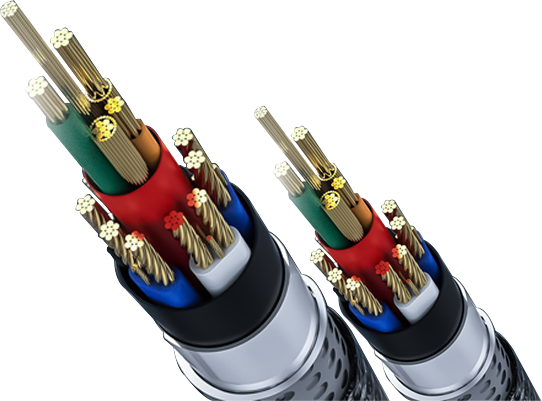
In industrial and commercial power engineering, cable selection directly determines the safety, stability, and cost-effectiveness of power supply systems. As widely used low-voltage power cables under the European standard system, NYY, N2XY, and NA2XY occupy significant positions in different scenarios due to their unique structural designs and performance advantages. This article comprehensively dissects the characteristics of these three cable types across core dimensions—structural differences, performance parameters, cost-effectiveness, and application scenarios—to provide professional guidance for electrical engineering design, construction, and procurement.
Introduction: The Critical Significance of Cable Selection
Industrial and commercial power demands are characterized by “high loads, complex environments, and extended operational cycles.” Selecting suitable cables not only ensures power supply safety but also reduces long-term operational and maintenance costs.
NYY, N2XY, and NA2XY are all low-voltage power cables compliant with DIN VDE 0276 and IEC 60502-1 standards, typically rated at 0.6/1kV and suitable for fixed installations. However, they exhibit significant differences in conductor material, insulation properties, and performance characteristics.
NYY cables offer core advantages in “cost-effectiveness + versatility,” making them the mainstream choice for residential and small commercial projects. N2XY cables leverage the superior performance of XLPE insulation, making them suitable for industrial high-load scenarios. NA2XY cables, featuring aluminum conductors, serve as a cost-optimized solution for large-scale projects. This article provides a systematic comparison to help readers precisely match cable types with application requirements.
Core Definitions and Design Positions of Category
NYY Cable: General-Purpose PVC Power Cable
NYY cable is a copper-core power cable featuring “PVC insulation + PVC sheath,” classified as a foundational product under European standards (DIN VDE 0276-602). It is designed as a “general-purpose fixed installation cable.” Featuring a simple structure and mature technology, it is widely used in residential buildings and small commercial spaces across Europe and globally. Its core characteristics are “high versatility, moderate cost, and easy installation,” meeting the power supply needs of most low-load, standard environments.
N2XY Cable: High-Performance XLPE Copper Cable
N2XY cable complies with DIN VDE 0276-603 standards, featuring an “XLPE (cross-linked polyethylene) insulation + PVC sheath” copper core structure. It represents an upgraded version of NYY cable. Positioned as a “high-load, long-life power cable,” it significantly enhances thermal resistance, electrical performance, and service life through optimized XLPE insulation. This makes it suitable for demanding applications such as industrial equipment and high-power circuits.
NA2XY Cable: Cost-Effective XLPE Aluminum Conductor Cable
NA2XY cable also complies with DIN VDE 0276-603 standards. As the aluminum conductor variant of N2XY, its structure comprises “XLPE insulation + PVC sheath + aluminum conductor.” Positioned as a “cost-optimized solution for large-scale projects,” it replaces copper conductors with aluminum. This maintains the high performance of XLPE insulation while substantially reducing material and installation costs, making it particularly suitable for low-voltage power supply systems involving long-distance, large-scale installations.
Structural Differences: Material Determines Performance Boundaries
The core distinctions among the three cable types stem from conductor material and insulation selection. All feature PVC sheathing, with structural design adhering to the classic concentric-layer configuration: “conductor - insulation - filler - sheath.” Specific variations are as follows:
Insulation Materials: Performance Gap Between PVC and XLPE
Insulation material is critical for determining a cable's heat resistance, electrical performance, and lifespan. The insulation differences among these three cable types directly define their application boundaries:
PVC Insulation (NYY Specific)
Material Properties: Polyvinyl chloride (PVC) compounded with plasticizers and stabilizers. Low cost and simple processing.
Operating Temperature: Long-term operating range -5°C to +70°C; short-term overload temperature ≤90°C
Electrical Properties: Insulation resistance ≥10¹²Ω・cm, dielectric strength ≥20kV/mm; suitable for low-voltage applications
Limitations: Poor heat resistance; prone to aging and cracking under prolonged high temperatures; releases toxic gases when burning; moderate environmental performance
XLPE Insulation (N2XY, NA2XY Specific)
Material Properties: Cross-linked polyethylene forms a three-dimensional network structure through chemical cross-linking, contains no plasticizers, and exhibits high stability.
Operating Temperature: Long-term operating temperature -20°C to +90°C, short-term overload temperature up to 130°C.
Electrical Properties: Insulation resistance ≥10¹⁴Ω・cm, dielectric strength ≥25kV/mm, low insulation loss.
Advantages: Significantly superior heat resistance and aging resistance compared to PVC; service life is 2-3 times longer than PVC insulation. Produces minimal smoke and releases no toxic gases when burning.
Sheath and Auxiliary Structure
The outer sheath of all three cable types is made of PVC with a thickness of 1.5-4mm. It offers weather resistance, abrasion resistance, and basic moisture protection, suitable for fixed installations such as underground and cable trenches. The filling layer uses polypropylene rope to fill gaps between conductors, ensuring cable roundness. Due to the slightly higher rigidity of XLPE insulation, N2XY and NA2XY cables have a filling layer 10%-15% thicker than NYY, enhancing bending performance.
Mechanical and Thermal Properties: Adapting to Diverse Installation Environments
Mechanical properties (flexibility, tensile strength) and thermal properties (heat resistance, thermal stability) determine cable installation difficulty and environmental adaptability.
Flexibility: NYY Optimal, NA2XY Least Flexible
Flexibility is jointly determined by conductor material and insulation hardness:
NYY: Copper conductor offers excellent flexibility (bending radius ≥ 6× cable outer diameter), PVC insulation is soft, resulting in the lowest overall bending difficulty. Suitable for installation in confined spaces.
N2XY: Copper conductor maintains flexibility (bending radius ≥ 8× cable outer diameter), XLPE insulation is slightly harder but does not affect standard installation. Overall flexibility is moderate.
NA2XY: Aluminum conductors have low tensile strength (only 50% of copper), poor flexibility (bending radius ≥10× cable outer diameter), prone to fracture from excessive bending; avoid frequent bending during installation.
Thermal Performance: XLPE Series Outperforms PVC
Thermal performance directly impacts cable reliability in high-temperature environments or overloaded conditions:
Temperature resistance: N2XY and NA2XY (-20°C to +90°C) offer a wider range than NYY (-5°C to +70°C). They resist brittleness in cold environments (e.g., outdoor winters) and aging in high-temperature settings (e.g., industrial workshops).
Thermal Stability: XLPE insulation has a heat deflection temperature ≥120℃, maintaining stable operation for 1 hour during overloads (e.g., 10% current exceeding rated value). PVC insulation has a heat deflection temperature of only 80℃, prone to softening and insulation failure under overload conditions.
Flame Retardancy: All three cable types offer flame-retardant options (ZR grade). However, XLPE insulation produces lower smoke density and toxicity than PVC, making it more suitable for densely populated areas.
Durability: XLPE series cables exhibit longer service life
Service life comparison under identical conditions:
NYY (PVC insulation): 15-20 years in standard environments; lifespan shortens to 10-15 years in humid or high-temperature conditions.
N2XY, NA2XY (XLPE insulation): 25-30 years in standard environments. Exceptional aging resistance and crack resistance ensure over 20 years of service life even in industrial corrosive environments.
Installation Considerations: Laying Methods and Practical Points
All three cable types are suitable for fixed installations, but installation requirements vary due to differences in weight, flexibility, and weather resistance:
Suitable Installation Methods
Direct Burial: All three types are suitable. N2XY and NA2XY, with superior corrosion resistance due to XLPE insulation, are better suited for moist soil or mildly corrosive environments. NA2XY offers significant weight reduction, lowering excavation and pulling costs.
Cable Trench/Conduit Installation: NYY offers superior flexibility for conduit pulling; N2XY and NA2XY require attention to bending radius to prevent insulation damage.
Outdoor Overhead Installation: Requires UV-protective sheathing. N2XY and NA2XY's XLPE insulation provides superior UV resistance compared to PVC, ensuring greater stability for long-term outdoor use.
Key Installation Parameters
Bending Radius: NYY ≥ 6D (D = cable outer diameter), N2XY ≥ 8D, NA2XY ≥ 10D (D = cable outer diameter)
Traction force: NYY (copper conductor) ≤3kN, N2XY (copper conductor) ≤3.5kN, NA2XY (aluminum conductor) ≤2kN (aluminum conductors have lower tensile strength; traction force must be controlled).
Weight Comparison: For the same cross-sectional area, NA2XY weighs only 30%-40% of NYY and N2XY. Large-scale installations can save over 50% in labor and equipment costs.
Joint Treatment Key Points
NYY: PVC insulation is easy to strip; standard crimp terminals are used for joints with moderate sealing requirements.
N2XY: XLPE insulation requires specialized stripping tools to prevent insulation cracking; terminals rated for temperatures above 90°C must be used for joints.
NA2XY: Aluminum conductors are prone to oxidation; joints require application of anti-oxidants and use of copper-aluminum transition terminals to ensure stable contact resistance.
Application Scenarios: Precise Matching of Requirements is Key
The application segmentation for these three cable types fundamentally balances “performance requirements” with “cost budgets.” Specific matching scenarios are as follows:
Core Applications of NYY Cable
Residential Buildings: Indoor wiring for homes and office buildings, low-load circuits like lighting, outlets, and air conditioning
Small Commercial: Power distribution systems for convenience stores, small supermarkets, and office buildings with stable loads and mild environments
Short-Term Projects: Power lines for temporary structures and leased factories with low lifespan requirements
Budget-Sensitive Projects: Small-scale construction, rural grid upgrades prioritizing minimal initial costs
Core Applications of N2XY Cable
Industrial Production: High-power equipment power supply in factory workshops (e.g., motors, machine tools), high-load continuous operation scenarios
Large Commercial: Power distribution trunk lines for shopping malls, data centers, and hospitals, demanding extreme reliability and safety.
Long-Distance Transmission: Main trunk lines for urban underground distribution networks and industrial parks, emphasizing low-loss requirements.
Special Environments: High-temperature workshops, damp basements, and other scenarios requiring superior insulation performance.
Core Applications of NA2XY Cable
Large-scale projects: Low-voltage distribution networks in major industrial parks and new urban developments, featuring long-distance and large-span installations
Renewable energy: Collection lines for photovoltaic power stations and wind farms, requiring outdoor installation with cost sensitivity
Rural grids: Long-distance distribution lines in remote areas, minimizing material and installation costs
Temporary infrastructure: Temporary power supply for large event venues and industrial parks, utilizing lightweight designs for rapid deployment

.jpg)