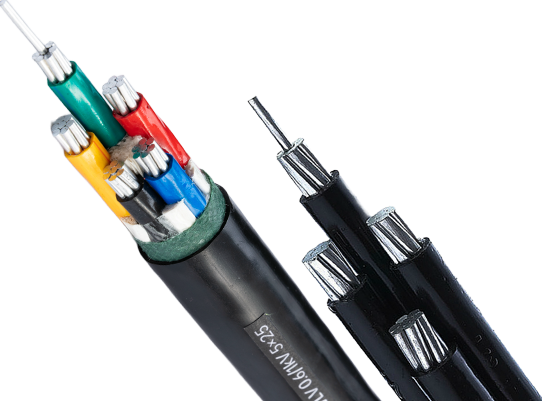
how-to-choose-the-number-of-cores-of-the-cable?
Basic Understanding: What is Cable Core Number?
The cable core refers to the insulated conductive wire inside the cable, which is the core component for transmitting current and electrical signals. The number of cable cores is the number of independent insulated conductors encapsulated in the same cable sheath. According to functional classification, cable cores are mainly divided into live wire (L), neutral wire (N), and protective ground wire (PE). Different core combinations correspond to different power supply systems and load working conditions.
In the electrical industry, cables are divided into power cables and control cables according to their uses, and their core number specifications are completely different. Power cables are mainly used for power transmission and distribution, with conventional core numbers including 1-core, 2-core, 3-core, 4-core, and 5-core, which are widely used in AC and DC power supply circuits. Control cables are used for equipment signal transmission and circuit control, with flexible core numbers ranging from 6 cores to 36 cores, and are mostly applied in industrial automation, mechanical equipment control, and instrument signal transmission scenarios.
It is worth noting that the core selection must strictly comply with national and international electrical standards such as GB 50217-2018 <Code for Design of Electric Power Engineering Cables>. The standard clearly defines the matching relationship between cable core numbers and power supply systems, which is the fundamental basis for standardized cable selection.
Core Principles for Choosing Cable Core Number
Cable core selection cannot rely on experience or random selection. It must follow four core principles: system matching, safety priority, scene adaptation, and economic rationality. These four principles run through the entire cable selection process and effectively avoid common selection errors.
Power Supply System Matching Principle
The power supply system type is the primary factor determining the cable core number. Low-voltage power supply systems are mainly divided into TN-C, TN-S, and TT systems, and different systems have strict corresponding core number requirements. The core difference lies in whether the neutral wire (N) and protective ground wire (PE) are independent or shared, which directly determines the selection of 3-core, 4-core, or 5-core cables.
Operational Safety Priority Principle
Electrical safety is the bottom line of cable selection. The core number must meet the grounding protection and leakage prevention requirements of the circuit. For electrical equipment with metal shells, high-power loads, and humid working environments, independent grounding cores must be configured to ensure that the equipment can quickly release static electricity and fault current, avoiding electric shock accidents and equipment damage caused by leakage current.
Usage Scene Adaptation Principle
Different wiring environments and load types put forward differentiated requirements for cable cores. Residential lighting, household appliances, industrial motors, high-power mechanical equipment, and weak current signal control circuits have completely different core matching schemes. Meanwhile, special environments such as underwater laying, underground pipe gallery, and mine engineering also need to adjust the core selection scheme according to environmental characteristics.
Economic Rationality Principle
On the premise of meeting safety and functional requirements, avoid excessive core redundancy and core shortage. Excess core configuration will increase cable purchase and laying costs and cause resource waste; insufficient cores will lead to circuit transformation and rework, increasing hidden engineering costs. Reasonable core selection can balance safety and economy and maximize project benefits.
Key Factors Affecting Cable Core Number Selection
In actual engineering selection, it is necessary to comprehensively judge multiple key factors to ensure that the selected cable core number is fully adapted to the project demand. The main influencing factors are as follows:
Power Supply System and Phase Number
Single-phase power supply and three-phase power supply have completely different core requirements. Single-phase circuits are mostly used in household and small commercial scenarios, relying on live wire and neutral wire to form a power supply loop, and need to be equipped with grounding cores according to the environment. Three-phase circuits are applied to industrial high-power equipment and three-phase power distribution projects, and the core number is matched according to the balance of three-phase load and the setting of grounding wires.
According to the provisions of GB 50217-2018, TN-C system (neutral wire and ground wire shared) adopts 4-core cables; TN-S system (neutral wire and ground wire completely independent) adopts 5-core cables; three-phase balanced load without neutral wire demand can adopt 3-core cables, which is the standard basis for three-phase cable core selection.
Load Type and Power Characteristics
Loads are divided into balanced loads and unbalanced loads. Three-phase balanced loads such as industrial fans, water pumps, and compressors have basically equal current of each phase, no need for neutral wire, and can use 3-core power cables. For unbalanced loads such as commercial lighting, household power distribution, and multi-device mixed operation, three-phase current is unbalanced, and neutral wire must be configured to balance voltage and current, so 4-core or 5-core cables are required.
In addition, high-power loads and loads with harmonic generation need to prioritize 5-core cables with independent PE wires. Harmonic current will cause neutral wire voltage deviation, and independent grounding protection can effectively improve circuit stability and avoid equipment failure.
Working Environment and Wiring Conditions
The environmental humidity, corrosiveness, and laying mode directly affect the core selection. In humid environments such as bathrooms, basements, and outdoor open-air wiring, and corrosive environments such as chemical plants and coastal areas, cables with independent grounding cores must be selected to enhance leakage protection performance. For long-distance laying and underwater laying projects, single-core or multi-core cables with stable performance can be selected according to current transmission demand to reduce intermediate joints and circuit failures.
Circuit Function and Control Demand
Power transmission circuits and signal control circuits have different core selection logics. Power cables focus on power transmission, with fixed core combinations; control cables focus on signal transmission and circuit control, and the core number is determined by the number of control loops and signal types. For multi-channel signal transmission and remote control circuits, it is necessary to reserve redundant cores on the basis of meeting basic functions to facilitate subsequent equipment debugging and circuit expansion.
Complete Selection Guide for Common Cable Core Numbers
Combined with industry standards and actual engineering scenarios, the following is a detailed analysis of the applicable scenarios, advantages and selection points of all conventional core cables, covering all common wiring scenarios from household to industrial use.
Single-core Cable
Single-core cable is a single independent conductive core cable, which is mainly suitable for high-voltage power transmission, low-voltage DC power supply circuits, and long-distance large-current transmission scenarios. In AC circuits, single-core cables are mostly used in special high-current equipment circuits. Due to the single-core structure, it has the advantages of large current-carrying capacity, strong heat dissipation, and simple laying. It is often used in underwater laying and large-scale power distribution main line projects where intermediate joints need to be reduced. It should be noted that single-core cables cannot form an independent power supply loop alone and need to be used in pairs or matched with other wires.
Two-core Cable
Two-core cables consist of live wire and neutral wire, without grounding core, and are suitable for 1kV and below single-phase pure power supply circuits. Typical scenarios include indoor lighting circuits, small low-power electrical equipment, and simple DC power supply loops. This type of cable is low in cost and simple in wiring, but has no grounding protection function, so it is only applicable to dry, closed, and non-electric-risk environments, and is prohibited for electrical equipment with metal shells and outdoor open-air wiring.
Three-core Cable
Three-core cables are divided into two types: single-phase three-core (L+N+PE) and three-phase three-core (three live wires). Single-phase three-core cables are the mainstream for household socket wiring, adding an independent grounding core on the basis of live and neutral wires, which is safe and reliable, and suitable for household appliances, kitchen and bathroom electrical equipment with metal shells. Three-phase three-core cables are applicable to three-phase balanced load equipment such as industrial motors, fans, and water pumps. Since the three-phase current is balanced, no neutral wire is needed, and only three live wires are required to complete power transmission, which is the most cost-effective choice for industrial balanced load wiring.
Four-core Cable
Four-core cables adopt the 3L+PEN or 3L+N structure, which is the special matching cable for TN-C power supply system. The four cores are three live wires plus a shared neutral and protective ground wire, or three live wires plus an independent neutral wire. It is mainly used for three-phase unbalanced load circuits in industrial workshops, old building power transformation, and general industrial power distribution. Compared with 5-core cables, 4-core cables have lower cost and simpler wiring, but the integration of neutral wire and ground wire leads to relatively weaker safety protection performance, so they are not suitable for high-precision equipment and high-safety standard scenarios.
Five-core Cable
Five-core cables (3L+N+PE) are composed of three live wires, one independent neutral wire, and one independent protective ground wire, which is the standard matching cable for TN-S power supply system. This structure completely separates the neutral wire and ground wire, with independent voltage balance and leakage protection functions, and has extremely high circuit stability and safety. It is widely used in high-standard scenarios such as modern commercial buildings, intelligent buildings, medical equipment, precision electronic equipment, and new energy projects. It can effectively avoid harmonic interference, leakage current impact, and ensure the stable operation of high-precision electrical equipment, and is the preferred cable for new industrial and civil wiring projects.
Multi-core Control Cable (6-36 Cores)
Multi-core control cables are specially used for equipment signal control and weak current transmission. The core number is flexibly selected according to the number of control loops. The conventional selection principle is "functional matching + proper redundancy". For single-loop start-stop control equipment, 6-10 core cables can be selected; for multi-channel signal detection and remote control equipment, 12-24 core cables are matched; for complex automated production lines and instrument monitoring systems, 30-36 core cables are required. It is necessary to reserve 1-2 redundant cores during selection to facilitate later circuit maintenance and function expansion.
Common Selection Mistakes and Avoidance Methods
In actual engineering construction, many safety hazards and cost waste are caused by incorrect core selection. The following are the most common mistakes and standardized avoidance schemes:
First, cancel the grounding core blindly to save cost. Many constructors replace 3-core single-phase cables with 2-core cables and 5-core industrial cables with 4-core cables in order to reduce costs. This behavior will completely lose the leakage protection function, which is extremely easy to cause electric shock accidents and equipment shell electrification, and does not meet national electrical specifications. In all scenarios with metal equipment shells, humid environments, and high safety requirements, independent grounding cores must be retained.
Second, ignore the load balance to select cores arbitrarily. Using 3-core cables for three-phase unbalanced loads will lead to unbalanced three-phase voltage, equipment heating, and frequent tripping; using 4-core cables for precision equipment will cause signal interference and unstable operation due to the integration of neutral and ground wires. It is necessary to judge the load balance first before selection, and match the core number according to the system type.
Third, excessive redundancy leads to cost waste. Some projects blindly select high-core cables regardless of actual demand. For example, using 5-core cables for three-phase balanced load equipment and multi-core control cables for single-signal circuits, which greatly increases the project cost. On the premise of meeting safety and functions, the core number should be selected accurately to avoid redundant waste.
Fourth, confuse power cables and control cables. Power cables are used for strong current power transmission, and control cables are used for weak current signal control. Cross-use will cause signal distortion and current overload, and the two types of cables must be strictly distinguished and selected according to circuit functions.
Standardized Selection Steps for Cable Cores
To ensure accurate and standardized selection, follow these five steps in sequence for all cable wiring projects:
Step 1: Confirm the circuit attribute. Distinguish whether the circuit is a strong current power transmission circuit or a weak current control circuit, and determine the basic cable type (power cable or control cable).
Step 2: Clarify the power supply system. Judge the system type (TN-S/TN-C/TT) of the project, and initially match the optional core number range according to national standards.
Step 3: Analyze the load characteristics. Confirm single-phase/three-phase power supply, load balance, equipment precision and safety requirements, and screen the core number that meets the load operation conditions.
Step 4: Combine the usage environment. Adjust the core scheme according to environmental humidity, corrosiveness, and laying mode to ensure environmental adaptation and safety.
Step 5: Optimize economy. On the premise of meeting specifications and safety, eliminate redundant cores, properly reserve redundant cores for control circuits, and complete the final core selection.
Conclusion
The selection of cable core number is not a random choice, but a standardized technical work based on electrical system specifications, load characteristics, and usage scenarios. The core selection logic can be summarized as follows: single-phase household safe wiring prefers 3-core cables, three-phase balanced industrial loads choose 3-core cables, TN-C power distribution systems match 4-core cables, high-standard TN-S systems and precision equipment must use 5-core cables, and control cables are matched with core numbers according to control loops and reserve redundant cores appropriately.
Standard cable core selection is the basis for ensuring the safe, stable, and long-term operation of electrical circuits. Every engineering practitioner must abandon empirical selection habits, strictly follow GB 50217-2018 and other industry standards, and comprehensively consider system matching, safety performance, scene adaptation and economic benefits. Only accurate core matching can effectively avoid electrical faults, reduce engineering costs, and ensure the safe and efficient operation of all electrical wiring projects.