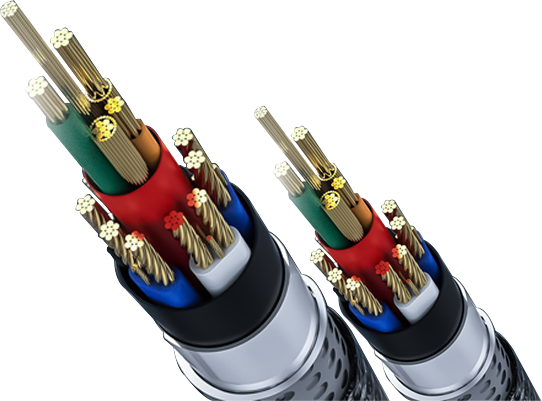
Overview of Bare Conductor
What is a bare conductor?
A bare conductor is a metal conductor without insulation, offering superior heat dissipation and conductivity without insulation barriers. Primarily made of copper, aluminum, or their alloys, it has become the fundamental medium for power transmission due to its simple structure, cost-effectiveness, and easy installation.
Why Does Bare Conductor Still Dominates Modern Power System?
In today's highly advanced insulation cable technology, bare conductors have not been phased out but instead occupy a core position in high-voltage and ultra-high-voltage power transmission scenarios. The key reasons are: under high-voltage conditions, insulation layers are prone to aging and breakdown, resulting in extremely high maintenance costs; whereas bare conductors dissipate heat naturally through air, enabling them to withstand higher current densities. Additionally, fault diagnosis is straightforward and repair costs are low, making them particularly suitable for the rigid demands of long-distance, high-capacity power transmission.
The Typical Application of Bare Copper Conductor
With a conductivity exceeding 99.9%, bare copper conductors are extensively utilized in overhead transmission lines, substation grounding systems, industrial busbars, and railway electrification contact networks. Their irreplaceable nature is particularly evident in critical applications where stringent requirements for conductivity and mechanical stability are imposed.
Introduction to HDBC (Hard Draw Bare Conductor)
HDBC (Hard-Drawn Bare Conductor), a core type of bare copper conductor, is reinforced through cold-drawing to achieve high tensile strength and stable conductivity. This makes it the preferred conductor for high-voltage overhead lines and grounding systems.
HDBC Definition and Core Concepts
The full definition of HDBC
HDBC (Hard-Drawn Bare Conductor), also known as 'hard-drawn bare conductor' in Chinese, is a bare conductor made from high-purity electrolytic copper through continuous cold-drawing without annealing. It features high mechanical strength and stable conductivity, making it ideal for long-term fixed installations.
The Technical Essence of the Process of "Dead lift"
"Cold drawing" is a cold working process in metal fabrication that applies tensile force to copper rods at room temperature, gradually reducing their cross-sectional dimensions through die pressing. During this process, the copper's crystal structure undergoes plastic deformation, resulting in grain refinement and denser arrangement, which significantly enhances tensile strength and hardness while simultaneously reducing ductility. Compared to hot working, cold drawing eliminates the need for high-temperature heating, thereby preserving copper's electrical conductivity to the greatest extent and achieving higher production efficiency.
Core Difference of Hard, Medium and Soft Tension Copper Conductor
The essential difference of the three lies in the processing technology and the subsequent heat treatment:
Hard drawing (HDBC): a cold-drawing process without annealing, with a tensile strength of ≥400MPa and elongation of ≤10%, offering the highest hardness but the poorest flexibility.
Cold-drawn with mild annealing, featuring tensile strength of 250-350MPa and elongation of 15%-25%, achieving a balance between strength and flexibility.
Soft drawing (annealing): After cold drawing, complete annealing is performed, with tensile strength ≤220MPa and elongation ≥30%. It exhibits excellent flexibility but the lowest strength.
Naming of Typical Products in International Market
While global market nomenclature for hard-drawn bare conductors varies, the core meanings are consistent: HDBC (a universal abbreviation), HD Copper Conductor, and Hard Drawn Copper Wire. Among these, HDBC has become the industry-standard term due to its conciseness.
HDBC Manufacturing Process
Material selection of copper rod: purity determines the upper limit of performance
The raw material for HDBC must be electrolytic copper rods with a purity of ≥99.9% (Cu+Ag content), and the total impurity elements (such as Fe, Pb, S) must be controlled below 0.05% — impurities can significantly reduce conductivity and affect mechanical properties. Additionally, the oxygen content must be strictly controlled within 200 ppm, as excessive oxygen can cause copper rods to become brittle at high temperatures, compromising the stability of subsequent drawing processes.
Tension Drawing Process: Strength Revolution of Cold Working
HDBC employs a continuous cold-drawing process without intermediate annealing. The copper rod undergoes multi-stage die reduction, with each pass maintaining a 15%-25% surface reduction rate. During the drawing process, the copper's tensile strength increases proportionally with the reduction rate, achieving a final tensile strength of 400-480MPa—more than twice that of soft-drawn copper. Simultaneously, the hardness (HV) rises to 120-140, ensuring wind sway resistance and tensile strength during overhead installation.
Surface Treatment: Oxidation Control of Bare State
The HDBC product features a bare copper surface with a pale red metallic luster and surface roughness of Ra≤0.8μm. Hard-drawn copper exhibits a slower oxidation rate than soft-drawn copper—this is attributed to denser grain structure post-cold working, which increases oxygen diffusion resistance. However, prolonged exposure to humid or industrial-polluted environments still leads to the formation of a copper oxide film (CuO/Cu₂O). Notably, the oxide film typically measures ≤5μm in thickness, exerting minimal impact on conductivity while providing some anti-corrosion benefits.
Mechanical and Electrical Characteristics of HDBC
Tensile strength: 400-480MPa (adjustable based on cross-sectional dimensions), significantly exceeding the ≤220MPa limit of soft-drawn copper, meeting the high-tension requirements for overhead lines.
The elongation is ≤10%, which is a low ductility material, the deformation before fracture is small, and the impact resistance is weak;
Conductivity: ≥97% IACS (International Annealed Copper Standard), only marginally lower than soft-drawn copper (≥100% IACS), with virtually no compromise in electrical performance.
Anti-creep property: Excellent-The dense grain structure after cold working inhibits creep deformation at high temperature, and the creep elongation is ≤0.5%/1000h during long-term high temperature (≤100℃) operation.
Aerial sag performance: The sag is only 60%-70% of that of soft-drawn copper. Under the same span and tension, HDBC has a smaller sag, which reduces the required tower height and lowers project costs.
Comparison of Drawing State of Bare Copper Conductor
Hard-Drawn Bare Copper Conductor (HDBC)
Hard-drawn bare copper conductors are produced by continuous cold drawing without annealing, resulting in high tensile strength, low elongation, and limited flexibility. Although electrical conductivity is slightly lower than that of annealed copper, it is sufficient for power transmission. Thanks to excellent sag resistance and structural stability, HDBC is mainly used in overhead transmission and distribution lines, where mechanical strength is a key requirement.
Medium-Drawn Copper Conductor
Medium-drawn copper conductors are cold-drawn and partially annealed to achieve a balance between strength and ductility. They offer moderate tensile strength, medium elongation, and improved flexibility, while maintaining relatively high conductivity. This makes them suitable for grounding, earthing systems, and certain power distribution applications that require both mechanical reliability and limited flexibility.
Soft-Drawn (Annealed) Copper Conductor
Soft-drawn copper conductors are fully annealed after drawing, providing the highest electrical conductivity, excellent flexibility, and high elongation, but lower mechanical strength. These properties make annealed copper ideal for insulated cables, control cables, and electrical windings, especially in installations involving frequent bending or restricted spaces.
Key Differences Between HDBC and Other Bare Conductors
HDBC vs Annealed Bare Copper: Annealed bare copper is the 'softened version' of HDBC—recovered flexibility through high-temperature annealing, but with strength reduced by over 50%. HDBC excels in mechanical stability, while annealed copper offers greater installation flexibility. Neither has an absolute advantage; they simply suit different scenarios.
HDBC versus medium-hard drawn copper: Medium-hard drawn copper serves as a 'middle ground' solution, offering balanced strength and flexibility. However, HDBC demonstrates greater cost efficiency in overhead scenarios — for the same span, HDBC can adopt a thinner cross-section, thereby reducing material costs.
HDBC vs Bare Aluminum Conductor (AAC): Aluminum conductors weigh only 30% of copper but deliver just 61% of IACS conductivity. HDBC outperforms AAC by 1.6 times in conductivity efficiency while offering superior corrosion resistance and creep resistance. However, AAC's lightweight design makes it ideal for ultra-high voltage and long-span transmission lines (reducing tower load). These two materials thus form a complementary solution for high-voltage applications.
HDBC vs ACSR/AAC: ACSR (Aluminum Conductor with Steel Core) enhances strength through steel core while aluminum conductors deliver conductivity, offering lightweight and cost-effective advantages but with only 58% conductivity compared to IACS. HDBC provides higher conductivity and easier maintenance, though its weight exceeds ACSR by over 2.5 times. ACSR is ideal for ultra-long-distance and heavily ice-affected areas, whereas HDBC excels in medium-to-short-distance applications requiring high conductivity.
Core application scenarios of HDBC
HDBC's application scenarios are highly specialized for "fixed installations with stringent mechanical and electrical conductivity requirements":
Overhead transmission and distribution lines: The core conductors of medium and high-voltage lines, which reduce tower height and project costs due to their high tensile strength and low sag.
Grounding and lightning protection system: The preferred grounding network for substations and power plants-high conductivity ensures rapid discharge of lightning currents, while mechanical strength resists soil settlement and external impacts.
Railway electrification: The contact wire conductor is a critical component, featuring strong resistance to wind sway and tensile forces, and is designed to withstand the friction and vibrations generated during high-speed train operation.
Industrial power networks: busbar systems in large factories and metallurgical enterprises, featuring high conductivity to reduce energy consumption, and mechanical stability designed for long-term heavy-load operation.
Lightning protection systems: Lightning arresters for buildings and bridges, featuring a bare design to ensure unimpeded transmission of lightning current.
HDBC Standard and Specification
The production and selection of HDBC must comply with both international and domestic standards.
IEC 60228: The International Electrotechnical Commission standard specifies the dimensions, conductivity, and mechanical performance requirements for bare copper conductors.
ASTM B3: The American Society for Testing and Materials standard, specifically addressing technical parameters and testing methods for hard-drawn copper wire.
National standards: GB/T 3953 (Electrical Round Copper Wire) and GB/T 1179 (Overhead Stranded Wire), which specify the size range (0.5-50mm²) and performance specifications of HDBC.
Common specifications: Diameter range 0.8-16mm (single-core), stranded wire cross-section 10-1200mm² (multi-core); AWG size 14-4/0 (equivalent cross-section 2.08-107mm²).
Advantages and Limitations of HDBC
Advantage:Hard Power for Core Value
Outstanding mechanical strength: Its tensile strength exceeds twice that of soft-drawn copper, with exceptional resistance to wind loads and ice/ice雹 impact, making it ideal for long-term outdoor fixed installations.
Excellent sag performance: With the same span, it achieves smaller sag, reduces tower investment, and decreases the area occupied by the line corridor.
Long service life: The oxide film on bare copper is stable, with corrosion resistance superior to aluminum conductors, enabling outdoor service life exceeding 30 years.
The cost-effectiveness is outstanding: In overhead scenarios, the same conductivity as flexible copper can be achieved by reducing the cross-sectional area, while material costs are reduced by 15%-20%.
Limitations:Compromises of Rigid Traits
Extremely poor flexibility: elongation ≤10%, incapable of small-radius bending, requiring strict bending radius control (≥15 times conductor diameter) during installation.
Not suitable for repeated bending: Repeated bending may cause cracks or even fractures, making it unsuitable for mobile devices or scenarios involving frequent disassembly.
Incompatible insulation coating: The high surface hardness of hard-drawn copper makes it prone to issues like poor adhesion and accelerated aging during insulation layer application, making it unsuitable for insulated cables
How to choose the right bare conductor?
Preferred scenarios for HDBC: overhead power transmission and distribution lines, fixed grounding grids, and industrial busbars with long-term operation, where frequent adjustments are unnecessary after installation.
Scenarios for selecting pull/pull copper: factory wiring requiring minimal bending, equipment connection cables, and flexible ground leads.
Environmental and Mechanical Considerations: For humid and corrosive environments, HDBC (copper's superior corrosion resistance compared to aluminum) is the preferred choice; for large-span and heavy-ice areas, ACSR is an option; lightweight applications may require AAC/AAAC.
Cost vs Performance Analysis: Aluminum conductors are available for short-term installation and low-load scenarios. For long-term operation and high-conductivity requirements, HDBC offers lower lifecycle costs (energy and maintenance savings far exceed the initial material price difference).
Installation and Operation Notes
Tension control: During wire laying, the tension should be maintained below 40% of the tensile strength to prevent permanent deformation caused by overstretching.
Bending radius: For single-core HDBC, the bending radius must be ≥15 times the conductor diameter; for stranded wires, it must be ≥20 times. Sharp-angle bending is strictly prohibited.
Connection and clamping: Use crimping or brazing for connection, with the contact surface polished clean (to remove oxide film) and moderate clamping force (to avoid conductor damage).
Storage and transportation: Avoid damp and saline-alkali environments. Elevate the storage area to prevent moisture, and protect the surface from collisions and scratches during transportation.
Conclusion
As the core type of rigid-drawn bare conductors, HDBC (High-Density Bare Conductor) has become an indispensable component in power infrastructure, combining "high mechanical strength with near-full conductivity." Compared to flexible-drawn copper, aluminum conductors, and ACSR (Aluminum-Copper-Silver-Rhodium), HDBC's competitive edge lies in its stability and cost-effectiveness for overhead applications. While less flexible, its advantages in fixed installations and long-term operations far outweigh its limitations.
Amid the accelerated energy transition and surging power demand, HDBC will remain the preferred conductor for high-voltage transmission and distribution, lightning protection grounding, and industrial power networks, thanks to its mature manufacturing processes, clear standards, and extensive application validation, ensuring the safety and efficiency of power systems.