What Is YJV Cable? Complete Guide to XLPE Power Cable & Buying Tips
What is YJV cable?
Introduction
YJV cable, officially designated as Cross-linked Polyethylene Insulated Polyvinyl Chloride Sheathed Power Cable, serves as a cornerstone product in power transmission and distribution systems. With its exceptional electrical performance and environmental adaptability, it has become the preferred cable type for industrial facilities, urban infrastructure, and commercial buildings. In power engineering, cable reliability directly determines system stability. YJV cables, renowned for their heat resistance, extended service life, and high safety standards, are widely utilized across scenarios ranging from low-voltage distribution to medium-voltage transmission. When selecting reliable power cables for projects, gaining in-depth understanding of YJV cable technical specifications, selection methodologies, and application scenarios will enable you to make more informed decisions.
Analysis of the Meaning of YJV Letters
The model naming of YJV cables follows the logic of China GB/T standards, where each letter corresponds to specific structural components and has a clear correspondence with international standards (IEC/BS), facilitating cross-scenario application references.
Core definitions of each letter
- Y: Refers to the cross-linked polyethylene (XLPE) insulation layer, which represents the core technological highlight of YJV cables. Through chemical or physical cross-linking processes, polyethylene molecules form a three-dimensional network structure, significantly enhancing heat resistance and insulation stability.
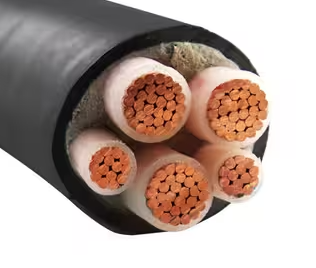
- J: Refers to copper conductors (Class 1 or Class 2). Copper, with its high conductivity and low resistance loss, is the predominant conductor material for power cables, ensuring efficient electrical energy transmission.
- V: Refers to the polyvinyl chloride (PVC) outer sheath, which primarily provides mechanical protection, moisture resistance, and chemical corrosion resistance to safeguard the cable's internal structure from external environmental damage.
Comparison of Standard Naming Between China and Foreign Countries
The naming logic of China GB/T standards focuses on materials and structural characteristics, while international standards (such as IEC 60502 and BS 6724) place greater emphasis on performance parameter labeling. For example, YJV cables in IEC standards correspond to XLPE insulated, PVC sheathed copper-core cables. Although the model descriptions differ, the core structure remains consistent. In BS standards, similar products are labeled in forms such as "XLPE/PVC/SWA", where SWA corresponds to the armored layer structure.
Structural Composition of YJV Cable
The YJV cable features a layered design where structural layers work synergistically to achieve optimal balance between electrical performance, mechanical strength, and environmental adaptability.
Electric conductor
The core material is high-purity copper, categorized into Class 1 (solid conductor) and Class 2 (stranded conductor). Stranded conductors exhibit greater flexibility, facilitating installation. Copper conductors achieve a conductivity rate exceeding 97%, with resistance losses significantly lower than aluminum conductors, effectively reducing heat generation during power transmission and enhancing system efficiency.
Insulating course
Cross-linked polyethylene (XLPE) material offers the following outstanding advantages: it allows long-term operating temperatures up to 90°C, which is 20°C higher than traditional PVC insulated cables; its dielectric loss value ranges only from 0.0002 to 0.0005, ensuring stable insulation performance; and it exhibits strong anti-aging properties, resisting degradation in ultraviolet and oxygen environments, thereby extending the cable's service life.
Sheath
The outer layer consists of polyvinyl chloride (PVC) sheathing, which exhibits excellent mechanical strength to withstand compression and friction damage during installation and use. It also possesses moisture-resistant and acid/alkali-resistant properties, making it suitable for various complex environments.
Optional feature layer
To meet specific application requirements, YJV cables can incorporate specialized functional layers: The armor layer (YJV22 features steel tape armor, while YJV32 uses steel wire armor) enhances compressive and tensile strength, making them ideal for direct underground installation. The flame-retardant layer (ZR-YJV) suppresses fire spread through flame retardant additives. The fire-resistant layer (NH-YJV) employs mica tape wrapping to maintain power supply for up to 90 minutes during fires. The low-smoke halogen-free sheath (WDZ-YJY) releases no toxic gases when burning, ensuring safety in densely populated areas.
Core technical parameters
The technical specifications of YJV cables determine their applicable scenarios and operational safety, with the key performance indicators as follows:
Rated voltage
Standard models cover low-voltage (0.6/1kV) and medium-voltage (up to 35kV) categories. The 0.6/1kV models are widely used in building power distribution and industrial equipment supply, while medium-voltage models are employed in urban distribution networks and long-distance transmission scenarios such as renewable energy power stations.
Temperature tolerance
The normal operating temperature is 90°C, and it can withstand temperatures up to 250°C during short circuits (with a maximum duration of 5 seconds), without experiencing insulation layer breakdown due to transient overloads.
Installation Requirements
The minimum bending radius shall not be less than 15 times the cable's outer diameter to prevent insulation layer damage during installation. This design is suitable for various installation methods including direct underground burial, cable trenches, cable trays, and pipelines. Among these, armored models (YJV22, YJV32) are particularly suitable for direct underground burial or environments prone to mechanical damage.
Classification of YJV Cable
Based on structural and performance differences, YJV cables can be classified into the following categories to meet diverse application requirements:
Configure by core count
- Single-core design: Ideal for high-voltage transmission or high-current applications, effectively reducing eddy current losses typical of multi-core cables.
- Multi-core configurations include 2-core (single-phase power supply), 3-core (three-phase power supply), 4-core (three-phase + neutral line), and 5-core (three-phase + neutral line + protective ground wire). Among these, the 4-core and 5-core models are the mainstream choices for building power distribution and industrial facilities.
Classify by protection level
- Unarmored (YJV): Lightweight design, ideal for indoor cable trays and pipeline installation.
- Steel tape armor (YJV22): Featuring exceptional compressive strength, it is ideal for direct underground burial and cable trench installation.
- Steel wire armor (YJV32): With high tensile strength, it is suitable for installation in complex terrains such as underwater and mountainous areas.
Classify by performance level
- Standard type (YJV): Sufficient for basic power transmission requirements;
- Flame-retardant type (ZR-YJV): Classified into three grades (A, B, and C), with Grade A offering optimal flame-retardant performance, suitable for applications such as subways and hospitals.
- Fire-resistant type (NH-YJV): Maintains power supply during fires, used for fire suppression systems and emergency exit lighting;
- Low-smoke halogen-free type (WDZ-YJV): Environmentally friendly and non-toxic, suitable for high-rise buildings and data centers.
Typical application scenarios
The comprehensive performance of YJV cables enables them to meet power transmission requirements across multiple applications:
- Power transmission and distribution systems: urban distribution network upgrades, outgoing cables from substations;
- Industrial facilities: factory production lines, heavy machinery, and power supply for chemical industrial parks, particularly suitable for high-temperature and high-load environments;
- Construction Engineering: Main distribution lines for commercial complexes, office buildings, and residential communities, with certain flame-retardant/fire-resistant models utilized in fire protection systems.
- Underground engineering: Power transmission systems for urban underground utility tunnels, tunnels, and subways, where armored models can withstand soil pressure and corrosion.
- New Energy Projects: DC/AC cables for photovoltaic power stations and wind farms, designed to withstand harsh outdoor environments.
Core Advantages of YJV Cable
Compared to other types of power cables, YJV cables demonstrate distinct advantages in the following aspects:
- Higher current-carrying capacity: XLPE insulation provides superior heat dissipation compared to PVC. For cables with identical cross-sectional area, YJV cables demonstrate 20%-30% higher current-carrying capacity than VV cables.
- Extended service life: With a designed lifespan exceeding 30 years—1.5 times longer than conventional PVC insulated cables—this product delivers lower long-term operational costs.
- Excellent insulation reliability: XLPE insulation features high breakdown field strength, effectively preventing leakage and breakdown faults while reducing maintenance costs.
- Wide environmental adaptability: Through modifications such as armor, flame retardancy, and fire resistance, it can be adapted to various complex environments including underground, high-temperature, and flammable conditions.
- High cost-effectiveness: Although the initial procurement cost is slightly higher than VV cables, the long-term operational energy consumption losses and maintenance costs are lower, making it suitable for long-term project applications.
Comparison of YJV with other common cables
YJV vs VV cable
The fundamental difference between the two lies in their insulation materials: YJV cables utilize XLPE insulation with a working temperature of 90°C, offering long service life and high current-carrying capacity, while VV cables employ PVC insulation that is prone to aging at 70°C and has shorter lifespan. Under identical load conditions, YJV cables allow for smaller cross-sectional dimensions, reducing installation costs, whereas VV cables are only suitable for applications with limited budgets or short-term usage scenarios.
YJV vs International XLPE Cable
Structurally, XLPE insulation and copper-core conductors are uniformly adopted, but there are differences in standard requirements: China GB/T 12706 standards place greater emphasis on mechanical strength and environmental adaptability, while IEC 60502 standards impose stricter requirements on electrical performance indicators. Export projects must select products certified according to the corresponding standards based on target markets to ensure compliance.
YJV vs THHN/XHHW Cable
THHN/XHHW is a standard North American architectural cable primarily used for indoor wiring, featuring a relatively small cross-sectional area (typically ≤50mm²). In contrast, YJV cables are medium and low-voltage power cables with cross-sectional areas exceeding 400mm², suitable for mainline transmission. The application scenarios and voltage levels of these two types of cables differ significantly.
How to select the right YJV cable?
When selecting equipment, comprehensively consider voltage levels, installation environments, load requirements, and safety regulations. Below is a practical guide:
Selection by voltage level
- Low-voltage power distribution (≤1kV): Select the 0.6/1kV model for power supply to buildings and industrial equipment.
- Medium-voltage transmission (6-35kV): Use YJV cables corresponding to the voltage level, with matching medium-voltage accessories (e.g., terminal heads and intermediate joints).
Selection based on installation environment
- Indoor cable tray/pipeline: Non-armored YJV model, featuring lightweight structure and excellent heat dissipation;
- Underground direct burial: steel tape armor (YJV22) to withstand soil pressure and corrosion;
- Submarine/mountainous environments: Steel wire armor (YJV32) for enhanced tensile strength;
- High-temperature / corrosive environment: Select temperature-resistant modified or corrosion-resistant sheath models.
Model selection based on load demand
Calculate the cross-sectional area based on the load current: Refer to the current-carrying capacity table in GB/T 16895.15 standard. For example, for a 100A load at 30°C ambient temperature, a 25mm² YJV cable (with a current-carrying capacity of approximately 115A) is recommended. For long-distance installations, verify the voltage drop (allowable value ≤5%) to prevent low terminal voltage from affecting equipment operation.
Select model according to safety requirements
- Crowded places (subways, hospitals): flame-retardant Class A (ZRA-YJV) or low-smoke halogen-free models;
- Fire protection system: Fire-resistant type (NH-YJV), ensuring emergency power supply during fires;
- Chemical Industrial Park: Anti-corrosion sheath model designed to resist erosion by acidic and alkaline media.
Essential Checklist for Purchasers
- Verify that the cable model matches the project voltage and core count requirements.
- Verify that the product complies with GB/T 12706 or the international standards of the target market;
- The MTC (Material Testing Certificate) must be provided, with priority given to Grade 3.1 or 3.2 certificates for critical projects.
- Specify the installation environment and determine whether functions such as armor and flame retardancy are required;
- Verify critical dimensions such as conductor cross-sectional area and insulation thickness to avoid non-standard products.
Standards and Certification
The production and acceptance of YJV cables must adhere to stringent standards, with certification documents serving as the cornerstone of quality assurance.
Core Standards
- China standard: GB/T 12706 "Insulated Power Cables and Accessories with Extruded Sheathing", where GB/T 12706.1-2020 adopts the IEC 60502 standard equivalently and adds multiple safety index requirements;
- International standards: IEC 60502 (globally applicable), BS 6724 (UK), UL 1072 (North America);
- Special standards: Flame retardancy performance complies with GB/T 19666, and fire resistance performance complies with GB/T 12666.6.
Key authentication document
- Factory Inspection Report (MTC): It is categorized into four levels: 2.1 (Conformity Declaration), 2.2 (Factory Self-Test Report), 3.1 (Third-Party In-House Inspection), and 3.2 (Independent Third-Party Inspection). For medium and high-voltage projects, it is recommended to select certificates at level 3.1 or above.
- Third-party testing reports: Issued by authoritative institutions such as SGS and BV, verifying that product performance complies with standards;
- Type Test Certificate: For special models (e.g., fire-resistant or flame-retardant), it certifies that the product has passed specialized performance tests.
Conclusion
YJV cables have become a benchmark product in power transmission due to their superior XLPE insulation performance, flexible structural design, and broad applicability across various scenarios. They are particularly suitable for high-reliability applications such as industrial facilities, urban infrastructure, and renewable energy projects. With features like high current-carrying capacity, long service life, and low maintenance costs, these cables deliver long-term economic benefits and enhanced safety assurance for projects.
Whether you are a buyer selecting products or an engineer conducting technical design, understanding the model meanings, structural characteristics, and selection methods of YJV cables is crucial for project success. For technical parameter tables, customized selection solutions, or the latest quotes, please feel free to contact us. We provide professional technical support and comprehensive project services.
Get your exclusive YJV cable solution now to ensure safer and more efficient power transmission!