In the fields of power transmission and signal communication, cables are the "blood vessels" that connect various devices and ensure stable system operation. Whether it's high-voltage power transmission in urban power grids, powering equipment in industrial workshops, or powering everyday household appliances and transmitting signals in communications equipment, different types of cables are essential. Among the many cable categories,
single-core and multi-core cables are two core categories. Their differences in structure and performance make them suitable for distinct applications. Understanding the differences between the two is not only a prerequisite for electrical installation safety but also crucial for improving transmission efficiency and controlling project costs. This article will comprehensively analyze the core differences between single-core and multi-core cables from the perspectives of definition, structure, performance, and application, providing professional reference for project selection.
Single-core Cable: Simple Structure, Focused on High-Power Transmission
Single-core cable, as the name suggests, consists of only one conductor. Its structural design is centered around efficiently carrying high currents, resulting in a simple overall construction focused on its core function.
Basic Structure: Three-Layer Core, Stable and Reliable
Single-core cables are constructed from three layers, each with a clear division of labor:
Conductor: Serving as the core for current transmission, it is typically made of highly conductive copper or aluminum. (Copper conductors offer higher conductivity and strong oxidation resistance, making them ideal for applications requiring high transmission stability. Aluminum conductors are lower cost and lighter, making them suitable for long-span applications like high-voltage transmission.)
Insulation: Wrapped around the conductor, it isolates the conductor from the outside world to prevent leakage or short circuits. Common materials include polyvinyl chloride (PVC) and cross-linked polyethylene (XLPE). XLPE insulation offers superior temperature and aging resistance, making it suitable for high-temperature and high-voltage environments.
Outer Jacket (Optional): Some single-core cables feature an outer jacket over the insulation layer, typically made of PVC or polyethylene (PE). This jacket enhances the cable's mechanical protection against friction, compression, and chemical corrosion. It is commonly used in complex installation environments, such as outdoor and underground installations.
Core Performance: Strong Load-Carrying Capacity and Easy Maintenance
The performance advantages of single-core cables are directly related to their simple structure. Key highlights include:
High Current Carrying Capacity: The cross-sectional area of a single conductor can be designed larger as needed (for example, the cross-sectional area of a single-core cable for high-voltage transmission can reach hundreds of square millimeters). There is no electromagnetic interference between multiple conductors, enabling efficient transmission of high currents.
High Mechanical Strength: The structure of a single conductor is more stable, with superior tensile and fracture resistance compared to multi-core cables. It is suitable for long-term fixed installations and is less susceptible to frequent external disturbances.
Easy Fault Detection: With only one conductor, if a fault such as leakage or open circuit occurs, there is no need to individually check multiple cores. Tools such as multimeters and insulation testers can quickly locate the problem, improving repair efficiency.
Typical Application Scenarios
The characteristics of single-core cables make them particularly suitable for high-power, fixed-line transmission needs. Common applications include:
Power Systems: High-voltage transmission lines (such as 110kV and 220kV power grids), busbar connections within substations, and trunk lines in low-voltage distribution systems. Industrial: Main power supply lines for large industrial equipment (such as machine tools and inverters), and workshop grounding systems (single-core cables offer more stable grounding resistance and are less likely to experience grounding failure due to core breakage).
Construction: Main power shaft lines in high-rise buildings and power cables in underground garages (must withstand certain mechanical stresses over a long period of time and do not require frequent flexing).
Multi-core Cable
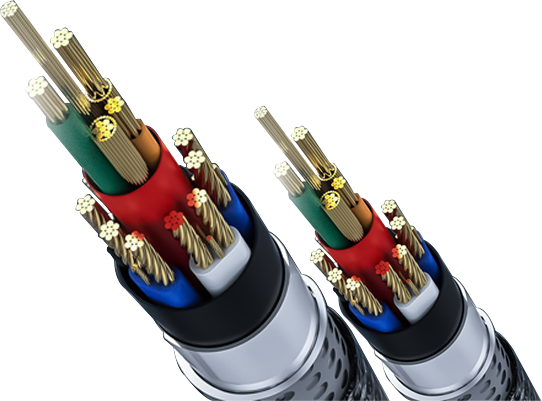
Multi-core cable refers to a cable containing two or more independently insulated conductors (cores) within a single outer sheath. Its core design is to "integrate multiple circuits into one," meeting the compact wiring requirements of complex scenarios.
Basic Structure: Multi-core Integration, Orderly Arrangement
The structure of a multi-core cable is relatively complex, centered around the integrated design of "multiple cores + a unified outer sheath":
Multiple Insulated Cores: Each core consists of a conductor (copper or aluminum) and an independent insulation layer. The number of cores can be customized based on requirements. Common configurations include two cores (such as a two-hole household outlet cable), three cores (such as a three-phase motor power cable), four cores (such as a three-phase cable with a neutral conductor), and even dozens of cores (such as control cables and communications cables). The cores are typically arranged within the cable in a regular pattern (such as twisted or parallel) to reduce electromagnetic interference.
Filling Layer (Optional): If the number of cores is large or the arrangement is irregular, filler material (such as polypropylene rope or asbestos rope) is added between the cores to round the cable's cross-section, improve structural stability, and mitigate external forces from compressing the cores. Shielding (optional): Some multi-core cables used for signal transmission (such as communications cables and instrumentation cables) have a shielding layer (such as copper mesh or aluminum foil) added to the outside of the core wires. This effectively isolates external electromagnetic interference (such as high-frequency interference from industrial equipment) and ensures stable signal transmission.
Outer Jacket: This jacket surrounds all core wires (or shielding layer) and is typically made of PVC, PE, or neoprene. Its primary function is to protect the internal core wires from mechanical damage, moisture erosion, and chemical corrosion. Some outer jackets are also oil-resistant and heat-resistant, making them suitable for specialized environments.
Core Performance: High Flexibility and Space Savings
The advantages of multi-core cables lie in their integration and flexibility, solving wiring pain points in complex scenarios:
High Space Utilization: A single multi-core cable can replace multiple single-core cables, eliminating the need for separate wiring for each circuit group and significantly reducing the number of cables. This is particularly suitable for applications with limited space (such as equipment interiors, wall routing, and automotive wiring harnesses). Good Flexibility: When multiple fine-core wires are twisted toge
ther, the cable's overall bending performance is improved, making it suitable for frequent bends or complex routing (such as portable device power cables and robotic arm wiring), and less prone to conductor breakage due to bending.
High Wiring Efficiency: During installation, a single cable is required to connect multiple circuits, reducing the workload of cutting, securing, and marking cables. This makes it particularly suitable for scenarios with numerous control circuits and complex signal lines (such as automated production lines and smart home systems).
Typical Application Scenarios
The integration and flexibility of multi-core cables make them a top choice for scenarios with multiple circuits and complex wiring. Common applications include:
Control and Instrumentation Systems: Control cables for automated production lines (such as multi-core cables connecting PLC with sensors and actuators), and signal transmission cables for industrial instruments (such as flow meters and pressure gauges).
Communications: Local Area Network (LAN) cables, and video signal cables for security surveillance systems (such as composite cables with 2 cores and 1 core for video). Consumer and portable devices: Home appliances (e.g., rice cookers and washing machines, whose power cords are mostly 2- or 3-core), automotive wiring harnesses (interior lighting, central control, and sensor connections all use multi-core cables, saving space and facilitating organization), and portable electronic devices (e.g., laptop charger cables, which are mostly 2- or 3-core, offering both flexibility and portability).
Core Differences Between Single-Core and Multi-Core Cables
The differences between single-core and multi-core cables fundamentally stem from differences in their structural design. These differences extend to key dimensions such as performance, installation, and cost, directly impacting their suitability for practical applications.
In terms of the number of conductors, a single-core cable's core structure consists of a single, independent conductor. Current or signal transmission throughout the cable relies entirely on this single conductor, without interference or coordination from other conductors. Multi-core cables, on the other hand, integrate two or more independently insulated cores within a single outer sheath. Each core is capable of independently transmitting current or signals, and the multiple cores together form a complete cable, capable of simultaneously meeting the transmission needs of multiple circuits. This difference in the number of conductors underlies all performance differences between the two.
In terms of flexibility, single-core cables are limited by the structure of a single conductor. Especially when used for high-current transmission, the conductor's cross-sectional area is typically larger, resulting in greater overall rigidity and less flexibility. Frequent bending during installation or use can easily damage the conductor or crack the outer insulation, impacting the cable's lifespan and safety. Multi-core cables, on the other hand, consist of multiple fine wires, typically arranged in a twisted or other orderly pattern. This makes the cable more flexible and resilient, even in complex, curving routing environments. Frequent bending is less likely to damage the conductors, making them ideal for applications requiring flexible wiring, such as power cables for portable devices or connecting cables for robotic arms.
Current carrying capacity is one of the most significant differences between the two. Because single-core cables have only one conductor and do not need to share space with other cores, their cross-sectional area can be designed larger based on actual needs. Furthermore, there is no electromagnetic interference between multiple conductors, allowing them to efficiently carry high currents. Therefore, they are widely used in scenarios requiring high-power transmission, such as high-voltage power transmission and main power supply for large industrial equipment. In contrast, each core of a multi-core cable must coexist with other cores within the limited space of the outer sheath. This severely limits the cross-sectional area of a single core and prevents it from being as large as the conductor of a single-core cable. This results in a lower current carrying capacity for a single core, making them more suitable for multi-circuit, low-current transmission scenarios, such as control circuits in automated production lines or power supply for household appliances, but they struggle to meet the demands of high-power transmission. In terms of installation space requirements, single-core cables require a separate cable for each circuit. If a scenario requires simultaneous transmission of multiple circuits, multiple single-core cables must be laid. This inevitably takes up more installation space and easily leads to cluttered wiring, increasing the difficulty of subsequent management and maintenance. Multi-core cables, on the other hand, integrate multiple circuits into a single cable, eliminating the need for separate wiring for each circuit. This significantly reduces the number of cables and effectively saves installation space. Even in confined environments such as equipment interiors and wall routing, neat and orderly wiring can be achieved, significantly improving installation efficiency.
The ease of fault detection and repair significantly impacts the cable's future cost and maintenance efficiency. Single-core cables have only one conductor. If a fault such as a leakage or open circuit occurs, maintenance personnel can quickly locate the fault using standard tools like a multimeter and insulation tester, rather than checking multiple wires one by one. This streamlined and efficient repair process effectively reduces downtime. Multi-core cables, on the other hand, have many wires and the gaps between them are small. Therefore, when a fault occurs, maintenance personnel must check each wire individually to locate the fault, making it more difficult. Furthermore, if a single wire is damaged, the high density of the wires makes it impossible to replace it individually; the entire cable must be replaced, increasing both repair costs and time. Regarding electromagnetic interference, single-core cables, because they transmit signals only on a single path, avoid signal interference between multiple wires. They offer strong interference resistance, especially in high-current transmission scenarios, ensuring stable signal transmission without the need for complex anti-interference measures. Multi-core cables, on the other hand, have multiple wires arranged in close proximity. When transmitting current or signals, these wires are susceptible to electromagnetic interference, which can cause signal distortion and compromise transmission quality. Therefore, when used in applications requiring high signal transmission stability, such as communications and instrumentation, multi-core cables typically require additional shielding layers such as copper mesh or aluminum foil to isolate interference. This not only increases the cable's structural complexity but also increases manufacturing costs.
The difference in manufacturing costs is primarily determined by the structural complexity and production process of the two cables. Single-core cables have a simple structure. Production requires only processing a single conductor, wrapping it with an insulation layer, and, in some cases, adding an outer sheath. Complex processes such as multi-core insulation, filling, and shielding are unnecessary. This streamlined production process results in relatively low raw material and labor costs. Multi-core cables, on the other hand, are much more complex to produce, requiring the processing of multiple, independently insulated cores. In some cases, filling layers are added to ensure a rounded cable cross-section, and shielding layers are added to provide interference resistance. This involves numerous production steps and consumes more raw materials, such as insulation and shielding materials. This increases labor costs, making their manufacturing costs significantly higher than single-core cables.
Maintenance costs are closely related to the ease of fault detection and repair. Single-core cables allow for quick fault location and require fewer repair steps. Frequent cable replacement or complex repair procedures are unnecessary, resulting in lower labor and material costs for subsequent maintenance. Multi-core cables, on the other hand, are more difficult to troubleshoot. Repairs may require the entire cable to be replaced. Routine maintenance also requires careful attention to issues such as shield damage and hidden core faults. This makes maintenance more tedious and more costly.
Selection Guide: How to Accurately Choose Single-Core or Multi-Core Cable?
The decision between single-core and multi-core cable should be made based on three key factors: application scenario, transmission requirements, and installation environment. The specific selection steps are as follows:
Identify Core Requirements: Current and Number of Circuits
If high current transmission is required (such as high-voltage transmission or main power supply for large equipment) and only a single circuit is required, a single-core cable (such as a single-core XLPE cable for a 110kV power grid) is preferred.
If multiple low currents (such as control circuits or signal circuits) need to be transmitted simultaneously and the number of circuits is large, a multi-core cable (such as a 16-core control cable for an automated production line) is preferred.
Evaluate the Installation Environment: Space and Flexibility Requirements
If the installation space is ample (such as in open areas of substations or industrial workshops) and the cable does not require frequent bending (fixed installation), a single-core cable is suitable (its stable structure is less prone to damage). If the installation space is narrow (such as inside equipment, through walls, or in automotive wiring harnesses), or if the cable requires frequent bending (such as in portable devices or robotic arms), multi-core cables (flexibility and space-saving) are essential.
Consider Maintenance: Fault Detection and Cost
If the project requires high maintenance efficiency (such as power systems or critical industrial equipment) and requires rapid fault location, single-core cables are preferred (convenient fault detection and low repair costs).
If the project involves small equipment or a home environment with low maintenance frequency (such as appliance power cords), multi-core cables are recommended (easy wiring and less frequent maintenance).
Focus on Special Needs: Interference Resistance and Environmental Adaptability
If signal transmission (such as communications or instrumentation) requires isolation from external electromagnetic interference, multi-core cables with shielding should be selected (such as shielded twisted pair cables or shielded instrument cables).
For outdoor or underground applications, such as in complex environments (such as underground power transmission or chemical plants), single-core cables with strong outer sheaths are recommended. For multi-core cables, special attention should be paid to the corrosion resistance of the filling layer and shielding layer (such as oil-resistant, acid-resistant, and alkali-resistant outer sheath materials).
Conclusion:
Proper cable selection not only ensures the safe and stable operation of electrical systems but also reduces initial installation and maintenance costs, maximizing the project's cost-effectiveness. If you have any questions about cable selection, we recommend consulting a professional cable engineer or referring to the cable manufacturer's technical manual to avoid safety hazards or efficiency losses caused by improper selection.