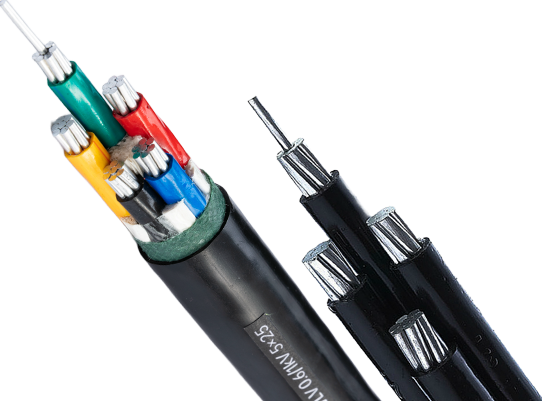
What Is Concentric Cable? An Overview of Its Structure and Function
Introduction: The Value of Concentric Cables in the Context of Distribution Network Upgrades
With the global renovation of urban and rural distribution networks, the upgrading of power supply to older residential communities, and the widespread adoption of underground distribution systems in cities, the demands on distribution systems regarding cable integration, grounding safety, and ease of installation continue to rise. Conventional power cables require the separate installation of phase, neutral, and ground conductors, which not only occupies significant installation space and involves cumbersome construction processes but also creates safety hazards such as leakage and ground faults due to improper grounding wire installation. Against this industry backdrop, concentric cables (Concentric Cable), with their unique structure that integrates phase and neutral conductors into a single unit, have become the primary cable product for distribution networks, residential power supply, streetlight distribution, and URD (Underground Residential Distribution) systems in Europe and the United States.
What Is a Concentric Cable? Basic Definitions and Product Features
A Concentric cable is an integrated power cable consisting of a single-core main conductor surrounded by a concentric neutral conductor. The core design concept involves no longer cabling the neutral line required for the circuit as a separate unit; instead, multiple strands of fine conductors are spirally wound in a concentric pattern around the insulation of the main conductor, with an outer sheath then applied to form the final product. The entire cable integrates both phase conductors and neutral circuit conductors internally. A single cable can accommodate the installation of both phase and neutral lines for single-phase power supply, and certain specifications can simultaneously provide grounding functionality. It is a specialized cable for low-voltage service entry and branch distribution.
From a product perspective, conventional power cables have phase and neutral conductors that are independent of each other, requiring multiple cables to be laid side by side during installation; in contrast, concentric cables embed the neutral layer within the cable body, which is the most significant structural difference. The mainstream concentric cables in the industry are primarily rated for 0.6/1 kV low voltage, with a small number of modified products extending to medium-voltage URD underground distribution applications. They are widely used in residential service connections, outdoor street lighting, secondary distribution in residential communities, and commercial building service lines, and are also the standardized cable selection for municipal underground distribution in North America and Europe.
Detailed Explanation of the Five-Layer Standard Structure of Concentric Cables
Central Conductor
As the core medium for power transmission, the primary materials used are copper and aluminum conductors. Conductor structures include solid single-round conductors, multi-strand stranded conductors, and compact tightly-layered conductors. Copper conductors offer excellent electrical conductivity, oxidation resistance, and creep resistance, and are commonly used in high-end residential service connections and precision commercial power distribution; Aluminum conductors are lightweight and cost-effective, making them widely used in large-scale municipal residential retrofits and streetlight trunk lines. Compact stranded conductors feature a uniform cross-section and high fill factor, which reduces the cable’s outer diameter and facilitates conduit installation and direct burial. Currently, this is the mainstream conductor type for concentric cables, primarily responsible for the forward transmission of load current.
Primary Insulation
Enveloping the central conductor, it isolates the phase conductors from the outer neutral conductor and serves as a critical structural element for ensuring inter-phase insulation safety. Common materials include XLPE (cross-linked polyethylene), PVC (polyvinyl chloride), and PE (polyethylene). XLPE insulation can withstand temperatures up to 90°C, is resistant to aging, and has low dielectric loss, making it suitable for long-term continuous full-load operation and the preferred choice for distribution-level concentric cables; PVC insulation is low-cost and easy to process, and is often used for standard short-distance residential service lines; PE insulation offers outstanding moisture resistance and weather resistance, making it suitable for outdoor, open-air, and direct burial installation in humid environments. Insulation thickness is strictly designed in accordance with BS7870 and ASTM standards based on the rated voltage and conductor cross-sectional area, eliminating the risk of insulation breakdown and phase-to-phase short circuits.
Concentric Neutral Layer
This layer is a signature feature of concentric cables. It consists of multiple strands of fine copper or aluminum wire wound uniformly in a spiral pattern around the outer surface of the insulation, with the entire conductor forming a continuous neutral circuit. This layer serves a dual purpose: during normal operation, it functions as a neutral conductor, carrying the return current of the load; in the event of a ground fault, it instantly acts as a fault grounding path, rapidly conducting the fault current to the grounding terminal, triggering the upstream protective switch to trip and thereby mitigating the risks of electric shock and fire. The cross-sectional area, number of strands, and winding pitch of the neutral conductor are all calculated based on the short-circuit parameters of the power distribution system to ensure it does not melt under the instantaneous high currents during a fault condition.
Separator/Binder Tape
Wrapped around the outer layer of the neutral conductor, this tape is made of non-woven fabric, polyester tape, or semi-conductive binding tape. Its primary functions are twofold: first, to secure the outer layer of concentric fine conductors, preventing the neutral conductor from loosening, shifting, or breaking during cable bending or dragging; second, to isolate the neutral layer from the outer sheath, preventing damage to the neutral conductor caused by high temperatures during the extrusion of the sheath, thereby enhancing the structural stability of the entire cable and extending its service life.
Outer Sheath
The outermost protective layer of the cable, available in three materials: PVC, HDPE, and LSZH (Low Smoke Zero Halogen). PVC sheaths offer high cost-effectiveness and resistance to mechanical abrasion, suitable for both indoor and outdoor use; HDPE (High-Density Polyethylene) is resistant to UV radiation and soil acid-alkali corrosion, making it the standard choice for underground direct-burial (URD) cables; LSZH sheathing is flame-retardant, low-smoke, and halogen-free, making it suitable for high-traffic environments such as enclosed commercial buildings and underground utility tunnels, where it protects the internal structure from damage caused by moisture, chemical corrosion, and external abrasion.
Operating Principle of Concentric Cables
Under normal power distribution conditions, alternating current is transmitted from the central conductor outward to the end-use electrical equipment. After powering the load, the current flows through the outer layer of concentric neutral conductors to form a return path, creating a complete single-phase closed-loop power supply that eliminates the need for a separate neutral conductor.
In the event of a ground fault, such as insulation damage or a phase-to-case contact, the exposed phase conductor comes into direct contact with the outer concentric neutral layer. The fault current is rapidly conducted through the continuous neutral conductor into the grounding system, causing the circuit breakers and fuses at the front end of the distribution system to trip instantly and cut off the power supply. This provides rapid ground fault protection, significantly reducing the likelihood of electric shock accidents caused by equipment leakage. Thanks to the neutral layer uniformly distributed around the entire circumference, the cable maintains balanced grounding conductivity in all directions. This stabilizes and balances line voltage drops during operation, optimizes three-phase voltage imbalance in the distribution network, and enhances the overall operational stability of the low-voltage distribution network.
Four Major Product Categories of Concentric Cables
Single-Core Concentric Cable
The most basic and widely used standard model, featuring a single main conductor plus a single-layer concentric neutral conductor. With a simple structure and low production costs, it is primarily used for residential service connections, single-circuit streetlight distribution, and small commercial building feeders, making it a standard product in the residential power distribution sector.
Split Concentric Cable
This design features a double-layer, segmented arrangement of neutral conductors. The neutral layer is divided by tape into two independent neutral circuits, allowing separate connection to the neutral wires of two different loads. It is commonly used in projects involving multiple meters per household, household-level retrofits, and multi-branch service connections to homes. It flexibly accommodates multi-circuit parallel distribution requirements and effectively reduces the need for redundant cable installation.
Double Concentric Cable
Featuring two independent concentric neutral conductors—inner and outer layers—this double-layer neutral structure significantly increases the total neutral cross-sectional area, doubling the fault current carrying capacity and providing excellent resistance to short-circuit surges. It is commonly used for main distribution in large communities, service lines for commercial and industrial buildings, and high-capacity secondary distribution network lines, and is suitable for municipal power grid systems with high short-circuit capacity.
URD-Specific Concentric Cable (Concentric Neutral URD Cable)
A specialized cable for underground residential power distribution, with a structure optimized for direct burial. It features a thickened HDPE corrosion-resistant outer sheath and a larger neutral conductor cross-section. Designed specifically for URD underground power distribution networks in Europe and the United States, it is buried beneath sidewalks and green belts to achieve fully underground, concealed wiring from the distribution transformer to residential units. It is also an essential product for municipal renovation projects overseas.
Six Core Advantages of Concentric Cables
Outstanding Safety Performance with Built-in Grounding Protection
The neutral conductor is fully integrated into the cable body, naturally forming a complete grounding loop. No additional PE grounding conductors need to be installed after construction, thereby eliminating at the source the risk of electric shock caused by omitted grounding conductors or loose connections. In the event of a fault caused by contact with equipment casings, fault currents are instantly dissipated, resulting in a significantly higher level of distribution safety compared to traditional branch circuit solutions.
Stable and Reliable Fault Discharge Path
The fully circumferential neutral layer ensures excellent electrical continuity, uniformly distributing fault currents across the entire cross-section. It offers strong short-term resistance to short-circuit currents. Compared to separately installed neutral conductors, it provides faster fault response times and effectively reduces the risk of short-circuit fires.
Excellent Comprehensive Mechanical Properties
The integrated cable structure is compact, with layers mutually supporting one another. Its tensile and compression resistance outperforms multiple single cables laid side-by-side. In direct-burial environments, it offers superior resistance to ground subsidence and soil compression damage, making it well-suited for complex underground installation conditions.
Simplified Installation and Shorter Construction Timelines
A single cable replaces the traditional two-cable configuration of phase lines plus a neutral line, reducing the consumption of conduit, cable trays, and earthwork, as well as labor hours. This significantly reduces overall project construction costs, with cost advantages being particularly evident in large-scale residential retrofit projects.
Stable Electrical Performance
The concentric ring structure optimizes the distribution of electromagnetic fields along the line, reducing line impedance and voltage losses. It provides better voltage drop control during long-distance power distribution, mitigates three-phase imbalance issues in distribution networks, and ensures stable voltage for end-use electrical equipment.
Space-Saving Installation
The single-cable integrated circuit design requires only half the space for conduit and cable tray installation compared to traditional dual-cable systems. It is suitable for narrow conduit runs, confined ceiling wiring scenarios, and space-constrained pipeline renovation projects in older residential communities.
Typical Application Areas for Concentric Cables
First, residential power distribution: As the service entry cable for households and the main trunk cable from the low-voltage side of the transformer to the resident’s meter box, it is the preferred choice for power grid retrofits in older residential communities both domestically and internationally;
Second, underground URD power distribution networks: A standard feature in European and American cities, these systems are buried directly beneath green belts and roads, enabling aesthetically pleasing municipal power distribution without overhead cables;
Third, commercial building power distribution: Used for individual service connections to shops and office buildings, as well as floor-level metering connections, simplifying internal building wiring;
Fourth, municipal streetlight systems: Single-phase power supply for streetlights on urban roads and in parks, with a single cable simultaneously handling both power supply and return current, thereby reducing maintenance failure rates for streetlight circuits;
Fifth, public infrastructure: Various small-scale public power distribution projects, such as small pumping stations, park power supply systems, and low-voltage branch feeders at stations.
Conclusion
Relying on its innovative integrated structure combining phase conductors and an embedded concentric neutral conductor, Concentric Cable breaks away from the traditional multi-cable, separate wiring model used in power distribution. With multiple advantages—including integrated grounding, simplified installation, safety and reliability, and a compact footprint—it has become a core product for low-voltage service connections, underground URD distribution networks, and streetlight projects. From its five-layer internal structure to its various product categories, and from raw material selection to standardized installation, the product design is comprehensively optimized for distribution network safety and construction efficiency.