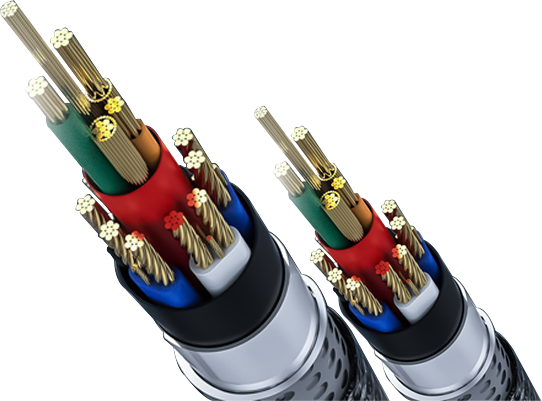
What is the difference between LSOH and LSZH?
In the specialized field of cables, LSOH and LSZH are two common abbreviations, representing Low Smoke Zero Halogen. Many people encountering these terms for the first time might mistakenly assume they denote different cable types. In reality, however, they describe the same category of cables with special properties.
Detailed Explanation of LSOH Cables
LSOH stands for “Low Smoke Zero Halogen.” These cables feature meticulously selected materials, with insulation and sheathing layers primarily composed of polyolefin-based polymers like polyethylene (PE) or polypropylene (PP). They incorporate metal hydroxides as highly effective flame retardants, such as aluminum hydroxide (Al(OH)₃) and magnesium hydroxide (Mg(OH)₂). When heated, these flame retardants absorb significant heat, release water vapor to dilute combustible gases, and form protective layers on material surfaces to block oxygen. Crucially, they contain no halogenated flame retardants or plasticizers, eliminating halogen gas generation at the source.
During fires, LSOH cables demonstrate exceptional performance. Conventional cables release dense smoke when burning, which not only obscures visibility and hinders escape routes but also severely irritates respiratory systems, increasing risks for trapped individuals. In contrast, LSOH cables emit minimal smoke during combustion, buying critical time for evacuation and fire rescue operations. During the 2017 Grenfell Tower fire in London, UK, the extensive use of conventional cables caused dense smoke from burning cables to rapidly fill the building. This trapped many residents and severely hampered rescue efforts. Had LSOH cables been used, they might have mitigated the smoke hazard to some extent, creating more favorable conditions for escape.
Additionally, LSOH cables do not emit halogen gases like hydrogen chloride (HCl) when burning. These halogen gases are highly corrosive, damaging electronic equipment and building structures while posing severe risks to human health, including burns and asphyxiation. The halogen-free nature of LSOH cables significantly reduces the risk of secondary injuries during fires.
Given their outstanding safety profile, LSOH cables find extensive applications across numerous sectors. In the construction industry, whether in towering office buildings or cozy residential complexes, LSOH cables are increasingly adopted for internal wiring systems—particularly in critical areas like escape routes and elevator shafts—providing vital protection for the lives of residents and workers. In public spaces like large shopping malls, hospitals, schools, theaters, exhibition halls, data centers, and airport terminals—where crowds gather—LSOH cables are indispensable. They maximize safe evacuation during fires. Within transportation systems—including subways, high-speed rail, train interiors, tunnels, and metro networks—relatively enclosed spaces mean fires could have catastrophic consequences. LSOH cables significantly mitigate fire hazards in these environments.
Unveiling LSZH Cables
LSZH also stands for “Low Smoke Zero Halogen.” It is fundamentally identical to LSOH cables, sharing the critical characteristic of low smoke and zero halogen emission. This means they produce minimal smoke and do not release halogen gases when burned. This property provides a relatively safer environment during fires, reducing harm from smoke and toxic gases.
The primary difference lies in regional usage and convention. Across the ocean in the United States, local industry practices and market perception favor the term LSZH for these low-smoke, zero-halogen cables. Conversely, in the United Kingdom and most European countries, LSOH remains the more widely recognized and commonly used terminology. For instance, in large commercial buildings and data centers in the U.S., engineers frequently reference LSZH cables during discussions and procurement. Conversely, LSOH cables are widely adopted and mentioned in projects like the London Underground and European hospital renovations. This variation is akin to regional dialects for the same object—the terminology differs, but the underlying product remains consistent, with no impact on the cable's performance or application.
Exploring the Differences and Similarities Between LSOH and LSZH
After understanding the characteristics and applications of LSOH and LSZH cables, a key question arises: What exactly distinguishes them? In reality, LSOH and LSZH cables are identical in properties and performance—they are essentially two different “nicknames” for the same product.
From a performance perspective, both LSOH and LSZH cables demonstrate exceptional safety in extreme fire scenarios. When exposed to flames, they emit extremely low levels of smoke, effectively maintaining visibility and greatly facilitating evacuation and firefighting operations. Imagine a sudden fire in a large shopping mall. If conventional cables were used, the dense smoke from combustion would rapidly fill the entire space, plunging people into instant darkness and chaos, making it difficult to find escape routes. LSOH/LSZH cables prevent this scenario by reducing smoke obstruction to visibility, significantly increasing the likelihood of safe evacuation.
Additionally, both cable types release no halogen gases during combustion. As mentioned earlier, halogen gases are highly corrosive and toxic, posing severe risks to human health and surrounding equipment. The halogen-free nature of LSOH and LSZH cables fundamentally eliminates this hazard, reducing secondary damage risks during fires and creating a relatively safer environment.
They share identical material composition and functional properties. Both the insulation and sheath layers utilize polyolefin materials with added metal hydroxides as flame retardants, delivering low-smoke, halogen-free, and flame-retardant properties. They play a vital role in various high-safety-requirement environments. The distinction lies solely in their names, stemming from regional and customary differences. Much like how different regions may have distinct names for the same food item, the essence and taste of the food itself remain unchanged. In the United States, the industry commonly uses LSZH to refer to this type of cable, while in the United Kingdom and Europe, LSOH is more prevalent. This variation does not affect the cable's performance, quality, or effectiveness in practical applications. Regardless of the region, selecting a low-smoke, zero-halogen cable that meets standards provides reliable fire safety assurance for any location.
Advantages of Low-Smoke, Zero-Halogen Cables
Low Smoke Emission Preserves Visibility
In extreme and hazardous fire scenarios, smoke often becomes a major obstacle hindering evacuation and fire rescue efforts. The low smoke emission characteristic of LSZH cables proves particularly critical. During a fire, conventional cables rapidly become a “source of dense smoke,” filling the entire space with thick smoke within minutes and drastically reducing visibility. Research indicates that smoke from burning conventional cables can reduce visibility to near zero within minutes, leaving occupants completely disoriented indoors and heightening panic and danger.
Low-smoke, halogen-free cables excel in this regard, producing minimal smoke during combustion. For instance, in actual fire simulation tests, visibility at the site remains at a certain level for an extended period when low-smoke, halogen-free cables burn, typically maintaining around 10-30 meters. Trapped individuals can use this limited visibility to locate evacuation routes and follow evacuation signs to exit in an orderly manner, significantly increasing escape success rates.
Reduced Toxicity from Halogen-Free Gases
Halogen elements like chlorine and bromine present in traditional cables release toxic gases such as hydrogen halides when burned. These gases are not only highly irritating but also cause severe damage to the respiratory tract and eyes.
Low-smoke, halogen-free cables eliminate this hazard at its source. Their materials contain no halogens, preventing the production of toxic gases like hydrogen halides during combustion. Consequently, during a fire, occupants face no secondary harm from toxic gases during escape, reducing the risk of poisoning, suffocation, and other life-threatening conditions. Additionally, surrounding electronic equipment and instruments are protected from damage caused by the corrosive effects of hydrogen halide gases, thereby minimizing property losses resulting from fires.
Comprehensive Protection
The advantages of low-smoke, zero-halogen cables extend beyond safeguarding human life to encompass the protection of various equipment and facilities. In modern society, electronic devices are ubiquitous—playing vital roles in offices, homes, industrial production, healthcare, and beyond. During a fire, conventional cables release smoke and toxic gases that not only endanger lives but also severely damage these electronic systems.
Fine particles in the smoke adhere to circuit boards, chips, and other precision components, disrupting normal operation. Toxic gases react chemically with metal components, causing corrosion that leads to short circuits and equipment failure. Low-smoke, zero-halogen cables, however, do not produce these harmful substances when burned, effectively safeguarding electronic devices. In data centers, where numerous servers and storage devices demand extremely controlled environments, using LSOH cables minimizes impact on critical equipment during fires, preserving data integrity and ensuring business continuity. In medical settings, where sophisticated equipment directly impacts patient health and safety, LSOH/LSZH cables provide a reliable operating environment, safeguarding the continuity of medical operations.
Comparison of Differences Between LSOH/LSZH and PVC Cables
Significant Differences in Combustion Characteristics
In terms of combustion properties, LSOH/LSZH cables and PVC cables are worlds apart. During a fire, PVC cables exhibit alarming behavior. PVC, or polyvinyl chloride, contains chlorine elements in its molecular structure. When exposed to flames, PVC cables ignite rapidly, releasing dense, toxic smoke. This smoke contains not only unburned carbon particles but also harmful gases like hydrogen chloride (HCl). Hydrogen chloride gas is highly corrosive, causing severe irritation and damage to human respiratory tracts and eyes. During fires, it reacts with moisture in the air to form hydrochloric acid, corroding and damaging surrounding metal equipment and building structures. Simultaneously, the dense smoke produced by burning PVC cables rapidly reduces visibility in the surrounding environment, obscuring escape routes within a short time and creating significant challenges for personnel evacuation and firefighting operations.
LSOH/LSZH cables, however, demonstrate distinct advantages. Manufactured from halogen-free materials, they do not produce toxic halogenated gases like hydrogen chloride during combustion, significantly reducing health hazards. Furthermore, they emit minimal smoke, effectively maintaining visibility at the fire scene and creating more favorable conditions for personnel escape and firefighting operations. Relevant experimental data indicates that under identical combustion conditions, smoke light transmittance from burning PVC cables may fall below 20%, whereas LSOH/LSZH cables achieve over 60% smoke light transmittance. This figure vividly illustrates the substantial difference in smoke emission between the two during combustion.
Cost Variation
Cost remains a critical factor in cable selection, with notable price differences between LSOH/LSZH and PVC cables. PVC cables benefit from widely available raw materials and relatively simple production processes, resulting in lower costs. Standard PVC cables typically offer market-friendly pricing, making them widely adopted in projects with strict cost controls and less stringent performance requirements.
However, the production process for LSOH/LSZH cables is more complex and stringent. It necessitates the use of specialized halogen-free polymer materials, which inherently cost more than the polyvinyl chloride used in PVC. During production, ensuring low-smoke, zero-halogen properties and excellent flame retardancy demands more precise formulation control, advanced manufacturing equipment, and stringent quality inspection procedures—all contributing to higher production costs for LSOH/LSZH cables. Market research indicates that LSOH/LSZH cables typically cost 20%–50% more than PVC cables of equivalent specifications. Despite their higher price, the significant value they deliver in fire safety and environmental protection makes the investment worthwhile in critical high-safety-demand locations such as densely populated public spaces and high-rise buildings.
Differing Application Scenarios
Due to variations in combustion characteristics and cost, LSOH/LSZH cables and PVC cables each have distinct application focuses. PVC cables, owing to their low cost, remain widely used in non-critical areas or outdoor settings where fire risks are relatively low and cable performance requirements are not particularly stringent. In ordinary outdoor lighting projects, such as park streetlight wiring or residential outdoor landscape lighting, where human activity is relatively dispersed, the potential harm from a fire is comparatively minor, and cost sensitivity is high, PVC cables can meet basic electrical transmission needs while reducing project costs. In non-critical equipment power supply lines within industrial plants, such as electrical connections for small machinery, PVC cables are also chosen for their price advantage.
Conversely, LSOH/LSZH cables, with their superior safety performance, are the unquestionable choice for high-safety-requirement environments. In densely populated public spaces like airports, hospitals, schools, and shopping malls, the consequences of a fire are unimaginable. The low-smoke, zero-halogen properties of LSOH/LSZH cables effectively safeguard human life, minimizing casualties from fires. In high-rise buildings, where evacuation is challenging and fires spread rapidly, LSOH/LSZH cables buy critical time for firefighting and rescue operations, mitigating fire risks. In confined spaces like subways and tunnels with limited ventilation, these cables prevent severe consequences from smoke and toxic gas accumulation.
Certification Standards
Internationally, a series of stringent and authoritative standards govern the production and testing of low-smoke, zero-halogen cables, with IEC 60754, IEC 61034, and BS EN 50267 being particularly prominent.
The IEC 60754 standard primarily focuses on testing gases emitted when cable materials burn. Specifically, IEC 60754-1 addresses the determination of halogen acid gas content. It stipulates that under specified conditions, gases produced by burning cable materials are collected and analyzed for halogen acid content to assess whether the cable meets low-smoke, zero-halogen standards. Generally, cables are classified as halogen-free when halide acid gas (HCl) emissions during combustion are less than 5 mg/g. IEC 60754-2 further evaluates the corrosiveness and other properties of gases produced during cable combustion by measuring the acidity (via pH value) and conductivity of the combustion gases, providing a more comprehensive assessment of cable safety.
The IEC 61034 standard focuses on measuring cable smoke density. Under specified conditions, a specific test apparatus and procedure simulate a cable combustion scenario. A photometric measurement system records the smoke's obstruction of light, using light transmittance to quantify smoke density. If a cable material achieves a light transmission value of 60%, it meets the low-smoke standard. Higher light transmittance indicates less smoke released during combustion, providing clearer visibility for personnel during fires and reducing smoke-related obstacles to evacuation and rescue efforts.
The BS EN 50267 standard encompasses general testing methods for cables under fire conditions, including assessments of gases emitted during combustion and the determination of halogen and acid gas content. Its various sections evaluate cable performance in fires from different perspectives, ensuring cables meet fire safety requirements in practical applications. For instance, large-scale construction projects often explicitly require cables to comply with BS EN 50267 standards to guarantee building safety during fires.
Selecting cables certified to these standards is crucial for ensuring quality and performance. Certified cables demonstrate strict adherence to relevant standards throughout production, offering reliable assurance in material selection, manufacturing processes, and quality inspection. Simultaneously, selecting cables from reliable manufacturers is equally vital. Reputable manufacturers typically possess advanced production equipment, professional technical teams, and comprehensive quality control systems, enabling them to consistently produce high-quality cables that meet standards. In the market, well-known cable manufacturers such as Nexans and Prysmian have gained widespread recognition and adoption for their low-smoke, zero-halogen cables due to their stringent quality control and strong market credibility. Their cables not only meet international standards but also provide comprehensive after-sales service and technical support, offering users greater peace of mind during operation.
Summary
LSOH and LSZH are simply different names for the same category of low-smoke, zero-halogen cables. Their fundamental purpose is to reduce smoke and toxic gas emissions during fires, thereby minimizing fire-related hazards and providing robust protection for human life and property safety.
In modern society, as safety and environmental awareness continue to grow, low-smoke, zero-halogen cables are increasingly applied across numerous sectors including construction, transportation, and energy. They not only meet stringent modern building standards for fire safety and environmental protection but also provide more reliable electrical transmission assurance for diverse settings.